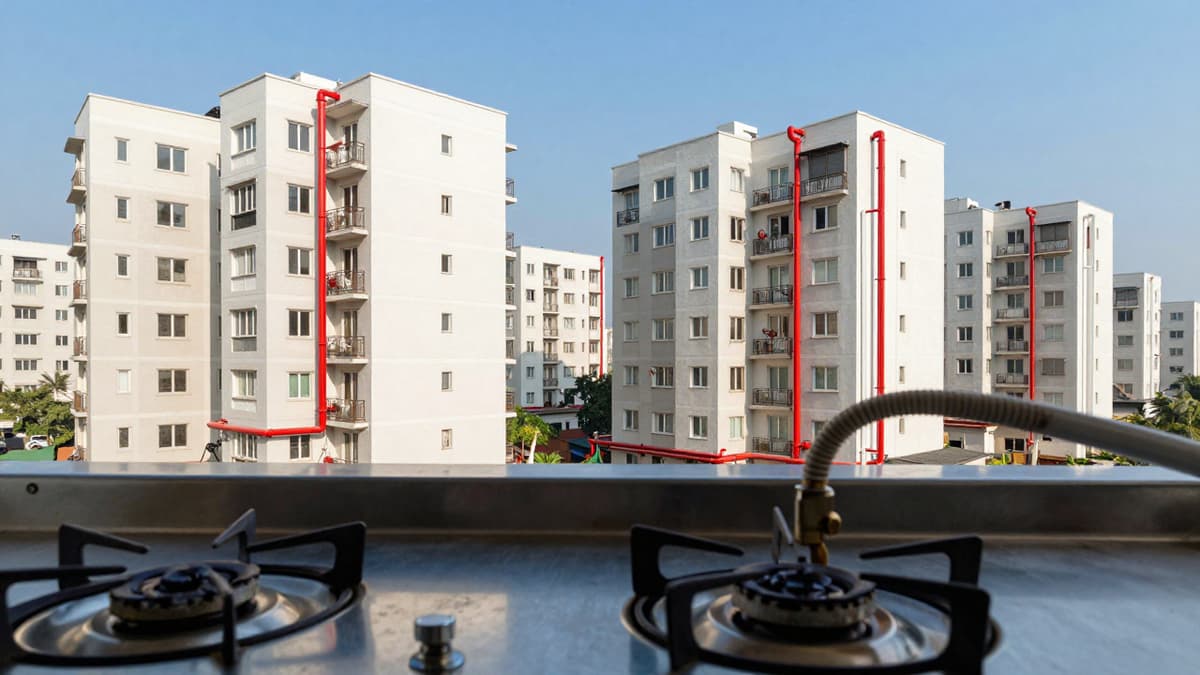
India's government issues a strict mandate ending LPG supplies for households refusing to switch to Piped Natural Gas where pipeline connectivity is already available, aiming to stabilize energy networks.
In a decisive move to address a fuel shortage exacerbated by global disruptions, the Indian government has mandated that LPG supply discontinuation will occur for households failing to switch to Piped Natural Gas (PNG) where infrastructure is available. This directive, issued via a new order on March 24, 2026, aims to streamline energy distribution and reduce reliance on imported liquefied gas.
The urgency behind this policy stems from severe shortages caused by the ongoing war in West Asia, which has disrupted supplies from key sources and damaged liquefaction facilities in the Gulf. With the Strait of Hormuz remaining blocked, the Ministry of Petroleum and Natural Gas has notified the Natural Gas and Petroleum Products Distribution Order 2026. This regulatory framework seeks to fast-track pipeline infrastructure, ease approvals, and promote a strategic shift toward domestically produced fuels.
Under the new regulations, LPG supply to any household will cease three months after notification if the consumer does not opt for a PNG connection, provided it is technically feasible. The order explicitly states that this provision does not apply where providing a piped connection is "technically infeasible," though an entity controlling access must issue a no-objection certificate (NOC) in such cases to maintain supply.
This policy is designed to free up limited LPG stocks from areas with pipeline connectivity and divert them to regions lacking such infrastructure, thereby promoting fuel diversification during the global supply crisis.
To facilitate the rapid rollout of pipeline networks, the order imposes strict timelines on public authorities and entities controlling access to housing complexes. Public authorities must grant rights of way or necessary permissions within prescribed timelines; failure to do so will result in approvals being deemed granted automatically. Furthermore, entities controlling access to housing areas must grant permissions within three working days, with last-mile PNG connectivity to be provided within 48 hours.
The regulations explicitly bar authorities from imposing charges beyond those specified in the order. Applications for pipeline connectivity in housing areas cannot be rejected arbitrarily. In cases where a right of way or right to use permission is not granted by the controlling entity for a housing complex, a formal notice will be issued. If the issue remains unresolved, oil marketing companies will proceed with LPG supply discontinuation three months after the communication date.
To resolve disputes regarding land access and grant rights of way, designated officers with powers akin to a civil court are empowered to intervene. Authorised entities are required to begin laying pipelines within four months of receiving approval, with penalties including the possible loss of exclusivity for non-compliance.
The Petroleum and Natural Gas Regulatory Board (PNGRB) has been designated as the nodal agency to monitor implementation. The board will track approvals, rejections, and compliance to ensure the order's objectives are met. The order also mandates that authorised entities maintain records of reasons for technical infeasibility for any NOCs issued, withdrawing them only when operational connectivity can be provided.
Commenting on the strategic shift, Oil Secretary Neeraj Mittal posted on the platform X that a crisis has been "turned into an opportunity" through ease of doing business reforms. The order, issued under the Essential Commodities Act, seeks to standardise charges and ensure time-bound permissions to strengthen energy security against global shocks.
The Ministry of Petroleum and Natural Gas emphasizes that Piped Natural Gas is a more convenient alternative that eliminates the need to book refills, as the fuel is continuously supplied through pipelines. By accelerating pipeline infrastructure and reducing reliance on a single fuel source, the government hopes to stabilize the market amidst the damage to global liquefaction facilities and the continued blockage of the Strait of Hormuz.
This regulatory overhaul marks a critical pivot in India's energy strategy, shifting the burden of supply management from individual consumers to infrastructure developers and authorities. By enforcing the Natural Gas and Petroleum Products Distribution Order 2026, the government ensures that domestic production takes precedence over volatile imports. Looking ahead, the rapid expansion of pipeline networks is expected to permanently alter the residential energy landscape, reducing the frequency of supply shortages caused by international conflicts. However, the success of this transition will depend heavily on the speed with which technical infeasibility exceptions are managed and the ability of authorities to meet the stringent three-day and 48-hour timelines for connectivity. If these deadlines are met, the immediate impact will be a stabilization of LPG stocks for remote regions, while the long-term effect will be a more resilient, diversified national energy grid less susceptible to global geopolitical disruptions.
Jun 8, 2026 00:51 UTC
Trump Claims Iran Nuclear Deal Imminent Despite Diplomatic Fractures
Jun 8, 2026 00:47 UTC
Iran Fires Missiles at Israel After Beirut Strike
Jun 7, 2026 22:00 UTC
US, Iran Peace Hops Fade 100 Days Into War
Jun 7, 2026 20:57 UTC
Iran Strikes Israel: IRGC Promises Week of Continuous Offensive
Jun 8, 2026 02:28 UTC
Trump Walks Out of Meet the Press After Rejecting Evidence Demands


