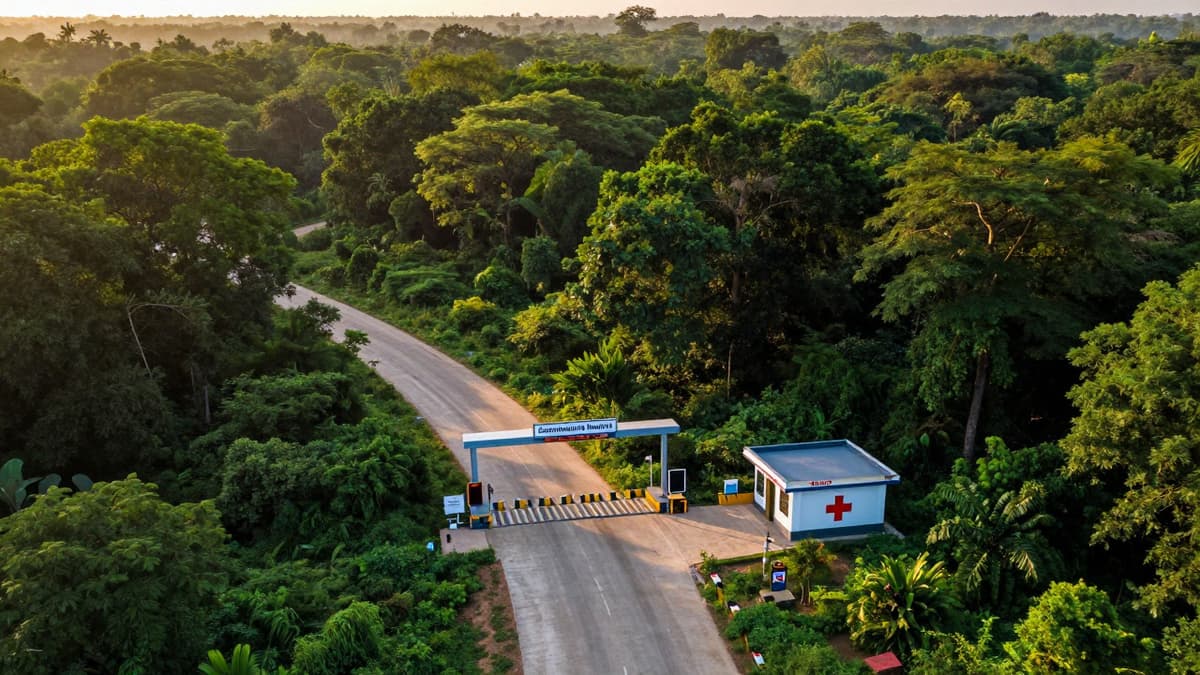
India stands at a historic juncture as Amit Shah's March 31, 2026 deadline ends, signaling a near-complete dismantling of the Red Corridor and a shift from terror to development.
The sun sets over Chhattisgarh's dense forests today, marking more than just the end of a day; it signals the final countdown to a historic deadline. Union Home Minister Amit Shah's March 31, 2026 target was never just a date on paper, but a security benchmark and a message to Naxalites and the nation. As that deadline ends today, the question rings louder than ever: is India closer than at any point in decades to ending Naxalism?
Speaking in the Lok Sabha on Monday, the home minister stated that India's anti-Naxal campaign has entered its final phase, claiming Naxalism has been almost wiped out in Bastar, the region once seen as the heartland of "Red Terror." He noted that the area is now seeing roads, schools, ration shops, health centres, and welfare delivery, marking a dramatic shift for a region that once symbolized the peak of Naxalist influence.
The Red Corridor did not appear overnight. Its story began in 1967 in Naxalbari, West Bengal, where a peasant uprising gave birth to what India later knew as Naxalism. The movement spread into remote, underdeveloped, and tribal-dominated regions, stretching across Chhattisgarh, Jharkhand, Odisha, Maharashtra, Madhya Pradesh, Andhra Pradesh, Telangana, and pockets of Kerala and Karnataka. This expanding belt of unrest became known as the "Red Corridor," eventually turning into a violent armed challenge where groups built parallel systems of control, attacked security forces, and extorted money.
At its peak, Naxalist violence affected 126 districts, reaching deep forest regions where the state's presence was weak. However, the numbers tell a starkly different story now. Government data shows the number of Left Wing Extremism (LWE) affected districts steadily fell from 126 in 2018 to 90 in April 2018, then to 70 in July 2021, and further to just 38 by April 2024. Furthermore, the number of worst-hit districts has been cut from 12 to 6, now limited to Bijapur, Kanker, Narayanpur, and Sukma in Chhattisgarh, West Singhbhum in Jharkhand, and Gadchiroli in Maharashtra.
The shrinking of the Red Corridor is evident in multiple categories. Among the 38 affected districts, the number of "districts of concern" has come down from 9 to 6, including Alluri Sitarama Raju in Andhra Pradesh and Balaghat in Madhya Pradesh. The category of other LWE-affected districts has also thinned, falling from 17 to 6. MHA data clarifies that Naxal active territory has shrunk from over 18,000 sq km in 2014 to around 4,200 sq km by 2024, and by 2025 it was reduced further to just a few hundred square kilometres.
The insurgency is losing ground and people. Over the past decade, as security operations were backed by roads, welfare, and a stronger state presence, the insurgency has steadily weakened. Between 2004-2014 and 2014-2024, violent incidents nearly halved from 16,463 to 7,744. Deaths of security personnel fell from 1,851 to 509, while civilian deaths dropped from 4,766 to 1,495.
The trend continued in 2025, when security forces killed 270 Naxals, arrested 680, and saw 1,225 cadres surrender. Add to that major operations like Operation Black Forest and mass surrenders in Bijapur, Chhattisgarh, and Maharashtra, and the pattern becomes clear: the Maoist movement is losing fighters. In fact, more than 8,000 Naxalites have abandoned violence in the last 10 years, reinforcing the government's claim that the insurgency is being squeezed into its final pockets.
The March 31 deadline represents the government's attempt to draw a final line under one of India's longest-running internal security threats. Over the years, Maoist groups targeted security forces, roads, telecom towers, and public infrastructure. In areas like Bastar, the fight was over whether roads could be built, schools could open, and banking could work. In Parliament, Shah argued, "Red terror was not there because there was no development; rather, development could not happen there because of red terror."
Shah compared Naxalbari, Bastar, Saharsa, and Ballia, noting that while all four had similarly low literacy and income levels in earlier decades, Naxalism took root only in Naxalbari and Bastar. He highlighted the brutality of the past, pointing to Naxalites hanging innocent villagers, staging sham "People's Courts," and trying to replace the Constitution with fear. The date matters because it marks the point where India ends the armed rebellion and the decades-long Naxal grip over neglected tribal regions.
Repainting the corridor involves a zero-tolerance approach combining security operations with welfare schemes. Once stretching across 12 states, the corridor has shrunk dramatically. The government's strategy focuses on restoring the rule of law and compensating for decades of developmental neglect. The National Policy and Action Plan on LWE, approved in 2015, outlines a multi-layered approach combining security, development interventions, and protection of local rights.
Security infrastructure has been drastically improved with 612 fortified police stations built, up from 66 in 2014, alongside 302 new security camps and 68 night landing helipads. Advanced technology, including drones, satellites, AI analysis, and social media monitoring, has strengthened coordination and helped reclaim territories long under fear.
As the deadline expires, the government's strategy of dialogue with those willing to negotiate, combined with firm action against attackers, has yielded tangible results. With Naxal active territory reduced to a few hundred square kilometres and more than 8,000 cadres having surrendered in a decade, the long-standing insurgency is effectively being contained. Looking ahead, the continued implementation of welfare schemes in the remaining 38 districts and the integration of advanced surveillance technology suggest that the trend of shrinking violent incidents will likely continue. The replacement of fear with governance signals a potential future where the remaining pockets of the movement are fully reintegrated into the democratic fabric of the state, marking a definitive end to the "Red Terror."
Jun 8, 2026 02:17 UTC
Magnitude 7.8 Quake Shakes Philippines, Urging Immediate Evacuations
Join 50,000+ readers getting the global briefing every morning.
No spam. Unsubscribe anytime.
Jun 8, 2026 02:17 UTC
Magnitude 7.8 Quake Shakes Philippines, Urging Immediate Evacuations
Jun 8, 2026 00:51 UTC
Trump Claims Iran Nuclear Deal Imminent Despite Diplomatic Fractures
Jun 8, 2026 00:47 UTC
Iran Fires Missiles at Israel After Beirut Strike
Jun 7, 2026 22:38 UTC
Congress Party Claims Unity for INDIA Bloc Delhi Meeting


