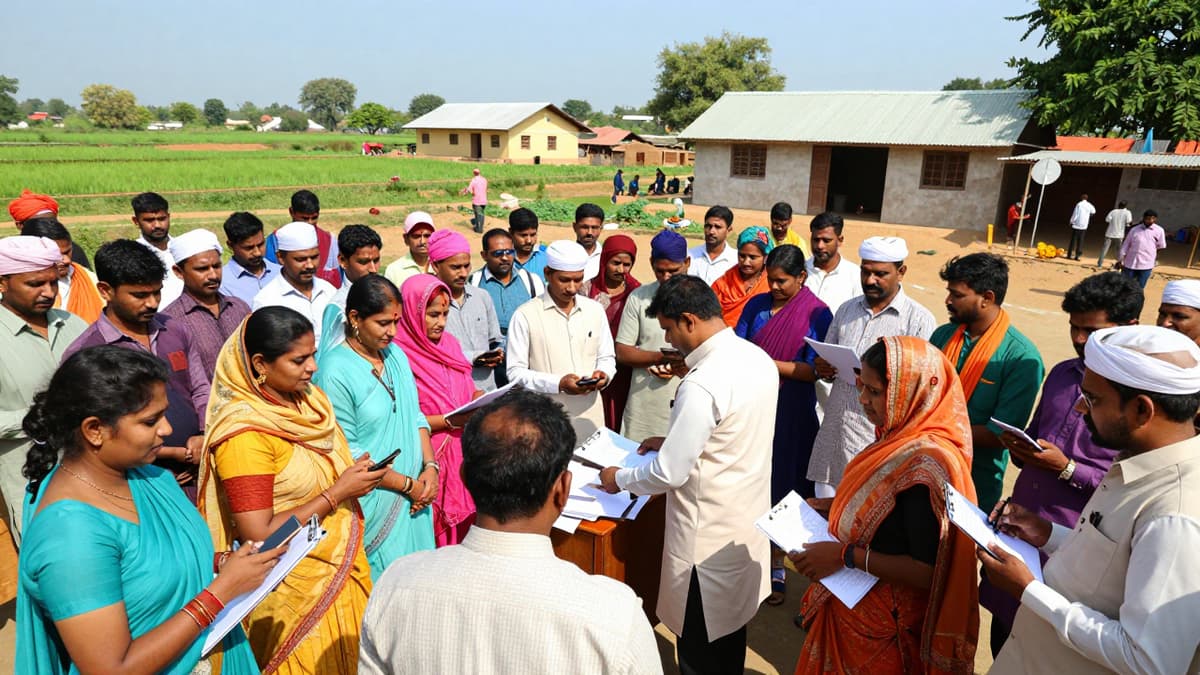
India has launched its massive 2026 census, the first in 15 years, featuring a controversial inclusion of caste data and raising fears about political representation shifts.
India has officially begun its massive 2026 census, described as the world's largest demographic exercise, involving the surveying of approximately 1.4 billion people across 28 states and eight union territories. This $1.24 billion undertaking marks a significant departure from the past, as it will include a caste enumeration for the first time in nearly a century, a move that has sparked intense political debate. The exercise is being closely watched due to its potential to reshape political representation following a five-year delay caused by the pandemic and administrative hurdles.
The census aims to update critical data on household composition, living conditions, and access to basic amenities that has been outdated since the last count in 2011. Registrar General and Census Commissioner Mritunjay Kumar Narayan announced at a news conference in New Delhi that the eighteenth census since independence will be conducted entirely digitally. This modernization effort will empower 30 million enumerators to use mobile applications on smartphones to collect data via 33 specific questions. Additionally, individuals have the option to self-enumerate through an online portal to receive a unique digital ID.
The operation is scheduled to run in two distinct phases, concluding on March 31 next year. The first phase, beginning Wednesday and running until September, is known as the House Listing and Housing Census. During this period, officials will ask residents about their household size, home ownership, and access to essential services like fuel, water, electricity, internet, and transport. This initial data collection lays the groundwork for the second phase, which will take place in February of the following year.
The second phase focuses on gathering comprehensive socioeconomic details, including education, migration patterns, and fertility rates. Crucially, the caste enumeration will occur during this second phase. For the first time, every individual will be asked to identify their specific caste, a significant shift from previous censuses that only recorded broad categories of Scheduled Castes (SCs) and Scheduled Tribes (STs). This change comes after the government initially opposed the inclusion of such questions but eventually announced the decision following pressure from campaigners and caste groups.
Dipa Sinha, a development economist specializing in social policy, emphasized the critical nature of this data. She noted that while the census counts people, it also reveals essential demographic trends, such as the distribution between rural and urban areas. This information is vital for governments to plan policies and for citizens to claim their rights. Furthermore, census data forms the foundation for allocations under antipoverty programs. Sinha highlighted that the delimitation exercise, which involves redrawing the boundaries of electoral constituencies based on population size, is now imminent.
This timing has raised alarms among politicians in southern India, where population growth has stalled compared to the north. There is a genuine fear that if delimitation relies solely on the new population figures, northern India, which already holds the bulk of parliamentary representation, will gain outsized political influence. This dynamic has long been a source of tension between the north and south. The implications extend to the recently passed women's reservation bill, which mandates that one-third of parliament seats be reserved for women once the new census and delimitation are complete.
The historical context of this census reveals a long evolution in how India counts its people. The first modern census occurred between 1865 and 1872 under British rule, though it was not coordinated until 1881. After independence in 1947, the first census was conducted in 1951. Over the decades, the scope expanded from simple household registration to include internal migration data since 1971, and details on employment and disability by 2011. This year also introduces questions on couples' relationship status, counting stable live-in unions as married.
However, the five-year delay has left significant data gaps. Ashwini Deshpande, an economist at Ashoka University, warned that relying on an outdated sampling frame from a decade ago introduces systematic errors into major surveys. Since large-scale surveys depend on the census as their master list, the lack of current data renders many recent findings potentially unrepresentative. This delay occurred during a period of rapid economic and political change, leaving the country without fresh demographic insights exactly when they are needed most.
The controversy surrounding the caste enumeration is particularly acute. Comprehensive caste data has not been collected since 1931, with the practice halted in 1951 to prevent social divisions. While limited data on SCs and STs was maintained through the National Sample Survey, the government's Bharatiya Janata Party (BJP) has historically opposed a full caste count, with Prime Minister Narendra Modi once likening proponents of the census to "urban Naxals." Despite this history, the decision to include the specific caste details in the second phase of the census marks a historic and deeply contested shift in Indian demographic data collection.
This year's census serves as a pivotal turning point for India's political landscape, driven by the urgent need for updated delimitation boundaries and the controversial inclusion of caste data. As the government transitions from the initial house listing to the detailed socioeconomic enumeration, the resulting data will dictate the redrawing of electoral constituencies. Experts predict that the disparities in population growth between the rapidly growing north and the stagnant south will lead to a significant shift in parliamentary representation. Furthermore, the inclusion of caste enumeration promises to provide a more granular view of social stratification, potentially reshaping welfare allocations and policy-making for marginalized communities. The convergence of these factors suggests that the 2026 census will not merely be a statistical exercise but a catalyst for long-term political and social restructuring across the nation.
Jun 8, 2026 02:17 UTC
Magnitude 7.8 Quake Shakes Philippines, Urging Immediate Evacuations
Join 50,000+ readers getting the global briefing every morning.
No spam. Unsubscribe anytime.
Jun 8, 2026 02:17 UTC
Magnitude 7.8 Quake Shakes Philippines, Urging Immediate Evacuations
Jun 8, 2026 00:51 UTC
Trump Claims Iran Nuclear Deal Imminent Despite Diplomatic Fractures
Jun 8, 2026 00:47 UTC
Iran Fires Missiles at Israel After Beirut Strike
Jun 7, 2026 22:38 UTC
Congress Party Claims Unity for INDIA Bloc Delhi Meeting


