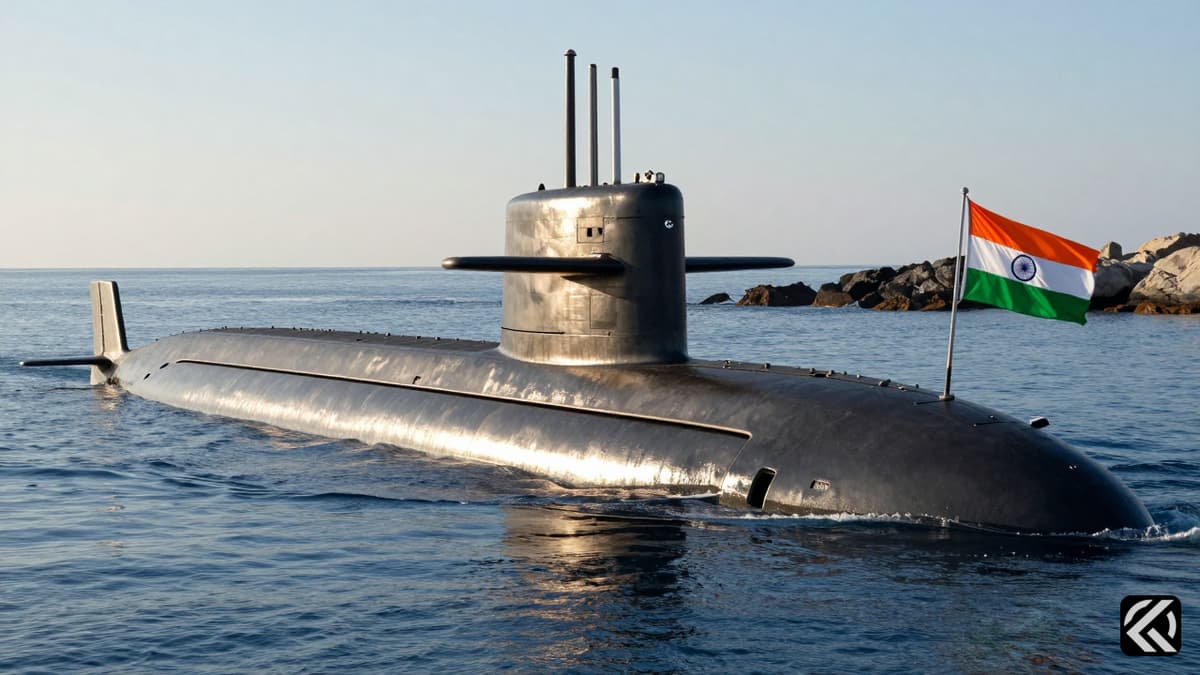
India takes a decisive step in maritime defense with the commissioning of INS Aridhaman. The vessel promises enhanced stealth and strategic reach, strengthening the nation's nuclear capabilities.
NEW DELHI: India is officially set to commission its third indigenous nuclear-powered ballistic missile submarine, INS Aridhaman, into the Indian Navy on Friday. This significant event marks a major boost to the country's strategic deterrence capabilities, as reported by the news agency ANI. The vessel represents a pivotal moment in the nation's defense history, moving beyond mere development to active operational readiness.
Defence Minister Rajnath Singh had previously hinted at the induction of this formidable asset, posting a message on X in Hindi that read, "It's not a word, it's power, 'Aridhaman'!" This enthusiastic endorsement underscores the high political and strategic value attached to the new platform. As part of India's Arihant-class series, the submarine is designed to significantly outperform its predecessors, establishing a new standard for the country's undersea strategic forces.
INS Aridhaman is a formidable 7,000-tonne vessel, making it notably larger and more advanced than its earlier siblings, INS Arihant and INS Arighaat. Built under the Advanced Technology Vessel programme at Visakhapatnam, the submarine represents a key milestone in India's indigenous defence capabilities. The vessel is equipped with an 83 MW Compact Light Water Reactor, a critical component designed for enhanced stealth and endurance, allowing the craft to remain submerged for extended periods.
The engineering improvements extend to the submarine's sensor suite and survival mechanisms. It features advanced indigenous sonar systems and acoustic suppression technologies, which drastically improve underwater detection and survivability against enemy threats. However, the most significant upgrade lies in its offensive capabilities. INS Aridhaman is fitted with eight vertical launch system tubes, a capacity double that of earlier submarines. This expansion allows the vessel to carry up to 24 K-15 Sagarika missiles with a range of 750 km or eight K-4 missiles with a range of 3,500 km.
Furthermore, the platform is designed with future flexibility in mind. The submarine is expected to support future K-5 missiles with a range of around 6,000 km, ensuring the asset remains relevant as ballistic missile technology evolves. With its induction, India will operate three nuclear-powered ballistic missile submarines under the Strategic Forces Command. This triad of vessels strengthens the country's sea-based leg of the nuclear triad and moves the nation closer to achieving continuous at-sea deterrence. This operational strategy ensures that at least one nuclear submarine remains deployed at all times, providing an unshakeable second-strike capability.
The operational base for this critical asset is expected to be Project Varsha near Visakhapatnam. This high-security naval facility has been specifically designed to house India's nuclear fleet, ensuring maximum protection and logistical support for the submerged fleet. The location at Visakhapatnam has long been the hub for India's submarine programs, and the arrival of INS Aridhaman solidifies its status as the nerve center of the country's undersea nuclear deterrent.
While the commissioning of INS Aridhaman is the immediate headline, the broader narrative of India's naval modernization is far-reaching. The country is not resting on its laurels with this single achievement. India is also progressing on additional naval capabilities to ensure comprehensive maritime dominance. The planned induction of the Russian Akula-class nuclear-powered attack submarine, Chakra III, is set to complement the new fleet. Additionally, negotiations are currently underway for advanced diesel-electric submarines under Project-75(I), signaling a multi-layered approach to naval defense.
The induction of the nuclear-powered ballistic missile submarineINS Aridhaman signifies a mature phase in India's nuclear arsenal. The vessel's ability to carry theK-4 missile extends its strategic reach significantly compared to earlier platforms. By doubling the number of vertical launch tubes, the Indian Navy gains the flexibility to carry a diverse mix of missile types, from shorter-range tactical options to long-range strategic weapons. This versatility is crucial for a deterrence strategy that must remain robust against evolving regional threats.
The focus on indigenous technology is evident throughout the vessel's design. From the Compact Light Water Reactor to the acoustic suppression technologies, every system prioritizes self-reliance. The success of the Arihant-class program has allowed India to claim a unique position in the global nuclear order. Operating three such submarines creates a rotation cycle that makes continuous deterrence not just a concept, but a reality. As long as one vessel is patrolling, the strategic balance remains intact.
Looking ahead, the integration of the K-4 missile and the potential future deployment of the K-5 missile will further alter the strategic equation in the region. The 3,500 km range of the K-4 already covers a vast portion of the neighboring territories, while the projected 6,000 km range of the K-5 will extend that horizon significantly. The commissioning of INS Aridhaman is not an isolated event but a calculated move in a long-term strategy to secure India's sovereignty through unmatched naval power.
The induction of the new submarine at Project Varsha cements Visakhapatnam as the primary stronghold for India's strategic nuclear forces. As the facility continues to expand to house this growing fleet, the operational tempo is expected to increase, ensuring the rotation of vessels remains seamless. The trajectory suggests a continued commitment to indigenous construction, with future projects likely building upon the technological foundations laid by the Arihant-class program. As negotiations for Project-75(I) and Chakra III progress, the Indian Navy is poised to maintain a formidable, multi-dimensional undersea presence for decades to come.
Jun 8, 2026 00:51 UTC
Trump Claims Iran Nuclear Deal Imminent Despite Diplomatic Fractures
Jun 8, 2026 00:47 UTC
Iran Fires Missiles at Israel After Beirut Strike
Jun 7, 2026 22:00 UTC
US, Iran Peace Hops Fade 100 Days Into War
Jun 7, 2026 20:57 UTC
Iran Strikes Israel: IRGC Promises Week of Continuous Offensive
Jun 8, 2026 02:28 UTC
Trump Walks Out of Meet the Press After Rejecting Evidence Demands


