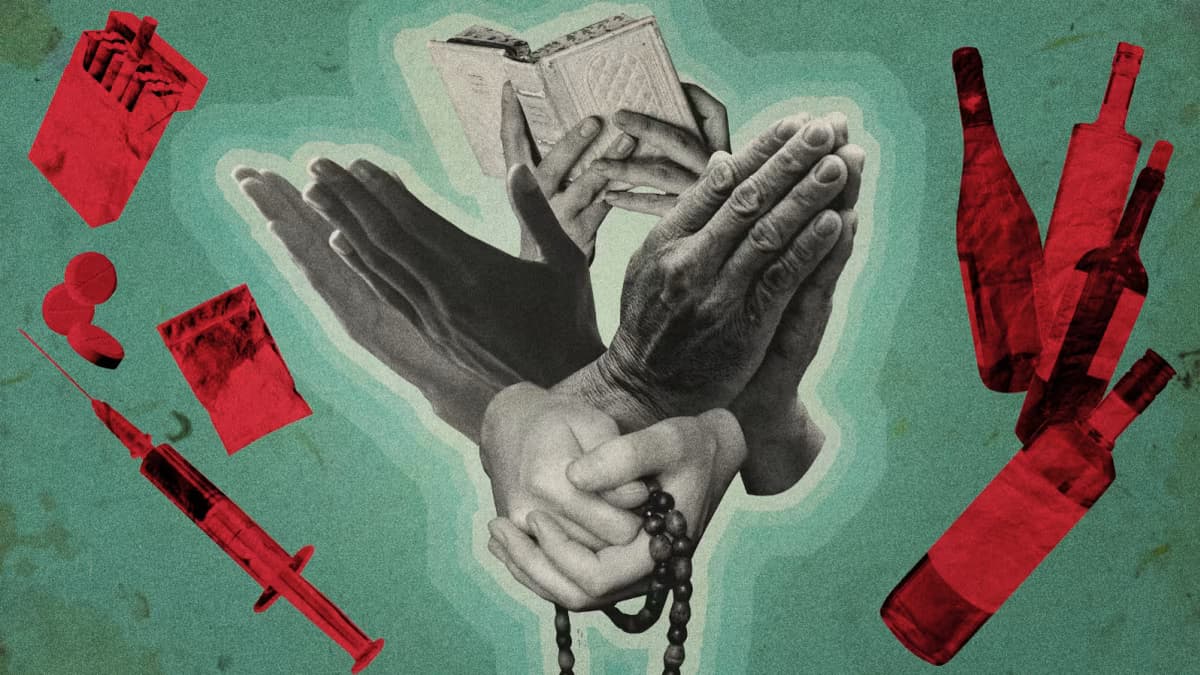
A study published in the journal JAMA Psychiatry in February found that a person’s spiritual belief or a steady religious practice had a protective effect from addiction.
When she was in her 40s, Jenny Teeters had a serious drinking problem that she hid behind her professional success.
At one point, she managed a high-six-figure tech job, raised two teen girls, finished her MBA and taught Zumba — all while intoxicated.
She got to a place where she could no longer juggle it all. She knew she needed help. What finally made her sobriety stick, she said, was a newfound faith in a higher power.
“In my addiction, I had veered away from faith, because I really thought, ‘who am I to be going into a church, knowing that I’m doing the same damaging thing over and over again?’ I had so many unhealthy attachments and addictions with my drinking,” said Teeters, who now lives in South Carolina. “But when I confessed to a priest about my drinking, he told me I needed to work on a personal relationship with Jesus.”
That conversation planted a seed.
“And it just became this vehicle by which they helped bring me back.”
New research suggests that kind of connection may help others, too. A study published in the journal JAMA Psychiatry in February found that a person’s spiritual belief or a steady religious practice had a protective effect from addiction.
The analysis, which included 55 studies encompassing more than a half-million people, found that those who had a spiritual belief or religious practice were less likely to have a harmful relationship with alcohol, drugs or cigarettes. Those with a connection to a higher power had more success recovering from addiction, too.
No single demographic benefited more from a spiritual connection, but more than half of African Americans in the study reported that their spirituality or religion “made all the difference” in their recovery — a rate two- to threefold more than that of White people.
Faith, or a spiritual connection, also seemed to help women gain the same level of success with the recovery process as men. Earlier research has shown that women typically face more barriers to recovery. Society judges women much more harshly than men for addiction, and women, who are more often caregivers, may find it difficult to make time for themselves or spend money on rehab.
The new study doesn’t explain why faith protects against the harmful effects of drugs, alcohol or smoking. No one religious or spiritual practice appeared to be more protective against addiction, but the risk reduction was higher for people who regularly engaged in a spiritual or religious community, defined as weekly attendance at a religious service.
One possible reason for the protective effect between faith and substance use is that excessive drug and alcohol use would not typically be the norm in a religious community, said Dr. Amy Krentzman, who researches spirituality and alcoholism recovery and did not work on the new study.
A belief in a higher power also provides people with hope and solace — great foils for addiction. Regular attendance in a faith community also provides connection.
“Traditional religious congregations or participation would give a person a broader base of social support, which is extremely helpful with recovery,” said Krentzman, an associate professor in the School of Social Work at the University of Minnesota.
Social connection of any kind is key in recovery, said Dr. Anisah Bagasra, an assistant professor of psychology at Kennesaw State University in Georgia who researches religious commitment and substance use.
“Religious participation staves off loneliness and isolation, and individuals who are isolated are more likely to use alcohol and drugs to cope with life circumstances,” said Bagasra, who did not work on the new study.
People often also credit the camaraderie and social support they experience with the peer-led recovery organization Alcoholics Anonymous with their sobriety. It’s not religious, and all are welcome, but AA does ask members to believe in “a power greater than us as individuals.” The purpose is to foster humility, reduce a person’s anxiety by releasing their need for control and provide an external source of strength for long-term recovery.
Research shows that the most effective ways to help someone end their addiction to alcohol often includes a combination of approaches like behavioral therapies, medications such as naltrexone or disulfiram, and a support system like 12-step programs.
For Teeters, along with the camaraderie she found attending Catholic in Recovery, a 12-step program rooted in the church, and a year in outpatient rehab, she felt she needed to develop a real spiritual camaraderie to get sober.
Developing her personal relationship with Jesus took real imagination and practice. She first pictured herself on the beach in Monterey, California.
“I’m sitting there, and there’s birds flying around, and I can hear the ocean, and there’s literally a person sitting next to me,” Teeters said. “I’d practice getting comfortable with Him sitting next to me, and I’d tell Him what’s on my mind, and maybe I’ll listen to see if something is said back.”
She said that if a song were to describe this relationship, she’d pick Rob Base and DJ E-Z Rock’s “It Takes Two.”
She engages in this practice so frequently, she now pictures Jesus with her all the time.
“I’m in the gym doing chest presses and imagining him spotting me,” she said.
Krentzman says people managing addiction will often use spirituality and religiousness as a support mechanism that helps stabilize their mood and soothe them when they feel upset.
“If someone’s not having a drink because they’re in recovery, they’ve got to find something else to help them feel safe and secure and stable,” said Krentzman.
Religion or spirituality isn’t the only answer, Krentzman said; meditation is also powerful. Even taking three deep breaths when you’re upset can help.
Anything that helps a person develop good coping skills can work.
Having an active addiction, Krentzman said, is “a very limiting, narrow way of life.”
“When the person can get out from under that and start to open up their horizons, then they’re going to have a broadening quality of life and greater purpose in life. And when they stop using drugs or alcohol, they’ve got a whole life to discover, and in a sense, they can finally pursue a sense of purpose.”
Now in her 50s and sober, Teeters has found her sense of purpose. She’s a career and life coach who helps executives who are at a turning point figure out what will give their life meaning and success. She also works with Catholic in Recovery to help others like her.
“I didn’t know a single person in recovery when I was drinking,” Teeters said. “So I’m open about my recovery so that if you need a little bit of hope, you can take mine.”
May 1, 2026 03:50 UTC
Trump Administration Declares Iran Conflict Terminated
Join 50,000+ readers getting the global briefing every morning.
No spam. Unsubscribe anytime.
May 1, 2026 03:50 UTC
Trump Administration Declares Iran Conflict Terminated
Apr 25, 2026 01:38 UTC
Iranian FM Araghchi Heads to Islamabad for Critical US-Iran Talks
Apr 25, 2026 01:13 UTC
Calm Suspect in Delhi Rape-Murder Case Faces Mental Evaluation
Apr 24, 2026 23:24 UTC
Raghav Chadha joins BJP, Shaking AAP’s Rajya Sabha Strength


