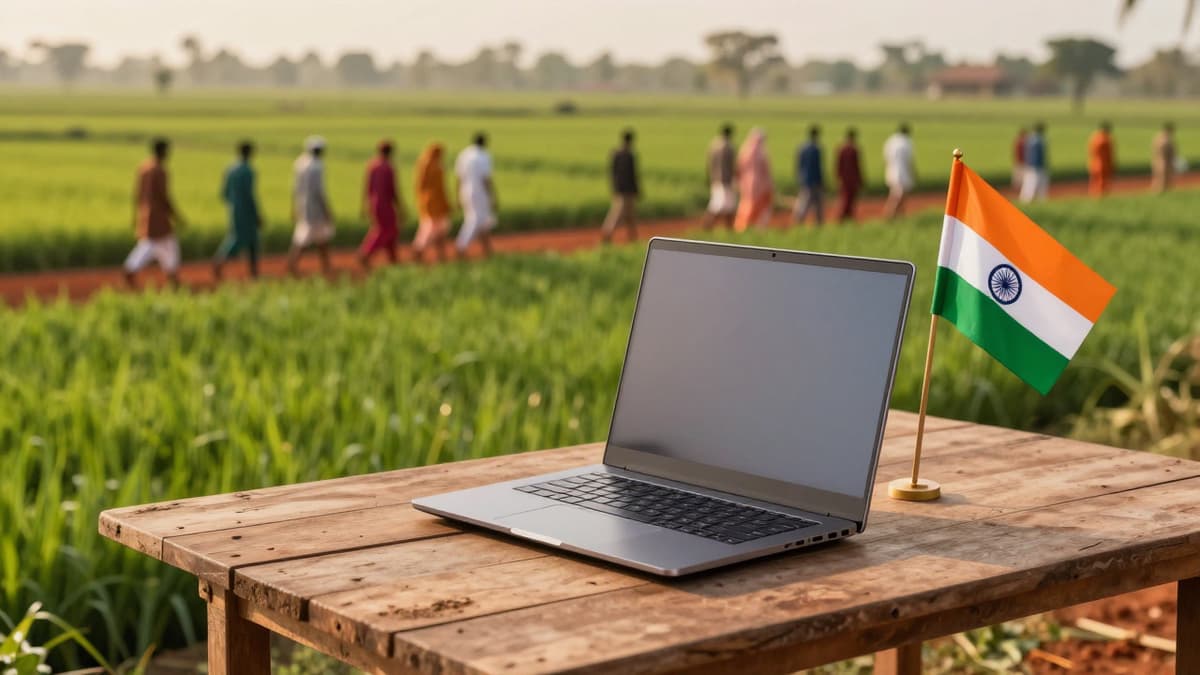
India's massive 2026 census marks a historic shift by counting castes for the first time in nearly a century, igniting intense political debate ahead of new electoral boundary redraws.
India has officially begun conducting its population census, the largest of its kind in history, marking a pivotal moment for the world's most populous nation. This massive exercise, costing $1.24bn, involves over three million officials surveying approximately 1.4 billion Indians regarding their household composition and living conditions.
The latest count is being watched with particular intensity because it includes caste enumeration for the first time since 1931, a move that has ignited significant political controversy. Following a five-year delay attributed to the pandemic and administrative hurdles, the census aims to update data that has been considered outdated since 2011.
The operation spans the country's 28 states and eight union territories, covering more than 7,000 towns and 640,000 villages. This effort, the eighth since independence in 1947, will utilize digital tools for the first time. Thirty million enumerators will use mobile applications to ask 33 questions, while citizens also have the option to self-enumerate via an online portal to receive a unique digital ID.
Registrar General and Census Commissioner Mritunjay Kumar Narayan announced the timeline during a news conference in New Delhi. The first phase, the House Listing and Housing Census, began on a Wednesday and runs through September, focusing on household counts, ownership, and access to amenities like water, electricity, and internet.
The second phase, scheduled for February, will conduct population enumeration to gather socioeconomic details on education, migration, and fertility. It is during this phase that the controversial caste data will be collected. The entire process is scheduled to conclude on March 31 of next year.
A census is more than a headcount; it provides the demographic structure necessary for policy planning and rights allocation. Dipa Sinha, a development economist, explains that the data reveals distribution between rural and urban areas and informs the allocation of funds for antipoverty programmes. The timing of this specific census is critical because it precedes a major delimitation exercise.
This delimitation involves redrawing electoral constituency boundaries based on the new population figures. Southern Indian politicians have voiced strong concerns that a redistribution based purely on population size could result in northern India, where the majority of the population resides, receiving outsized political representation. This tension exacerbates existing north-south divides, as the bulk of parliamentary representation already stems from the north.
Furthermore, the census data will serve as the basis for implementing the women's reservation bill passed the previous year. This legislation mandates a one-third reservation for women in parliament once delimitation is complete, making the accuracy and timing of the census a direct determinant of future political representation.
The inclusion of caste data marks a significant departure from post-independence practices. Comprehensive caste data has not been collected since 1931, and the practice was halted in 1951 to avoid fostering "social divisions." While limited information on Scheduled Castes (SCs) and Scheduled Tribes (STs) was maintained through the National Sample Survey, a full count of the broader caste system has been absent for decades.
The decision to include caste enumeration in the 2026 census came after sustained pressure from campaigners and caste groups, despite historical opposition from Prime Minister Narendra Modi's Bharatiya Janata Party (BJP). In a 2024 interview, Modi had characterized proponents of a caste census as thinking like "urban Naxals," a term used to describe far-left and tribal groups. The new process will ask every individual to state their caste, rather than just identifying as SC or ST, creating the first systematic, population-wide count of jati in a century.
Economist Ashwini Deshpande of Ashoka University highlights that this is a "genuinely historic - and deeply contested - exercise." She notes that the delay has created significant data gaps, as all large-scale surveys rely on the census as a sampling frame. Without an updated master list, recent surveys may suffer from systematic errors, rendering them unrepresentative of the actual population.
The completion of this census will fundamentally alter the political landscape of India. With the data finalizing by March 2027, the subsequent delimitation exercise will likely redistribute parliamentary seats, potentially cementing the political dominance of northern regions while diminishing the relative influence of the south. The inclusion of caste data will also force a national reckoning on social stratification, moving beyond the binary of SC/ST recognition to a granular understanding of caste dynamics. As the government moves to implement the women's reservation, the accuracy of this data will determine the demographic reality of India's parliament for years to come, making this census a definitive turning point in the nation's socio-political history.
Jun 8, 2026 02:17 UTC
Magnitude 7.8 Quake Shakes Philippines, Urging Immediate Evacuations
Join 50,000+ readers getting the global briefing every morning.
No spam. Unsubscribe anytime.
Jun 8, 2026 02:17 UTC
Magnitude 7.8 Quake Shakes Philippines, Urging Immediate Evacuations
Jun 8, 2026 00:51 UTC
Trump Claims Iran Nuclear Deal Imminent Despite Diplomatic Fractures
Jun 8, 2026 00:47 UTC
Iran Fires Missiles at Israel After Beirut Strike
Jun 7, 2026 22:38 UTC
Congress Party Claims Unity for INDIA Bloc Delhi Meeting


