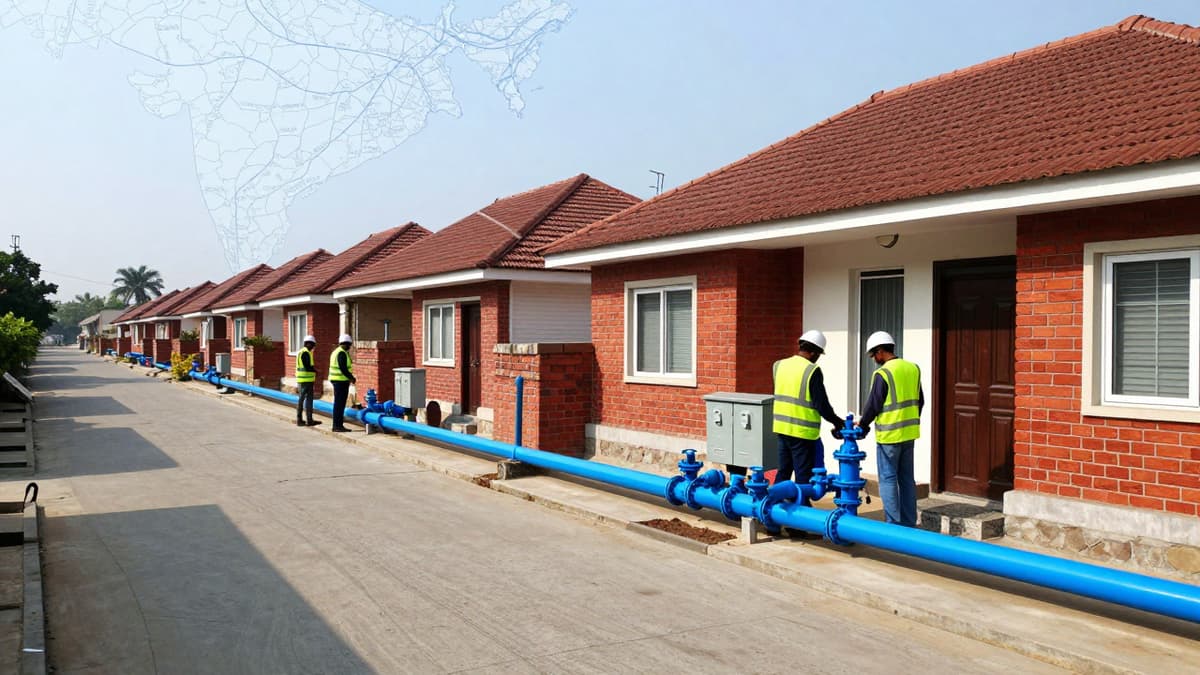
The government has issued a strict directive requiring households in areas with pipeline access to switch from LPG to piped gas, signaling a major shift in India's energy distribution strategy amid global supply disruptions.
The Indian government has initiated a significant restructuring of its household fuel supply chain through a new directive that mandates the transition from liquefied petroleum gas (LPG) cylinders to piped natural gas (PNG). This decisive move, formalized via the petroleum ministry order 2026, explicitly halts LPG supply to residential addresses located in areas where piped gas infrastructure is already operational. The initiative is designed to diversify energy sources and mitigate vulnerabilities exposed by the ongoing disruption of global oil supplies caused by the Middle East crisis.
The urgency of this policy stems from a volatile global landscape where the ongoing crisis has damaged liquefaction facilities in the Gulf and introduced restrictions around the critical Strait of Hormuz. Amidst these disruptions, authorities are positioning PNG as the superior alternative for both domestic and commercial users, emphasizing its ability to provide a continuous supply through a permanent pipeline network. This eliminates the logistical need for repeated cylinder refills and the associated supply chain bottlenecks that have plagued the sector. The directive, issued under the Essential Commodities Act, represents a strategic pivot to secure national energy independence by shifting the primary fuel source for connected households.
Neeraj Mittal, the Oil Secretary, contextualized the reform as a strategic pivot where "a crisis has been turned into an opportunity." Speaking on the social media platform X, Mittal highlighted that the reforms are intrinsically linked to the broader goal of improving the ease of doing business in the energy sector. The new order introduces a framework of time-bound clearances and standardized charges intended to accelerate the execution of infrastructure projects. By streamlining the approval processes for pipeline development, the government aims to overcome historical delays and ensure that the physical network expands rapidly to cover more regions.
The core of the mandate requires that any household notified by an authorized entity must apply for and obtain a PNG connection if pipelines have been laid in their vicinity. The order stipulates a strict deadline: "The LPG supply to such an address shall cease after three months from the date of the communication." This timeframe provides a transitional period for residents to adapt to the new infrastructure while ensuring a definitive end to cylinder-based supply in these specific zones. The policy is not merely about infrastructure expansion but also about the optimization of the existing LPG supply chain. By halting supply in connected areas, the government intends to reallocate LPG cylinders to remote regions lacking pipeline access, thereby supporting a broader strategy of "fuel diversification."
Under the new rules governing this transition, public authorities face stringent obligations regarding the granting of permissions and rights of way. The order mandates that these approvals must be granted within specified timelines; failure to do so will result in approvals being treated as automatically granted. Furthermore, authorities are prohibited from levying charges that exceed those prescribed under the framework. In residential clusters, entities responsible for managing access are required to grant permissions within three working days. For last-mile connections, the target is even more aggressive, with completion expected within 48 hours. The policy explicitly states that applications for pipeline connectivity in such areas shall not be rejected, removing bureaucratic hurdles that may have previously stalled expansion.
To resolve disputes related to land access and permissions, the order empowers designated officers with authority akin to that of a civil court, allowing them to grant the right of way where necessary to facilitate the rollout. Simultaneously, pipeline operators are bound by their own set of strict timelines, required to begin laying pipelines within four months of receiving approval. Non-compliance carries significant consequences, including the possibility of losing exclusivity rights. The oversight of this entire implementation has been entrusted to the Petroleum and Natural Gas Regulatory Board (PNGRB), which will track approvals, rejections, and compliance across all involved entities to ensure accountability.
The transition is not absolute for every location, as the order provides specific exceptions for cases where a piped connection is "technically infeasible." In such instances, a no-objection certificate (NOC) can be issued by authorized entities to allow the continued supply of LPG. The order clarifies, "The supply of LPG to a household shall not cease, if the authorised entity issues a no-objection certificate (NOC) on the ground that it is technically infeasible to provide a piped natural gas connection or gas supply to such household." However, this flexibility comes with a requirement for transparency; authorized entities must maintain detailed records explaining the reasons for such infeasibility. Furthermore, the NOC is temporary in nature, as it must be withdrawn once the entity is able to operationalize piped gas supply to those specific households.
This strategic move to promote piped natural gas is expected to fundamentally alter the energy consumption landscape for millions of households. By forcing the LPG to PNG shift where infrastructure exists, the government aims to create a more resilient energy network capable of withstanding global shocks. The focus on speeding up approvals and standardizing charges suggests a future where infrastructure development is faster and less prone to bureaucratic stagnation. As the crisis in the Middle East persists, the reliance on a continuous pipeline supply is projected to become the backbone of national energy security, potentially reducing the nation's exposure to international market volatility. The long-term impact will likely be a more efficient distribution system where LPG is reserved for areas where piped gas cannot yet reach, creating a more balanced and secure energy ecosystem for the country.
Jun 8, 2026 00:51 UTC
Trump Claims Iran Nuclear Deal Imminent Despite Diplomatic Fractures
Jun 8, 2026 00:47 UTC
Iran Fires Missiles at Israel After Beirut Strike
Jun 7, 2026 22:00 UTC
US, Iran Peace Hops Fade 100 Days Into War
Jun 7, 2026 20:57 UTC
Iran Strikes Israel: IRGC Promises Week of Continuous Offensive
Jun 8, 2026 02:28 UTC
Trump Walks Out of Meet the Press After Rejecting Evidence Demands


