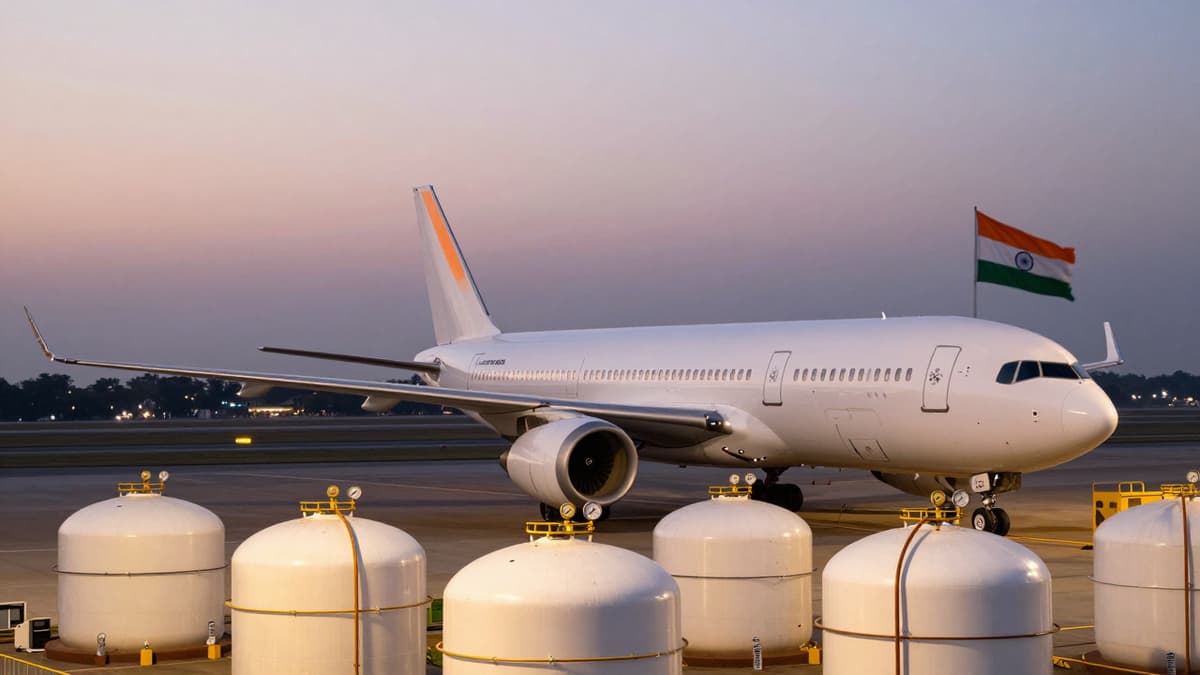
The Indian government intervenes to shield domestic travelers as commercial LPG prices spike 10% and aviation fuel costs soar. New caps and under-recovery data reveal the economic strain on OMCs and consumers alike.
The Indian government has intervened to moderate the cost of air travel for domestic passengers while allowing market forces to dictate commercial fuel costs. On Wednesday, April 1, 2026, prices for commercial liquefied petroleum gas (LPG) rose more than 10% in major metro cities, while aviation turbine fuel (ATF) prices more than doubled for international and chartered flights. State-owned oil marketing companies notified that 19 kg commercial cylinders in Delhi increased by ₹195.5 to ₹2,078.5. Meanwhile, the government ensured that domestic travelers are protected from the full brunt of the ATF price hike, limiting the increase for domestic flights to just 25% compared to the massive surge seen in international routes.
The trigger for these adjustments lies in global market dynamics, specifically a 44% spike in benchmark Saudi Contract prices between March and April 2026. Additionally, 20% to 30% of global LPG supplies remain stranded in the Strait of Hormuz, creating supply constraints that have driven up prices. While international airlines face a record ATF price of ₹2.07 lakh per kilolitre, domestic airlines in Delhi and Mumbai are seeing a price of ₹1,04,927 per kilolitre, representing a significantly smaller increase from the previous ₹96,638.14. The Petroleum Ministry stated in a social media post that to insulate domestic travel costs, the PSU Oil Marketing Companies, in consultation with the Ministry of Civil Aviation, have passed only a partial and staggered increase of 25% to the airlines. This decision ensures that foreign routes absorb the full cost increase, while domestic passengers see only a ₹15 per litre hike passed on, compared to the potential ₹60 per litre that would have applied without the government cap.
The financial strain on public sector entities is evident in the reported under-recoveries. The Petroleum Ministry informed that petroleum under-recovery for oil marketing companies currently stands at ₹380 for every commercial cylinder. Based on current estimates, cumulative losses are projected to scale to ₹40,484 crore by the end of May. For context, under-recoveries in the previous year stood at ₹60,000 crore, requiring a ₹30,000 crore compensatory bailout package from the union government, with the remainder absorbed by the companies themselves. Furthermore, under-recoveries on diesel and petrol remain significant, at ₹104.99 per litre and ₹24.4 per litre respectively. To aid the OMCs, the Union Government had previously reduced the Special Additional Excise Duty on petrol and diesel by ₹10 per litre on March 27.
IndiGo has indicated it will announce revised fuel charges shortly, following a pattern established last month where various Indian airlines imposed a fuel surcharge of ₹400 for domestic travel. The surge in costs also impacted commercial LPG consumers, with hikes varying by city: Mumbai saw a ₹196 increase, Chennai ₹203, and Kolkata ₹218. Notably, there has been no change to prices for domestic LPG, which consists of 14 kg cylinders, highlighting the specific focus on the commercial sector in this price adjustment. The government emphasized that commercial LPG consumption accounts for less than 10% of the total LPG consumed in the country, and prices for this segment are deregulated and market-determined.
Minister for Civil Aviation Ram Mohan Naid emphasized the necessity of the government's intervention, stating that this calibrated approach will help shield passengers from sharp fare increases while easing the burden on domestic airlines. The minister noted that supporting the continued stability of the aviation sector is crucial for the broader economy, ensuring the smooth movement of cargo and maintaining vital air connectivity for trade and logistics. The Ministry of Petroleum clarified that the effective hike, if fully passed on in line with international price dynamics, would have exceeded ₹60 per litre. However, the decision to cap the hike at ₹15 per litre for domestic flights ensures that the burden does not fall entirely on the consumer or the airline's balance sheet.
The situation remains fluid as the government monitors the lifting of bottled hydrocarbon gas, which has seen 47,928 metric tonnes lifted since March 14 following a shift to allocate commercial LPG to entities ranging from 20% to 70%. The Ministry reiterated that since prices of commercial LPG are deregulated, the monthly revision reflects current global realities. The focus remains on balancing the financial health of the oil marketing companies with the affordability of essential services for the domestic population.
The current measures signal a strategic pivot to prevent a cascading economic impact on the domestic travel and trade sectors. With under-recoveries already high and losses projected to exceed ₹40,000 crore by May, the government's decision to cap the domestic ATF price hike at 25% serves as a critical buffer against inflationary pressure. However, the reliance on global market dynamics for commercial LPG, which is set to rise another 44% in benchmark contracts, suggests continued volatility. Unless global supply chains in the Strait of Hormuz stabilize, the risk of further price revisions remains high, potentially forcing the government to revisit its compensation packages or the extent of its intervention in the domestic aviation fuel market.
Jun 8, 2026 04:15 UTC
Trump Urges Netanyahu to Halt Iran Strike for Peace
Join 50,000+ readers getting the global briefing every morning.
No spam. Unsubscribe anytime.
Jun 8, 2026 02:28 UTC
Trump Walks Out of Meet the Press After Rejecting Evidence Demands
Jun 8, 2026 02:17 UTC
Magnitude 7.8 Quake Shakes Philippines, Urging Immediate Evacuations
Jun 8, 2026 00:51 UTC
Trump Claims Iran Nuclear Deal Imminent Despite Diplomatic Fractures
Jun 8, 2026 00:47 UTC
Iran Fires Missiles at Israel After Beirut Strike


