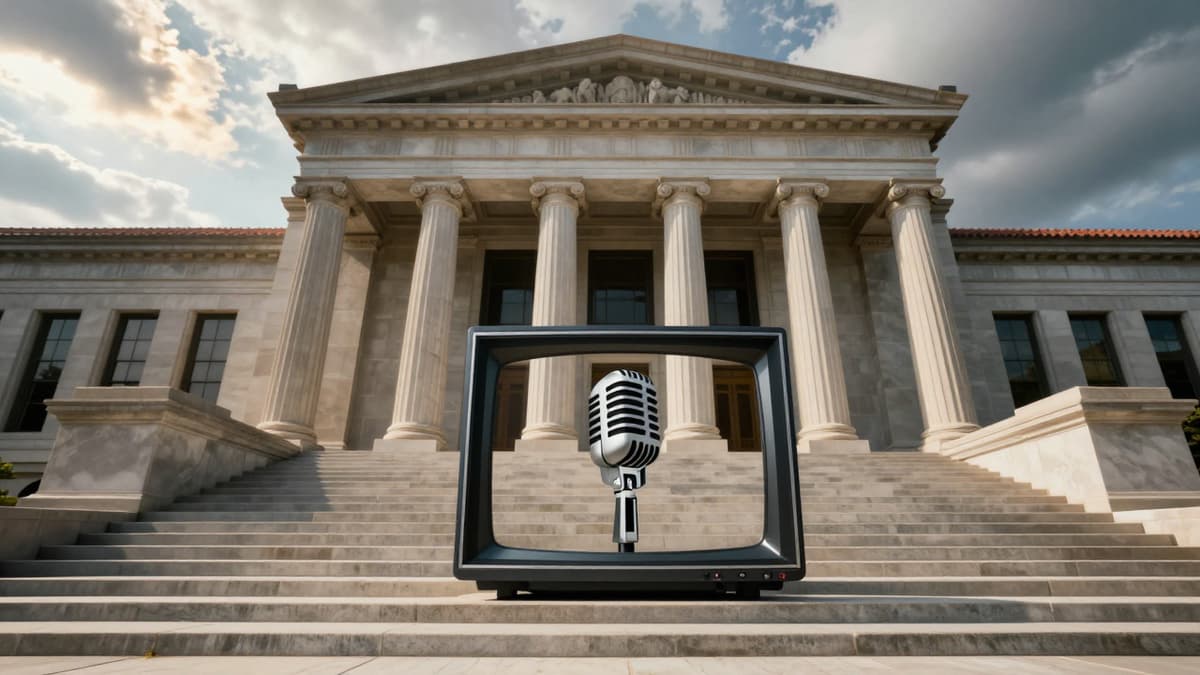
A federal judge has declared President Trump's executive order targeting public broadcasters unconstitutional, marking a significant victory for press freedom and First Amendment rights.
A federal judge on Tuesday ruled that a critical component of President Trump's executive order targeting NPR and PBS was unconstitutional, effectively blocking the administration from denying federal funds based on editorial viewpoints.
The decision by Judge Randolph Moss does not reverse the Trump-led campaign that previously stripped these stations of federal funding through Congressional action, yet it stands as a decisive affirmation of press freedom rights.
The ruling centers on an executive order titled "Ending Taxpayer Subsidization of Biased Media," which directed federal agencies to terminate any direct or indirect funding of NPR and PBS. Judge Moss, in his written opinion, stated that the order crosses the constitutional line by singling out two specific speakers and barring them from all federally funded programs solely on the basis of their speech. Quoting a 2024 Supreme Court ruling, Moss emphasized that the First Amendment draws a line at efforts to use government power, including the power of the purse, to punish or suppress disfavored expression.
"This is not just about two organizations; it is about the principle that the government cannot use funding as a lever to influence or penalize the press," said NPR CEO Katherine Maher in a statement following the news. Maher described the court's decision as a win for NPR, its network of stations, and its tens of millions of listeners nationwide, noting that the government cannot target a national news service or a local newsroom with financial retaliation.
The executive order, part of a multi-pronged effort to weaken public broadcasting, culminated in Congress rescinding federal support last summer. Although the order was ruled unlawful, the legislative action of cutting future funding that had already been allocated took effect last fall. This has resulted in tangible impacts across the country, with some stations forced to lay off staffers and cut back on programming. Despite Trump's remark in January that the networks were "sort of gone now," both major organizations have remained on the air, continuing their operations.
The legal battle highlights a specific instance of financial retaliation against public media. In May 2025, the Department of Education scrapped $23 million in funding for educational TV shows, a move also tied to Trump's executive order. Judge Moss has now deemed that specific action unlawful as well, noting that the First Amendment does not tolerate viewpoint discrimination of this type. This previous action by the Department of Education serves as a precedent for how the administration's orders have been applied across different federal agencies, targeting educational content specifically.
Both NPR and PBS filed lawsuits alleging violations of the First Amendment, arguing that the government cannot use the levers of power to punish speech based on ideological disagreements. On Tuesday afternoon, PBS issued a statement declaring the court's decision as a victory against "textbook unconstitutional viewpoint discrimination and retaliation." The network reaffirmed its commitment to its mission to educate and inspire all Americans as the nation's most trusted media institution.
The immediate legal outcome is a permanent injunction barring the Trump administration from implementing the executive order. However, the ruling explicitly states that it could, but does not guarantee, lead to some funding for PBS and NPR in the future. This is because public broadcasters have historically received grants from various federal agencies beyond the specific allocations that were rescinded by Congress. The judge's reasoning suggests that while Congress has the power to cut funding, the Executive Branch cannot use the power of the purse to target specific entities for their editorial content.
The ruling underscores the tension between legislative budgetary powers and constitutional protections against government censorship. While the administration's specific order was invalidated, the broader context of the funding cuts remains a complex challenge for the networks. The courts have made clear that while budget decisions are political, they cannot be used as a mechanism for suppressing specific voices. As the legal dust settles, the focus shifts to how these organizations will navigate the continued absence of the previously allocated federal funds while operating under the protection of this judicial ruling.
The immediate reaction from the broadcasting sector highlights the relief and resolve felt by the organizations involved. PBS and NPR have utilized the court's decision to reaffirm their independence and their commitment to serving the American public without fear of government interference. The judge's explicit mention that the order targets specific speakers based on their speech has been cited as a powerful defense of the principles of a free press. As the administration faces the injunction, the path forward for public media involves continuing operations despite the financial strains imposed by the earlier congressional actions. The ruling serves as a crucial check on executive power, ensuring that the First Amendment remains a robust barrier against financial retaliation for speech.
Jun 8, 2026 02:17 UTC
Magnitude 7.8 Quake Shakes Philippines, Urging Immediate Evacuations
Join 50,000+ readers getting the global briefing every morning.
No spam. Unsubscribe anytime.
Jun 8, 2026 02:17 UTC
Magnitude 7.8 Quake Shakes Philippines, Urging Immediate Evacuations
Jun 8, 2026 00:51 UTC
Trump Claims Iran Nuclear Deal Imminent Despite Diplomatic Fractures
Jun 8, 2026 00:47 UTC
Iran Fires Missiles at Israel After Beirut Strike
Jun 7, 2026 22:38 UTC
Congress Party Claims Unity for INDIA Bloc Delhi Meeting


