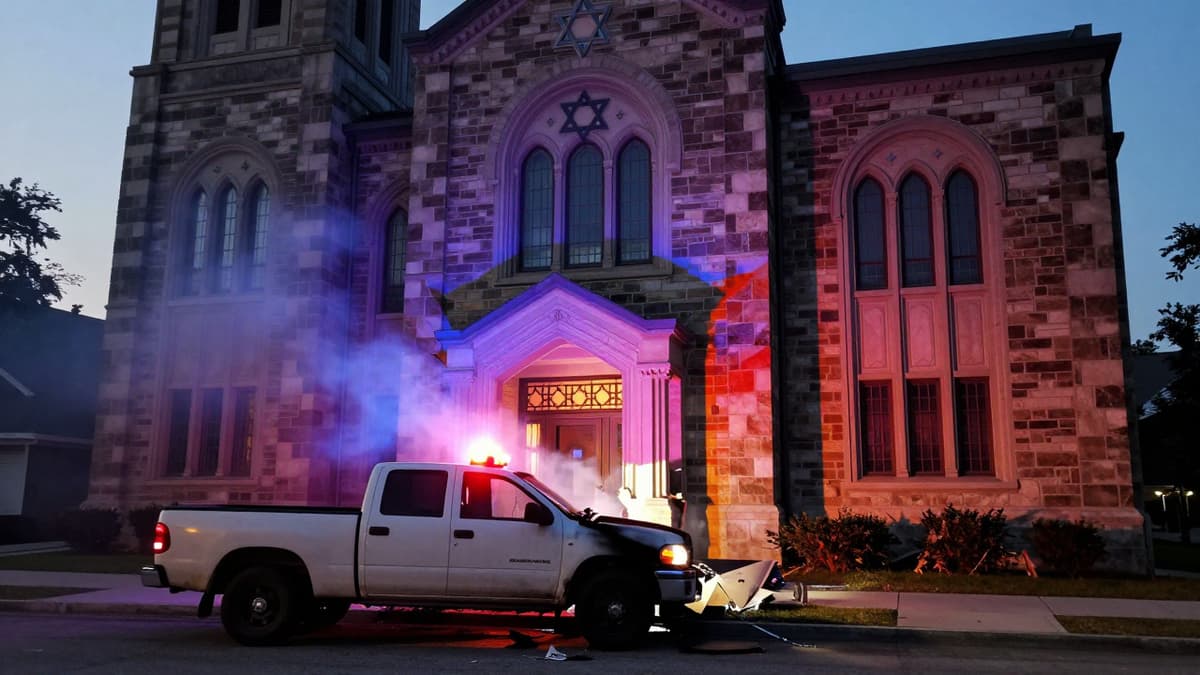
The FBI has classified the tragic Michigan synagogue assault as a Hezbollah-inspired terrorism plot, revealing Ayman Ghazali's deep ideological ties to the Iranian-backed group before the attack.
In a stark announcement on Monday, the FBI declared that the assault on a synagogue in West Bloomfield, Michigan, earlier this month was a calculated act of Hezbollah-inspired terrorism. The terror group is identified as the driving force behind the plot that specifically targeted the Jewish community and the largest Jewish temple in the state.
The tragedy unfolded on March 12, when the assailant, identified as Ayman Ghazali, a naturalized US citizen originally from Lebanon, executed a brutal plan. Ghazali waited in the synagogue's parking lot for more than two hours before ramming a pickup truck directly into the building. At the time of the impact, more than 100 children were attending school inside the facility, placing them in immediate danger.
As the vehicle crashed into the sanctuary, it struck a security officer before becoming wedged in a hallway. Security personnel immediately engaged Ghazali in a firefight. The confrontation ended tragically when Ghazali shot and killed himself inside the truck. The chaos sparked a fire in the vehicle's engine compartment, which released flammable liquid, believed to be gasoline, causing extensive damage to the historic building. Despite the severity of the explosion and fire, no other lives were lost during the incident, though the security officer hit by the vehicle sustained injuries.
Jennifer Runyan, the FBI's special agent in charge in Detroit, stated during the press conference that there is currently no evidence suggesting Ghazali had co-conspirators. However, the investigation has uncovered deep ideological roots for the lone attacker. Jerome Gorgon, the US attorney for the Eastern District of Michigan, noted that if Ghazali had survived the self-inflicted gunshot, he would have faced charges for providing material support to Hezbollah. Gorgon emphasized that Ghazali was inspired by Hezbollah propaganda to carry out the attack and acted under the group's direction and control, intending to kill others rather than just himself.
In the days following the assault, US officials confirmed that Ghazali was already flagged in federal government databases. He was listed as having connections to "known or suspected terrorists" associated with the Iranian-backed terrorist group Hezbollah in Lebanon. This pre-existing knowledge highlights the gravity of the intelligence failure or the speed at which such plots can be launched. The attack occurred against a backdrop of escalating regional tension; a week prior to the assault, members of Ghazali's family in Lebanon, including two of his brothers, were killed in an Israeli airstrike. This happened as the US and Israel entered their second week of conflict with Iran.
The Israeli military provided details on the family tragedy, identifying one of the deceased brothers, Ibrahim Muhammad Ghazali, as a Hezbollah commander responsible for managing weapons operations within the group's Badr unit. This familial connection underscores the direct link between the attacker and the militant organization's leadership.
Planning for the attack reportedly began days prior to the incident, intensifying significantly on March 9. A thorough review of Ghazali's online activity dating back to January reveals a pattern of behavior indicative of radicalization. He conducted repeated searches for pro-Hezbollah and Iranian news outlets, as well as videos related to gunfire and ammunition usage. His digital footprint shows a deliberate focus on acquiring the knowledge and skills necessary to execute a violent operation.
Beginning March 9, Ghazali closely followed speeches and live coverage involving Hezbollah's secretary general, Naim Qassem. He also tracked reporting regarding an Iranian fatwa, a religious ruling concerning Islamic law, which called for total jihad against the US military. This suggests his motivation was fueled by both direct calls from leadership and broader religious decrees issued by the Iranian state.
The FBI further revealed that Ghazali specifically researched Jewish cultural, educational, and religious centers throughout the Detroit metro area. He viewed multiple pages of upcoming events at Temple Israel and searched for specific terms and phrases such as "the largest gathering of Israelis in Michigan," "Orthodox synagogues," and "Israelis near me." This targeted research confirms the intent to strike the specific location identified as the largest Jewish temple in Michigan.
On the day of the attack, Ghazali communicated his intent to his sister, who authorities believe resides in Lebanon. He sent her numerous videos and messages affirming his Hezbollah-inspired terrorism ideology. Just ten minutes before he drove his truck into the synagogue, Ghazali sent his sister two videos in Arabic. In these recordings, he indicated that he was at the largest gathering of Israelis in the state of Michigan, had booby-trapped his car, and intended to forcibly enter and start shooting people.
In one of the recordings, Ghazali was heard saying, "God willing, I will kill as many of them as I possibly can." This explicit statement confirms his intent to cause maximum casualties, a plan that was only thwarted by his death during the subsequent exchange of gunfire.
The West Bloomfield synagogue attack has sent shockwaves through the community and law enforcement agencies. As the investigation concludes its initial phase, the focus now shifts to the implications of the attack. The FBI's confirmation of a lone actor inspired by foreign leadership but lacking a domestic cell of co-conspirators is a critical finding. This suggests that the immediate threat of a coordinated network within the US for this specific operation has been neutralized.
However, the ideological motivation and the online radicalization trail present a longer-term challenge. The detailed tracking of Ghazali's search history and the rapid execution of the plan indicate that individuals can be radicalized by digital propaganda and act independently without a formal support network on the ground. As the US continues to navigate its conflict with Iran and the involvement of proxy groups like Hezbollah, the risk of similar inspired acts remains a concern. The tragedy serves as a stark reminder of the evolving nature of terrorism, where remote ideological control can lead to immediate, localized violence. The community will likely face a prolonged period of heightened security and vigilance, while federal agencies may reassess monitoring protocols for individuals with flagged terrorist connections who are not yet part of a known active cell.
Jun 8, 2026 00:51 UTC
Trump Claims Iran Nuclear Deal Imminent Despite Diplomatic Fractures
Jun 8, 2026 00:47 UTC
Iran Fires Missiles at Israel After Beirut Strike
Jun 7, 2026 22:00 UTC
US, Iran Peace Hops Fade 100 Days Into War
Jun 7, 2026 20:57 UTC
Iran Strikes Israel: IRGC Promises Week of Continuous Offensive
Jun 8, 2026 02:28 UTC
Trump Walks Out of Meet the Press After Rejecting Evidence Demands


