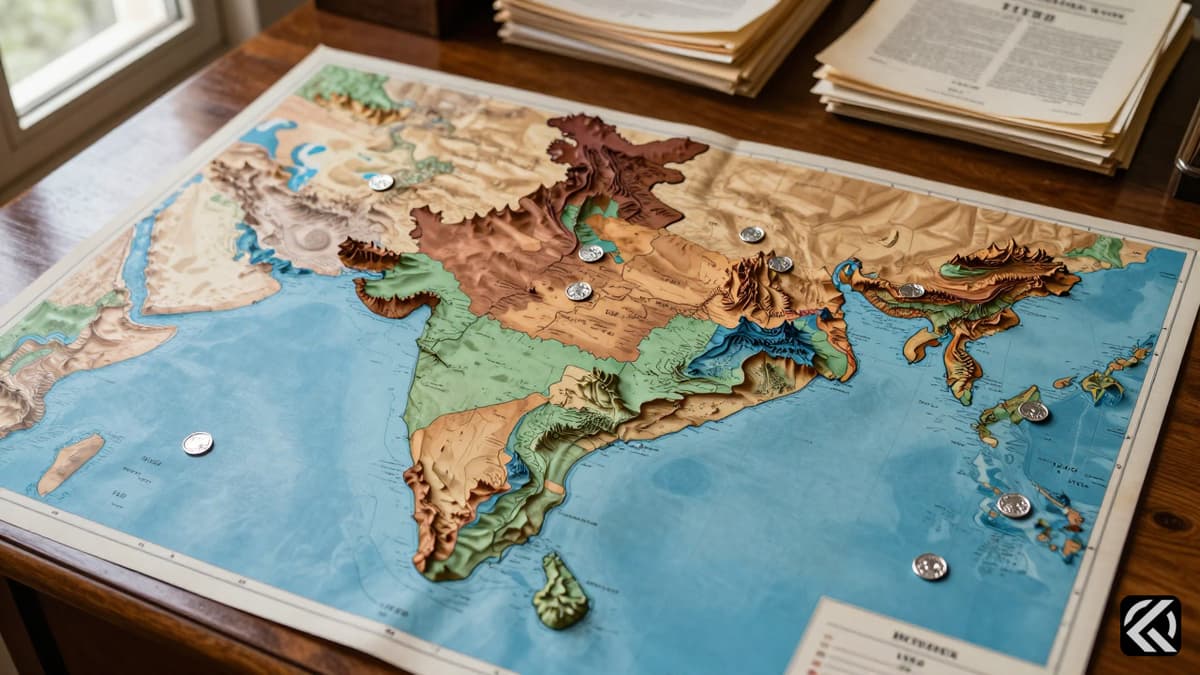
Historical data from 1951 to 1977 reveals that the Hindi belt's Lok Sabha share declined more sharply than the South, challenging assumptions about North-South balance during the 2026 Delimitation debate.
Amidst the ongoing political discourse surrounding the Delimitation Bill of 2026, a critical historical analysis reveals a nuanced reality regarding parliamentary seat distribution. The data indicates that between 1951 and 1977, the Hindi belt experienced a significantly steeper decline in its Lok Sabha share compared to the southern states. This period, characterized by periodic Lok Sabha seat reallocation following census exercises, challenges the simplistic narrative that any future expansion would see northern states simply gain at the expense of the South.
The figures from the mid-20th century present a complex picture where both the Hindi belt and the southern states saw their representation shrink, though at different rates. Specifically, the Hindi belt's share of total seats fell by 3.1 percentage points, whereas the South's share declined by only 1.2 points. This disparity was not the result of a zero-sum game where the South gained seats lost by the North. Instead, the shift was driven by the growing representation of Union Territories and the rising share of western and eastern states, fundamentally altering the federal map of India.
Historical context is crucial for understanding these statistics. The 1951 election was conducted before the linguistic reorganisation of states, meaning the administrative boundaries were vastly different from today. By 1956, following the reorganisation, states were broadly in their present form, yet the representation landscape had still not stabilized. Several Union Territories existed with little or no Lok Sabha representation at the time, which changed as the years progressed. For instance, in 1977, the last election analyzed in this context, Daman & Diu did not even exist as a separate Union Territory, highlighting how the political geography was still in flux.

Furthermore, the data requires careful interpretation regarding the nature of the constituencies themselves. The figures for 1951 and 1957 refer to seats rather than constituencies in the modern sense, as some constituencies at that time elected two members. Consequently, the comparison tracks the share of total seats rather than the voter population per Member of Parliament or the size of individual constituencies. This distinction is vital for accurately assessing the North-South representation dynamics without conflating seat counts with demographic voting power.
The evolution of this political landscape suggests that changes in parliamentary representation were shaped by a confluence of factors including state reorganization, the evolving status and representation of Union Territories, and the changing federal map of India. The comparison must be read with caution because the India of 1951 was a different geopolitical entity than the India of 1977 or 2026. The growing influence of western and eastern states, alongside the integration and expansion of Union Territories, created a dynamic where the North-South balance was just one variable among many in the equation of national representation.
The implication of these historical trends is significant for the current debate. The recurring assumption that northern states could gain seats at the direct expense of the southern states ignores the broader structural shifts that have occurred over the last century. The decline in the Hindi belt's share was not a redistribution to the South but a dilution caused by the inclusion of new entities and the reorganization of the eastern and western regions.
While the 1977 election marked the end of the era where seats were periodically reallocated after census exercises, the historical data from 1951 to 1977 serves as a critical baseline for the 2026 Delimitation Bill discussions. The analysis demonstrates that the decline in the Hindi belt's share was not offset by a corresponding gain in the South, but rather by the rising representation of Union Territories and the western and eastern states. This suggests that future reallocations will likely continue to be influenced by the evolving status of Union Territories and the demographic shifts in eastern and western India, rather than a simple transfer of power between the North and South. The historical record warns against viewing parliamentary seat changes through a binary North-South lens, emphasizing instead the complex, multi-faceted nature of India's federal geography.
Jun 8, 2026 02:17 UTC
Magnitude 7.8 Quake Shakes Philippines, Urging Immediate Evacuations
Join 50,000+ readers getting the global briefing every morning.
No spam. Unsubscribe anytime.
Jun 8, 2026 02:17 UTC
Magnitude 7.8 Quake Shakes Philippines, Urging Immediate Evacuations
Jun 8, 2026 00:51 UTC
Trump Claims Iran Nuclear Deal Imminent Despite Diplomatic Fractures
Jun 8, 2026 00:47 UTC
Iran Fires Missiles at Israel After Beirut Strike
Jun 7, 2026 22:38 UTC
Congress Party Claims Unity for INDIA Bloc Delhi Meeting