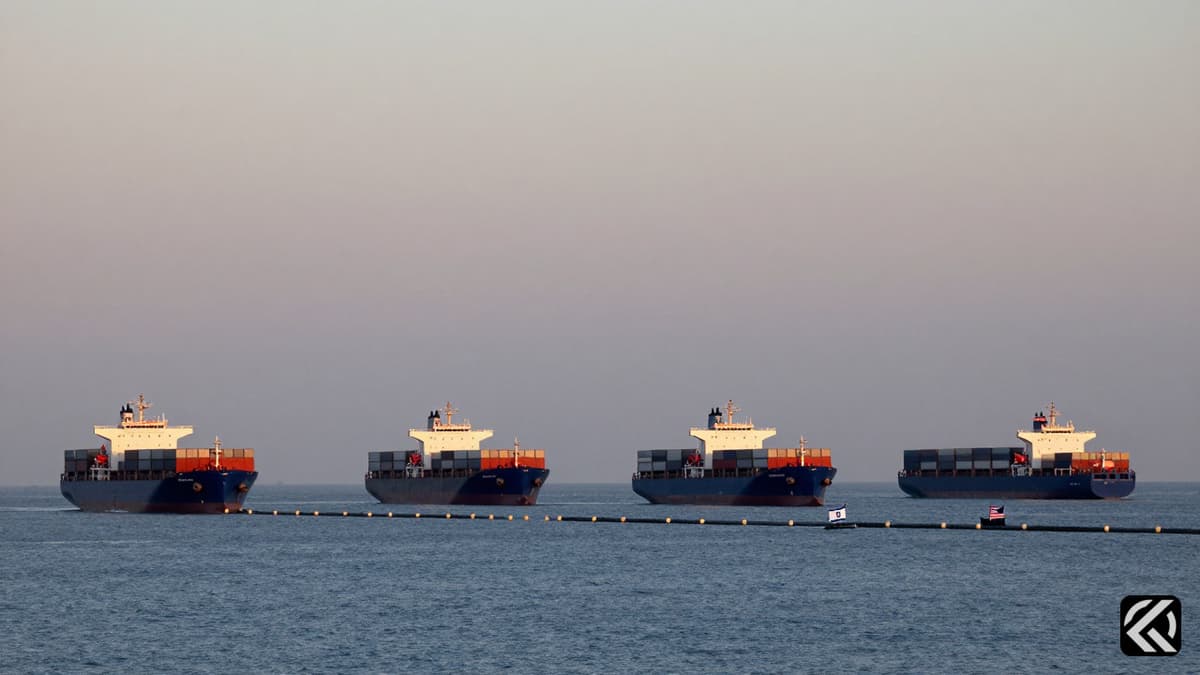
Amid a fragile truce, four vessels crossed the US blockade line from Iranian ports, while rocket alerts in Israel highlight the tension surrounding the new Israel Lebanon ceasefire agreement.
The Israel Lebanon ceasefire has officially come into effect, though the security situation remains volatile with rocket warnings blaring in northern Israel even as the truce begins. Four Iran-linked ships have crossed the US blockade line after sailing from Iranian ports, according to tracking data that reveals the vessels' movements. While the US maintains its blockade, these crossings have triggered a ripple effect across global oil markets and raised questions about the durability of the fragile peace agreement.
Early reports indicate that the ceasefire did not immediately silence the region. As news of the truce spread through Israel's northern communities, sirens blared three times in the evening, warning of incoming rockets from Lebanon. In the sky above the northern city of Nahariya, air defence interceptors launched to block the incoming fire, triggering loud explosions. Ambulance crews reported that at least three people were wounded by shrapnel in the hours before the ceasefire took effect, including two individuals with serious injuries.
On the ground, the atmosphere is defined by a mix of relief and deep scepticism. Gal, a student in Nahariya, expressed a sentiment shared by many locals, stating, "I feel like the government lied to us." He noted that while promises were made that this time would end differently, the current path toward a ceasefire agreement seems to solve nothing. This public sentiment underscores the difficulty of establishing a stable Hezbollah truce, as the group's actions remain a central point of contention in the negotiations.
The situation is further complicated by maritime developments. According to MarineTraffic data, four container ships crossed the blockade line after sailing from Iranian ports. Three of these vessels are flagged to Iran, while the fourth, the Tava 4, is registered in Comoros. The Azargoun left the port of Shahid Rajee and crossed the line around 16:00, apparently heading to Kandla in north-western India. Similarly, the Ashkan3 departed Chabahar just after 12:00 and is currently reported in Karachi, Pakistan. The Shabdis also left Chabahar, crossing at 21:00 with a destination of Zhuhai, China, while the Tava 4 sailed from Bandar Imam Khomeini and crossed the line at 13:00 en route to the Jawaharlal Nehru Port near Mumbai.
However, the reliability of this data is uncertain. US Central Command confirmed that the US "[continued] to hold the blockade," yet did not comment specifically on the timing of these crossings. Experts warn that some vessels may be turning off their trackers or transmitting false positions, a practice known as "spoofing," which complicates the assessment of the Iran ships blockade effectiveness.
Financial markets reacted swiftly to the announcement. Oil prices retreated slightly on Friday morning in Asia, with the global benchmark Brent crude falling by nearly 1% to $98.50 per barrel and US-traded oil dropping by 1.2% to $93.60. Major Asian markets also edged lower, with Japan's Nikkei 225 dipping by 0.8% and South Korea's Kospi falling by 0.3%. The conflict had previously strained a two-week conditional ceasefire between the US and Iran, with Tehran citing Israel's attacks on Lebanon as a breach of that agreement.
Political rhetoric from Washington adds another layer of complexity. President Donald Trump, addressing the war in Iran during a tax day roundtable in Nevada, stated, "I will say the war in Iran is going along swimmingly" and predicted it "should be ending pretty soon." While he commended the US military for shooting down rockets, he did not elaborate on the specifics. Talks in Islamabad between the US, Iran, and mediators failed to secure a deal over the weekend, though the White House indicates that discussions for a second round of peace talks are "ongoing," despite no confirmed time or place.
Regional leaders have also weighed in on the scope of the agreement. An Iranian parliament speaker, Mohammad Baqer Qalibaf, stated that Lebanon forms an "integral part" of a comprehensive ceasefire with the US. In a statement on Telegram following a meeting with a Pakistani military officer, he noted that establishing a comprehensive ceasefire in all conflict areas is a clause of the initial US-Iran agreement mediated by Pakistan. He emphasized that Lebanon will play an important role in moving forward for lasting peace in the region.
President Trump has also directly addressed the militant group involved in the conflict. Writing on Truth Social, he urged Hezbollah to abide by the ceasefire, stating, "I hope Hezbollah acts nicely and well during this important period of time." He added that a peaceful period would be a "GREAT moment for them" and called for an end to killing. The ceasefire is technically between Israel and Lebanon, but an Israeli official told CBS News that Israel reserves the right to respond militarily to "imminent threats from Hezbollah." Prime Minister Benjamin Netanyahu has previously stated that a more lasting peace deal will require the disarming of the Iran-backed group.
Security analysts caution that the situation is delicate. Frank Gardner, a security correspondent, described the Israel Lebanon ceasefire as very fragile, noting that the conflict is fundamentally between Israel and Hezbollah rather than the nation of Lebanon itself. He highlighted that Hezbollah is completely embedded in Lebanon, both politically and militarily, which makes the situation complex. While the group has signalled it is likely to abide by the ceasefire, they have added that a deal must include a "comprehensive halt" to all attacks in Lebanon.
Gardner noted that the Israelis will take very little provocation before breaking the ceasefire, making this arrangement even more fragile than the one between Iran and the US. He argued that for there to be peace in the Middle East, there must be peace in the Gulf, in Iran, and in Lebanon simultaneously. The conflict with Hezbollah has deep roots extending back to events in the West Bank and Gaza, meaning the current truce is likely just "breathing space" rather than a definitive resolution.
The breach of the US blockade by four Iran-linked ships, combined with the continued firing of rockets in northern Israel, suggests that the current peace agreement is under significant stress. While oil markets have dipped and leaders like President Trump express optimism, the lack of an immediate reaction from Hezbollah and the continued reports of potential spoofing indicate that the situation remains volatile. Unless a comprehensive halt to attacks in Lebanon is achieved and the deep-rooted conflicts in the region are addressed, the current ceasefire is likely to remain a temporary reprieve rather than a lasting solution, leaving the region vulnerable to renewed hostilities in the near future.
Jun 8, 2026 00:51 UTC
Trump Claims Iran Nuclear Deal Imminent Despite Diplomatic Fractures
Jun 8, 2026 00:47 UTC
Iran Fires Missiles at Israel After Beirut Strike
Jun 7, 2026 22:00 UTC
US, Iran Peace Hops Fade 100 Days Into War
Jun 7, 2026 20:57 UTC
Iran Strikes Israel: IRGC Promises Week of Continuous Offensive
Jun 8, 2026 02:28 UTC
Trump Walks Out of Meet the Press After Rejecting Evidence Demands


