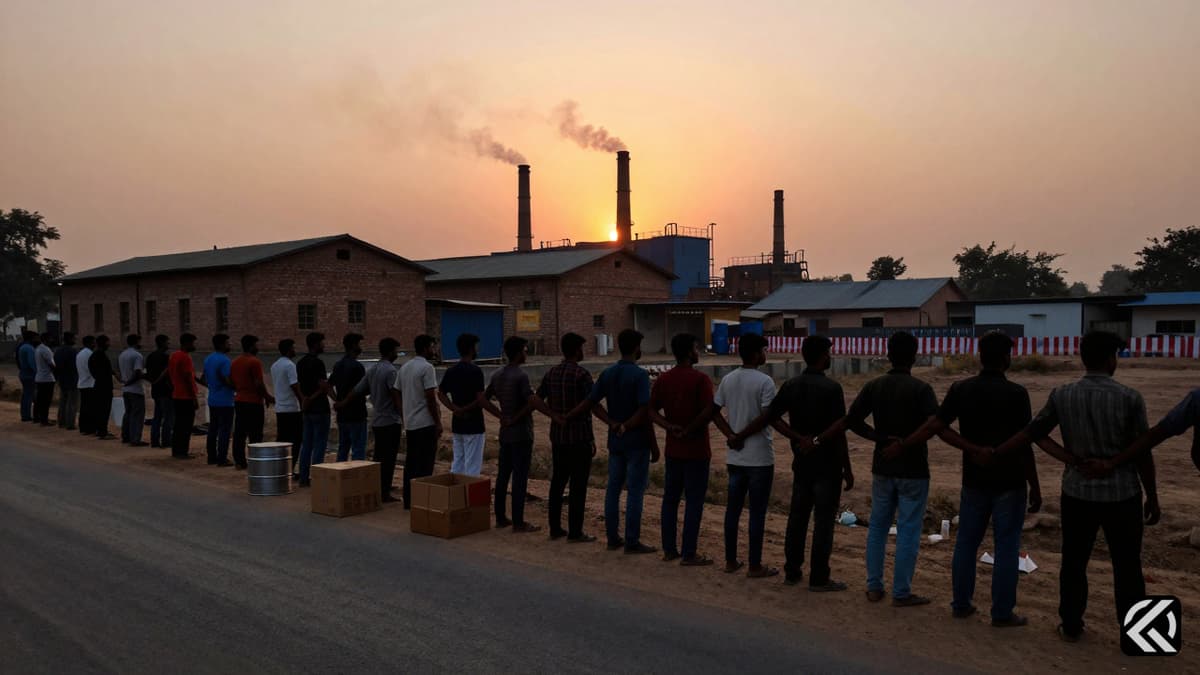
Escalating unrest in Noida sees hundreds arrested as migrant workers demand wage hikes to survive soaring living costs and stagnant pay.
Protesters gathered in Noida, India, demanding higher minimum wages, marking a significant escalation in labor unrest across the northern region. The movement, which began as small, peaceful gatherings about a week ago, has turned violent in some areas, prompting police intervention with tear gas and mass arrests.
The unrest primarily involves non-unionized contract workers in small factories producing auto parts, electronics, and garments, many of whom earn between 10,000 and 15,000 rupees monthly. These workers, often migrant families living in cramped housing on the city's outskirts, have faced stagnant wages for years while struggling with rising living expenses. As the demonstrations intensified, the government of Uttar Pradesh, where Noida is located, responded by announcing a temporary wage increase in two districts and pledging further action.
In the midst of the unrest, factory worker Soni Singh highlighted the disparity between effort and compensation. Singh noted that he works 12 to 14 hours daily but receives overtime pay for only three hours beyond the standard eight-hour shift, resulting in a monthly income of roughly 13,000 rupees. His experience reflects a broader issue where minimum wages are set by individual states and vary widely, often leading to compliance gaps.
"Minimum wages have always existed, but not all employers comply with them. In most cases, workers have little choice but to accept this because jobs are scarce," Singh added. This lack of compliance is critical in a sector where roughly nine out of ten Indian workers earn less than 25,000 rupees a month. This figure aligns with minimum wages for skilled workers in Delhi, the highest in the country, underscoring the poverty level in the vast informal sector which employs over 310 million people with little job security.
The economic pressure on these households is exacerbated by a severe cost of living crisis. With wages failing to keep pace with inflation, even a single day without work can result in a sharp cut in income. One anonymous female worker detailed the financial strain, stating, "I pay 5,000 rupees in rent and spend another 4,000 on groceries and necessities." This sentiment is shared by many, where basic expenses consume the majority of their income, leaving no room for savings or emergencies.
Recent increases in cooking gas prices, linked to global supply disruptions caused by the conflict in the Middle East, have further intensified the strain on household budgets. Rakhi Sehgal, an independent labor researcher and former consultant with the International Labour Organisation, identified the cost of living crisis as the common thread driving these recent protests. She noted that the demonstrations reflect a widening gap between stagnant wages and the rising cost of basic necessities.
What distinguishes these current India factory workers protests is the notable absence of major trade union leadership. A union leader, who requested anonymity due to fears of police action, observed that this lack of organized leadership is unusual for labor movements in India. This suggests a grassroots, desperate mobilization by workers who feel traditional structures are insufficient or unable to protect them.
The frustration also stems from India's recent labor code reforms. Introduced last year, these codes consolidated dozens of laws into four frameworks to strengthen worker protections and simplify compliance. However, implementation challenges remain. Vaibhav Gupta, a factory owner in Delhi employing 50 workers, expressed empathy for the rising living costs but warned of the difficulties businesses face. "When labor comes together to demand a raise, we have to listen," Gupta said, noting that sudden increases in labor costs often force businesses to cut into thin margins or absorb losses on existing orders.
Nikhil Dey, a labor rights activist, pointed out the dire consequences for smaller enterprises. "In a situation where they [small factories] can't make any other cost adjustments, they tend to squeeze the workers' time and wages, leading to worker exploitation," Dey told the BBC. This cycle of exploitation fuels the anger that has led to the current violence.
While the Uttar Pradesh government has announced temporary wage increases, the long-term viability of these measures remains a point of contention. Arvind Goel, co-chair of the industrial relations committee at the Confederation of Indian Industry, suggested that the government should consider bearing some social security costs for micro and small enterprises. This would help businesses comply with labor laws and potentially reduce future disputes. However, for the workers on the ground, the immediate future remains uncertain. As one factory worker poignantly stated, "We're working more every year, but not getting ahead. If this is the future, how will we ever live a decent life - or save anything for our children?" The tension between the need for fair wages and the economic realities of small business owners will likely define the trajectory of labor relations in the region.
Jun 8, 2026 00:51 UTC
Trump Claims Iran Nuclear Deal Imminent Despite Diplomatic Fractures
Jun 8, 2026 00:47 UTC
Iran Fires Missiles at Israel After Beirut Strike
Jun 7, 2026 22:00 UTC
US, Iran Peace Hops Fade 100 Days Into War
Jun 7, 2026 20:57 UTC
Iran Strikes Israel: IRGC Promises Week of Continuous Offensive
Jun 8, 2026 02:28 UTC
Trump Walks Out of Meet the Press After Rejecting Evidence Demands


