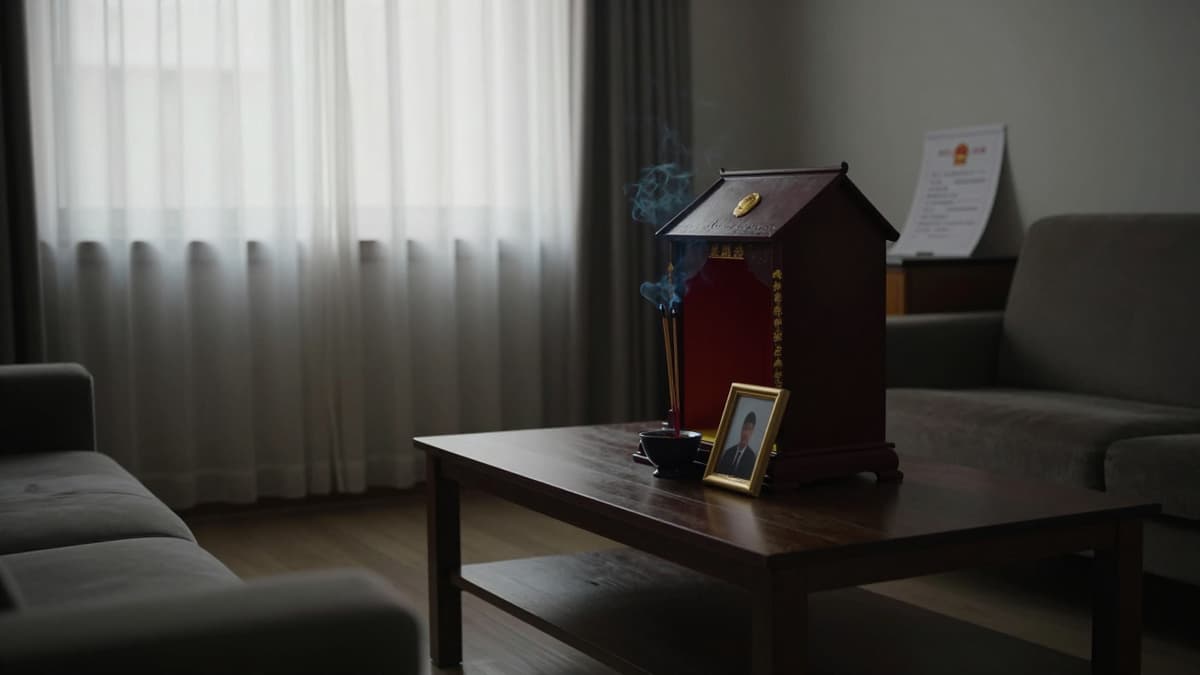
China enacts a historic ban on storing cremated remains in empty apartments, targeting the trend of "bone ash apartments" driven by skyrocketing funeral costs and scarce cemetery space.
The Chinese government has officially set a ban on storing the cremated remains of loved ones in empty apartments, a move designed to halt the rising trend of repurposing residential units for burial purposes. This new legislation, announced on March 31, 2026, directly targets the phenomenon known as "bone ash apartments," where family members convert vacant properties into makeshift ancestral shrines. The decision comes as families increasingly resort to these spaces due to the prohibitive costs of traditional burial options and a severe shortage of available cemetery plots.
The driver behind this shift is a stark economic reality where funeral costs have become a significant financial burden for many households. In 2020, a survey by British insurance firm SunLife indicated that funerals cost nearly half of the country's average annual salary, a figure that has only compounded as property values and funeral prices fluctuate. Furthermore, the price of funerals themselves remains high, prompting families to seek more affordable alternatives. While property prices in the country have fallen, dropping 40% from 2021 to 2025, making them cheaper than traditional graves, the government is now cracking down on the practice.
Cemetery spaces remain limited and operate under a strict lease system, requiring renewal every 20 years. The cost of securing a plot in Beijing's Changping Tianshou Cemetery ranges from 10,000 yuan (£1,095) to 200,000 yuan (£21,917). Eco-friendly burial plots offer a cheaper entry point, but standard tombstone plots start at approximately 150,000 yuan (£16,400) and can rise to 300,000 yuan (£32,841), a rate the cemetery's website explicitly notes as "relatively high" for Beijing. Consequently, the trend of expensive cemetery plots has pushed countless families toward the unconventional solution of empty apartments.
The new law explicitly prohibits the use of residential properties "specifically for the placement of ashes" and bans the burial of remains outside of designated cemeteries or areas where ecological burial is legal. Under the previous practices, mourners would utilize low property prices to entomb the ashes of relatives in empty units, turning the space into a ritual hall. These "bone ash apartments" became a popular alternative as the demand for traditional plots outstripped supply. Now, the State Administration for Market Regulation and the Ministry of Civil Affairs have laid out new requirements to regulate the funeral industry following growing public concerns over affordability and accessibility.
Social media reactions have highlighted the confusion and questions surrounding the enforcement of this new mandate. Commentators on Weibo, China's equivalent of X, have questioned the practicality of the ban. One user asked, "Who would resort to this if cemetery plots were affordable?" while another probed the regulatory gap: "How will those enforcing these rules know if the apartments are being used just to store ashes? And how will they deal with those cases?" These concerns underscore the difficulty of regulating a practice that has become a necessity for many due to economic pressure rather than mere preference.
The legislation is set to take effect days before the Qingming Festival, also known as Tomb Sweeping Day, a time when Chinese people traditionally tidy the graves of loved ones and make ritual offerings. The timing of the announcement suggests an attempt to standardize practices before the upcoming holiday, ensuring that the transition is clear to the public and industry operators alike. The ban aims to close the loophole that allowed families to bypass the high costs of formal burial grounds, forcing a shift back to regulated cemeteries or approved ecological burial zones.
As the government moves to enforce this ban, the tension between the cultural need for proper burial rites and the economic reality of rising costs remains a central point of contention. The new rules do not just address the physical storage of ashes but challenge the broader infrastructure of the Chinese funeral industry. With the Qingming Festival approaching, the immediate impact will likely be a wave of compliance checks and public discourse on how to balance tradition with affordability in a changing economic landscape.
The China ban bone ash apartments signals a significant shift in how the nation approaches death and remembrance. Based on the source material, future impacts will likely include increased pressure on cemetery operators to expand capacity and potentially lower prices to compete with the now-banned apartment option. If the high cost of traditional plots remains a barrier, the enforcement of this ban may lead to further social unrest or the development of new, state-sanctioned low-cost alternatives. The success of this regulation will depend entirely on the ability of authorities to verify compliance and the government's capacity to make expensive cemetery plots more accessible to the average citizen.
Jun 8, 2026 00:51 UTC
Trump Claims Iran Nuclear Deal Imminent Despite Diplomatic Fractures
Jun 8, 2026 00:47 UTC
Iran Fires Missiles at Israel After Beirut Strike
Jun 7, 2026 22:00 UTC
US, Iran Peace Hops Fade 100 Days Into War
Jun 7, 2026 20:57 UTC
Iran Strikes Israel: IRGC Promises Week of Continuous Offensive
Jun 8, 2026 02:28 UTC
Trump Walks Out of Meet the Press After Rejecting Evidence Demands