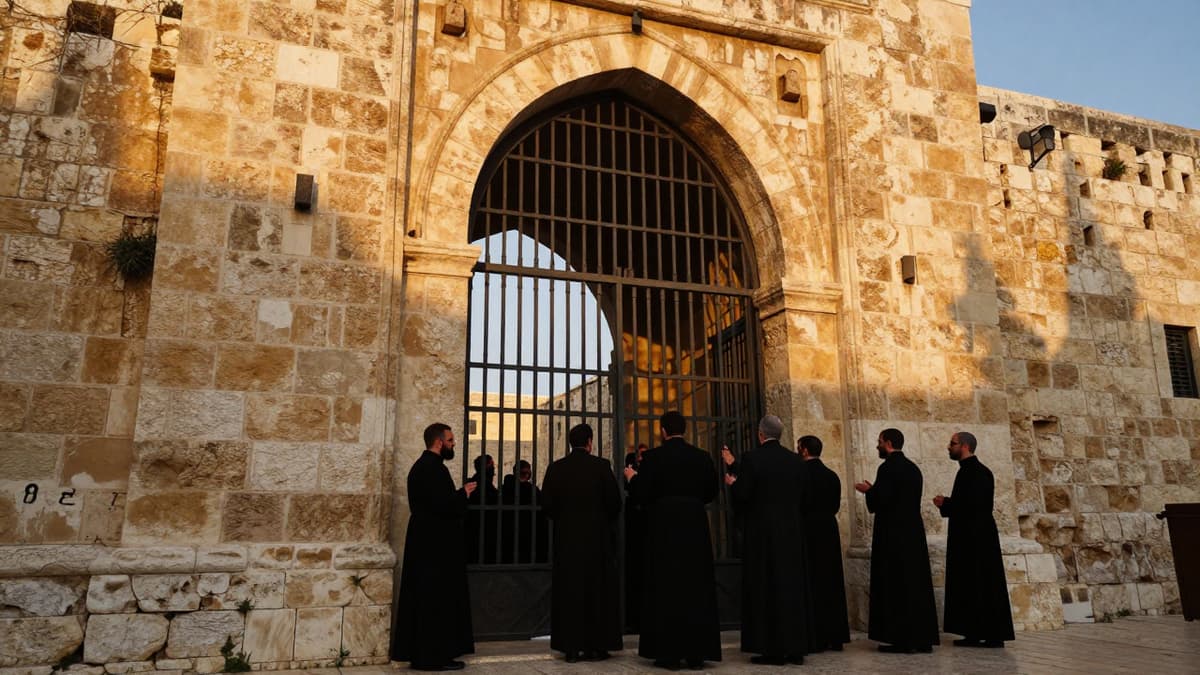
For the first time in centuries, Israeli police blocked senior church leaders from entering Jerusalem's most sacred site during Palm Sunday mass, sparking international condemnation.
For the first time in centuries, Catholic leaders have been barred from entering Jerusalem's Church of the Holy Sepulchre on Palm Sunday. According to church authorities, Israeli police physically prevented the church's senior leaders from entering the site to celebrate the traditional mass. This unprecedented action marks a significant departure from historical norms regarding access to the holy city's most sacred Christian sites.
The Latin Patriarchate in Jerusalem issued a stern statement on Sunday declaring that the Heads of the Church were prevented from celebrating the Palm Sunday Mass at the Church of the Holy Sepulchre for the first time in centuries. The church authorities characterized the incident as a "grave precedent" that disregards the sensibilities of billions of people worldwide who look to Jerusalem during this specific week of their calendar.
The restriction was implemented by Israeli security forces who stated that all holy sites in the Old City were closed to worshippers to safeguard public safety. Police officials explained that the Old City and its holy sites constitute a complex area that does not allow access for large emergency and rescue vehicles, necessitating the closure of locations without standard protected spaces.
While the Church of the Holy Sepulchre is the focal point of the conflict, similar Jerusalem religious restrictions have been noted at other sites. The number of Jews allowed to pray at the Western Wall has been limited to 50 a day, and Muslims have been completely barred from accessing Al Aqsa Mosque since the war started in late February, encompassing the entire holy month of Ramadan.
The two senior Church officials, including Cardinal Pierbattista Pizzaballa, were stopped en route while proceeding privately and without any characteristics of a procession or ceremonial act. The Patriarchate stated that the officials "were compelled to turn back" and condemned the action as a "manifestly unreasonable and grossly disproportionate measure" driven by what they described as a "hasty and fundamentally flawed decision."
In response to the closure, the Patriarchate had already cancelled the traditional Palm Sunday procession in Jerusalem due to the ongoing conflict. The situation has escalated quickly, with the Italian government criticizing the police decision to bar access to the church and announcing plans to summon the Israeli ambassador in Rome. Italian Prime Minister Giorgia Meloni described the ban as an insult not only to believers but to every community that recognizes religious freedom.
The office of Israeli Prime Minister Benjamin Netanyahu responded to the controversy by stating there was "no malicious intent whatsoever" in the ban. Officials claimed the restriction was solely based on concern for the safety of the celebrants. However, Netanyahu's office also added that given the holiness of the week leading up to Easter, Israel's security arms are putting together a plan to enable church leaders to worship at the holy site in the coming days.
Italian Foreign Minister Antonio Tajani explicitly stated on social media that the ban was unacceptable and had instructed the Italian ambassador in Israel to protest the decision. He further confirmed the intention to summon the Israeli ambassador in Rome on Monday. During mass at the Vatican on Sunday, Pope Leo offered prayers for the Christians of the Middle East, noting they are suffering the consequences of a brutal conflict and are in many cases unable to observe fully the liturgies of these holy days.
The diplomatic fallout extends beyond the Catholic Church. Earlier this month, a coalition of eight Muslim states-Saudi Arabia, Jordan, the United Arab Emirates, Qatar, Indonesia, Pakistan, Egypt, and Turkey-condemned Israel's continued closure of the Al-Aqsa Mosque compound. These states argued that the discriminatory and arbitrary limits on access to places of worship amounted to a "flagrant violation" of international law.
Historically, Israel captured East Jerusalem from Jordan in the 1967 war and has fought multiple conflicts since, but sweeping restrictions on access to holy sites during major religious periods have been rare. This Palm Sunday ban represents a stark shift in the security posture of the region, complicating the observance of the most sacred period in the Christian calendar. As the region remains tense with Iran firing thousands of projectiles toward Israel, security concerns cited by Israeli authorities continue to clash with religious traditions.
The current standoff highlights the fragile balance between security imperatives and religious liberty in East Jerusalem. With the Latin Patriarchate labeling the event a "manifestly unreasonable" measure and international governments preparing formal protests, the precedent set by this Palm Sunday ban may alter future interactions between Israeli security forces and religious delegations. If the plan to enable worship in the coming days is not fully realized or is accompanied by further restrictions, the erosion of confidence in access guarantees for the Church of the Holy Sepulchre could deepen diplomatic fractures. As the week leading to Easter progresses, the global community will likely scrutinize whether Israel's security plans will effectively restore access or if the closures will become a permanent feature of the conflict landscape, potentially setting a long-term trend of restricted religious movement in the Holy City.
Jun 8, 2026 02:17 UTC
Magnitude 7.8 Quake Shakes Philippines, Urging Immediate Evacuations
Jun 8, 2026 00:51 UTC
Trump Claims Iran Nuclear Deal Imminent Despite Diplomatic Fractures
Jun 8, 2026 00:47 UTC
Iran Fires Missiles at Israel After Beirut Strike
Jun 7, 2026 22:00 UTC
US, Iran Peace Hops Fade 100 Days Into War
Jun 8, 2026 04:15 UTC
Trump Urges Netanyahu to Halt Iran Strike for Peace


