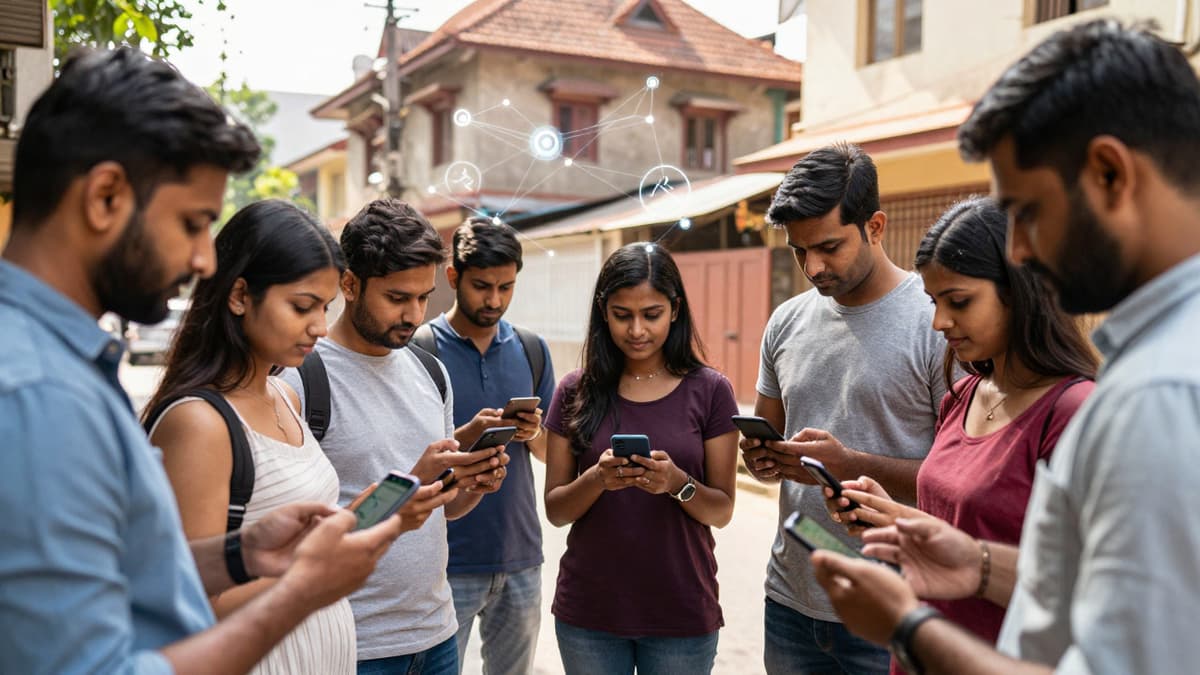
India begins its massive 2027 census with a new digital self-enumeration option starting April 1. Citizens can now conveniently submit household data online before official visits.
The Census 2027 officially kicks off today, April 1, 2026, initiating a comprehensive digital exercise covering the entire nation. For the first time, a specific facility for self-enumeration allows citizens to submit their household information online before official field visits. This initiative aims to streamline the data collection process while providing flexibility for respondents to participate at their convenience.
This digital transformation marks a significant departure from previous methods. The census is now completely digital, with enumerators recording data via mobile applications during house visits. To facilitate this, the Office of the Registrar General has introduced a web-based portal designed to ease the burden on participants. Citizens can now fill out the census schedule in any of the 16 available languages, ensuring broader accessibility across the country.
The participation process is designed to be user-friendly and straightforward. Residents seeking to utilize the self-enumeration feature must first access the dedicated portal. The initial step requires a login using a valid mobile number. Once logged in, individuals must use the provided map tool to identify their exact location to ensure accurate data mapping.
Following location identification, the respondent is tasked with filling in the necessary details. This involves completing the household information and the full census schedule online. The final submission step requires the user to submit the completed information directly through the system. Upon successful submission, the system automatically generates a unique identifier for that specific household.
This unique identifier is crucial for the subsequent fieldwork. Once the citizen receives their Self-Enumeration ID, they must retain it. When a census enumerator visits the home during the door-to-door phase, the resident must provide this ID. The enumerator will then use this ID to confirm the data and ensure the information is officially included in the final Census records.
The timeline for this digital entry period varies across the nation. The Office of the Registrar General has announced that dates for self-enumeration differ for each State and Union Territory. The process begins earliest in regions like Andaman and Nicobar Islands, Goa, Karnataka, Lakshadweep, Mizoram, Odisha, Sikkim, and Delhi (NDMC and Cantt. Board), running from April 1 to April 15, 2026.
Other regions follow a staggered schedule. Gujarat, Dadra and Nagar Haveli, Daman and Diu, have a window from April 5 to April 19, 2026. Uttarakhand follows shortly after with dates from April 10 to April 24, 2026. The period of mid-April sees participation for Andhra Pradesh, Arunachal Pradesh, Chandigarh, Chhattisgarh, Haryana, and Madhya Pradesh between April 16 and April 20, 2026. Bihar has a slightly longer window, running from April 17 to May 1, 2026.
As May approaches, the schedule expands to include Telangana from April 26 to May 10, Punjab from April 30 to May 14, and Delhi (MCD), Maharashtra, Meghalaya, Rajasthan, and Jharkhand from May 1 to May 15, 2026. Uttar Pradesh has a window from May 7 to May 21, 2026. Later in the year, Jammu and Kashmir, Ladakh, and Puducherry will have dates from May 17 to May 31, 2026.
The timeline extends further for Himachal Pradesh from June 1 to June 15, 2026, and Kerala and Nagaland from June 16 to June 30, 2026. The final set of states, including Tamil Nadu and Tripura, will have a window from July 17 to July 31, 2026. Assam and Manipur will participate in August, with dates from August 2 to 16 and August 17 to 31, respectively. For West Bengal, the dates remain to be decided.
A census is defined as a massive administrative and statistical exercise that collects, compiles, and analyzes demographic, social, and economic data on the country's entire population. India's Census is recognized as one of the world's largest such exercises. It is managed by the Office of the Registrar General and Census Commissioner under the Ministry of Home Affairs. Contrary to common misconceptions, the census is not held every five years. Instead, it is conducted once every 10 years.
The last census was not held in 2021 as scheduled. This delay was primarily due to the advent of the COVID-19 pandemic, which significantly impacted field activities and the collection of data throughout the country.
Regarding the content of the survey, the first phase of Census 2027 will include 33 specific questions. These range from the sex of the head of the household and the type of cereal consumed to the number of couples usually living in the household. A second phase, where caste will be enumerated, is scheduled for February 2027. However, questions for this second phase have yet to be notified.
The data release timeline is expected to be accelerated due to the digital nature of this exercise. Most Census data sets are expected to be published within the year 2027 itself. This rapid turnaround is attributed to the shift from paper-based collection to mobile applications, which allows for near real-time processing of information and significantly speeds up the overall workflow.
The Census 2027 marks a definitive shift toward digital efficiency, promising a faster and more accurate data release cycle. With the Office of the Registrar General overseeing a mobile-first approach, the lag times associated with manual scanning and digitization of paper forms will be eliminated. This technological pivot suggests that the statistical data collected from April through August 2026 will likely be processed and made available to the public within months of the final enumeration period. The integration of unique Self-Enumeration IDs further ensures data integrity, reducing the likelihood of duplication or loss during the transition from household submission to official recording. As the first phase of 33 questions gathers vital socioeconomic data, the system's ability to process this influx in real-time sets a new benchmark for future administrative exercises in the region.
Jun 8, 2026 02:17 UTC
Magnitude 7.8 Quake Shakes Philippines, Urging Immediate Evacuations
Join 50,000+ readers getting the global briefing every morning.
No spam. Unsubscribe anytime.
Jun 8, 2026 02:17 UTC
Magnitude 7.8 Quake Shakes Philippines, Urging Immediate Evacuations
Jun 8, 2026 00:51 UTC
Trump Claims Iran Nuclear Deal Imminent Despite Diplomatic Fractures
Jun 8, 2026 00:47 UTC
Iran Fires Missiles at Israel After Beirut Strike
Jun 7, 2026 22:38 UTC
Congress Party Claims Unity for INDIA Bloc Delhi Meeting


