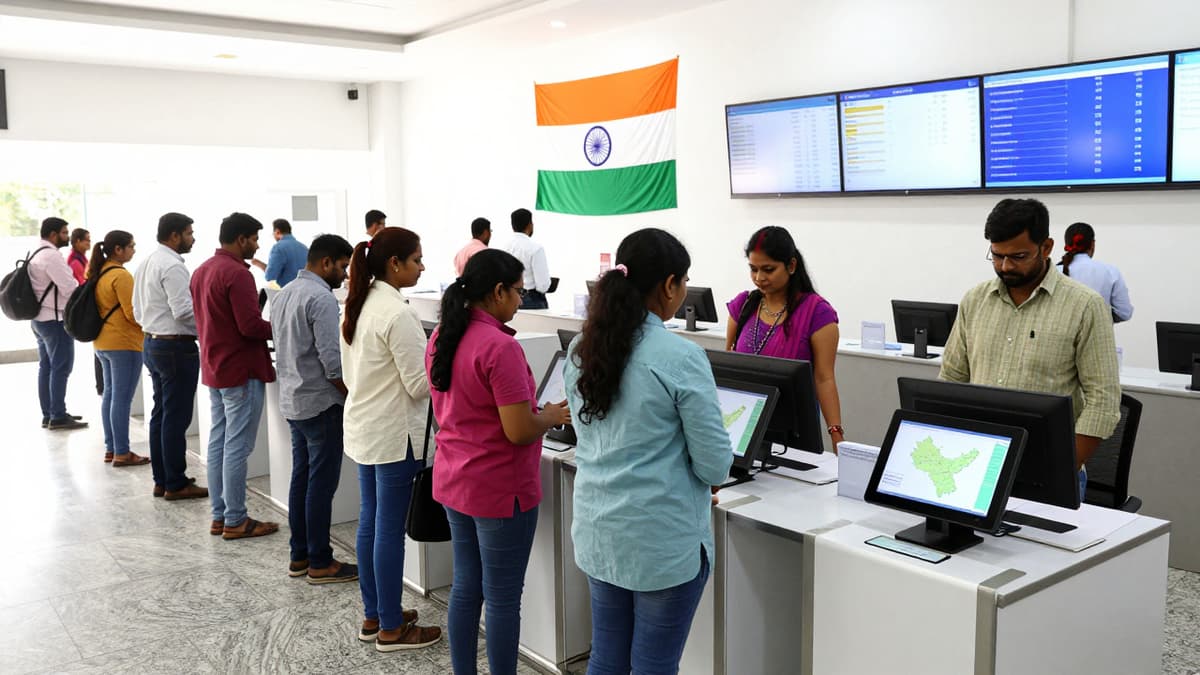
The Indian government has issued a groundbreaking clarification for Census 2027: couples in a stable live-in relationship will officially be counted as married, shifting historical record-keeping protocols.
The government has officially announced that in Census 2027, a live-in couple staying in a household within a "stable union" shall be treated as a married couple during the enumeration process. This clarification appears in an FAQ reply on the census self-enumeration portal, addressing whether such relationships will be considered marital status during self-filling or the enumerator's visit. While this is the first time a public clarification has been issued, officials note that unmarried couples declaring themselves as married were recorded as such in previous exercises.
This new directive impacts the 33 questions asked during the houselisting operations phase, which spans from April 1 to September 30, as notified by individual states or Union territories. The operation is divided into two distinct phases: a 15-day self-enumeration window followed by a 30-day period for enumerators to visit households. The census rules explicitly state that respondents are not required to provide documentary proof for their answers, which must be based on their knowledge and belief. Enumerators are instructed to record information exactly as declared by the respondent.
The self-enumeration (SE) process begins on April 1 in the NDMC area of Delhi. Respondents can access a dedicated web portal in English and 15 Indian languages to fill in their details. The process allows the head of the household or any responsible adult to complete the verification via OTP-based mobile authentication. The head of the household is defined as the person managing affairs and making decisions, rather than necessarily the eldest male member. All normally residing members of the household must be accounted for using a single household access method.
A critical component of the self-enumeration process involves the precise marking of the respondent's location. Users must select the correct district from a dropdown menu and enter their PIN code before specifying the village, locality, street, or nearby landmark. The interface includes a search option that loads a geotagging-based map of the area, requiring the respondent to zoom in until individual houses are visible. The user must then place a marker exactly on their house, ensuring the marker aligns with the correct side of the road and visible landmarks. Officials warn in the FAQs that incorrect placement of the marker may lead to the non-availability of household data in the enumerators' app.

Once the location is secured, respondents can enter data regarding housing conditions and amenities before submitting the form. The system allows users to save their progress as a draft, enabling them to complete the form in parts over the 15-day self-enumeration period. Upon submission, a unique Self-Enumeration ID is generated. This ID must be shared with the enumerator when they visit the household, allowing the official to verify and upload the data after adding the building number, census house number, and details on the use of the census house.
The self-enumeration process is designed to be efficient, with officials stating that it will take no more than 15 to 20 minutes. To assist users, the portal includes tips to guide respondents in selecting the correct options from various dropdown menus. Once a form is submitted or the self-enumeration period concludes, changes can only be made by an enumerator. The digital portal is geofenced, accessible only within the geographical boundaries of India, ensuring that all collected data is encrypted and stored on secure government servers.
This technical framework supports the broader policy decision regarding marital status. By defining a stable union as a married couple for census purposes, the government aims to capture a more accurate representation of household structures. The FAQ explicitly states that if a couple considers their relationship a stable union, they should be treated as a married couple. This aligns with the census philosophy that information is recorded based on the respondent's declaration rather than external verification.
The shift in classification may have significant implications for the demographic data collected. Historically, the inclusion of couples living together was a subject of enumerator discretion or respondent self-declaration. With this new explicit instruction, the data on married couples will now explicitly include those in stable live-in relationships who identify their union as such. This change standardizes the recording of household composition across the country, ensuring consistency in how different types of long-term partnerships are categorized during the census.
The houselisting operations phase is a critical precursor to the full census, gathering essential data on homes, food, internet usage, and living conditions. The integration of this definition into the self-enumeration portal ensures that respondents understand how to categorize themselves from the outset. As the census moves forward from the initial 15-day window into the enumeration phase, the clarity provided by these rules will guide enumerators in verifying household compositions. The use of a single household access point ensures that all members are linked to the correct marital status declaration, maintaining the integrity of the data collection process.
The implementation of these rules ensures that the upcoming national count reflects the lived reality of Indian households by recognizing stable live-in partnerships as marriages. As the census progresses through the 45-day window, the volume of data collected will likely increase, with the self-enumeration phase serving as the primary initial touchpoint. The reliance on self-declaration without documentary proof, coupled with the new definition for stable unions, suggests a trend toward more fluid and inclusive demographic tracking. Future analyses of the 2027 data may reveal shifts in household composition statistics, reflecting the growing prevalence of such unions, as the census continues to adapt its methodologies to contemporary social structures.
Jun 8, 2026 02:17 UTC
Magnitude 7.8 Quake Shakes Philippines, Urging Immediate Evacuations
Join 50,000+ readers getting the global briefing every morning.
No spam. Unsubscribe anytime.
Jun 8, 2026 02:17 UTC
Magnitude 7.8 Quake Shakes Philippines, Urging Immediate Evacuations
Jun 8, 2026 00:51 UTC
Trump Claims Iran Nuclear Deal Imminent Despite Diplomatic Fractures
Jun 8, 2026 00:47 UTC
Iran Fires Missiles at Israel After Beirut Strike
Jun 7, 2026 22:38 UTC
Congress Party Claims Unity for INDIA Bloc Delhi Meeting