As election season heats up, leaders clash over governance and identity. PM Modi outlines a vision for Assam while Kerala and Tamil Nadu brace for intense political battles.
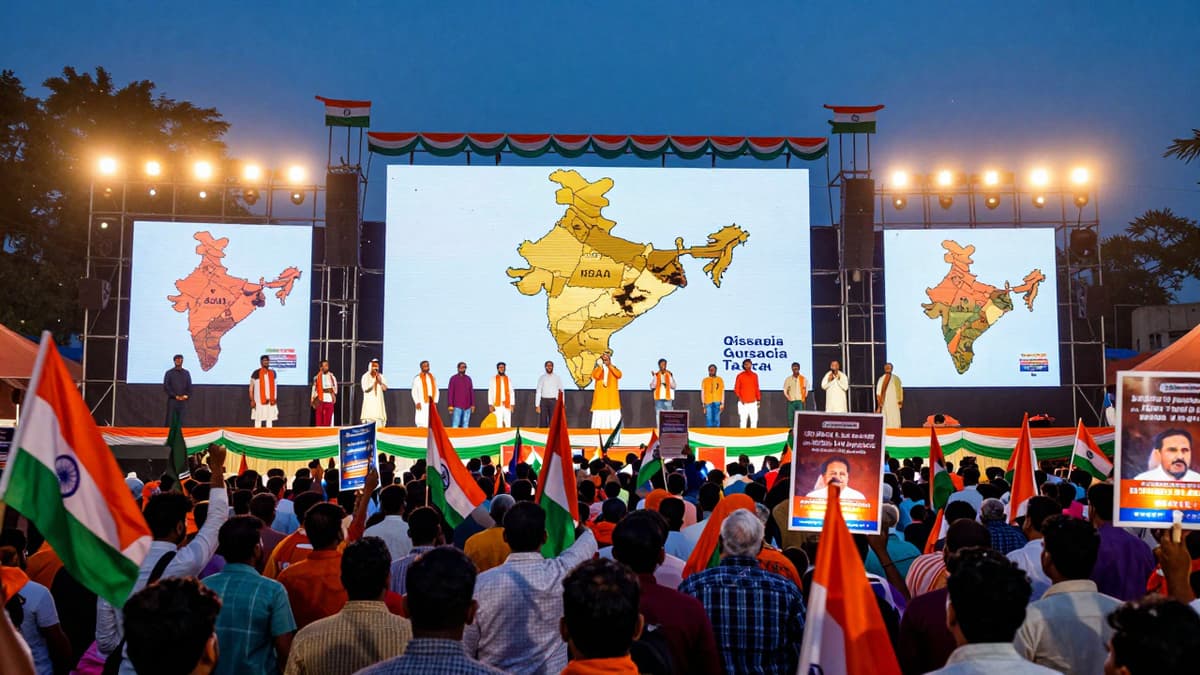
The 2026 state election season has erupted with intense rhetorical battles across India, as Prime Minister Narendra Modi and opposition leaders stake their claims. In Gogamukh, Modi outlined a specific roadmap for Assam Assembly Elections 2026, promising a Uniform Civil Code and safeguards for tribals. Simultaneously, leaders in Kerala and Tamil Nadu are mobilizing voters, with the BJP facing accusations of misuse of central agencies while the DMK prepares to defend its record in Tamil Nadu Assembly Elections 2026.
In Kerala, BJP national president Nitin Nabin launched a roadshow in Mattannur, expressing strong confidence in securing a mandate. Nabin claimed the party's support would surge from 2% to 20% under Modi's leadership. He criticized the existing LDF and UDF governments for focusing on their families rather than the people over the last 70 years. The BJP chief vowed to provide an alternative focusing on employment and infrastructure. Conversely, Telangana CM Revanth Reddy campaigned for the UDF, arguing that a UDF victory would ultimately benefit PM Modi in Delhi. Reddy emphasized that the UDF is the only path for industrial growth and job creation in the state.
The political narrative in Assam has taken a sharp turn toward identity politics. PM Modi alleged that the Congress party aims to introduce laws protecting "infiltrators" if they win, a move he claims would turn the majority community into a minority. Modi accused the Congress of trying to divide the country similarly to the Muslim League during Partition. In response, he promised that a BJP return would implement a Uniform Civil Code and protect tribals under the Sixth Schedule to safeguard Assam's identity. He also described the last ten years as an era of "service and good governance" under Sarbananda Sonowal and Himanta Biswa Sarma, predicting a hat-trick of victory for the BJP-NDA.
Tamil Nadu's political landscape is equally charged. Deputy CM Udhayanidhi Stalin campaigned in Tirupattur, vowing to defeat BJP "conspiracies" to ensure a victory for the Dravidian model 2.0 regime. He asserted that the BJP cannot win at the hustings and is merely trying to rule from Delhi. In Jolarpettai, Stalin further urged voters to decimate the AIADMK opposition and warned against the "fascist BJP" lacking popular sanction. Meanwhile, Tamil Nadu Chief Minister M.K. Stalin highlighted the absence of caste clashes and communal riots in his state compared to BJP-ruled regions, reinforcing the DMK's narrative during their campaign in Tiruchirappalli.
Beyond the rallies, the enforcement of the Model Code of Conduct has seen significant activity. In Puducherry, flying squads utilizing drone technology to monitor money power violations apprehended five individuals. These teams seized approximately ₹66,000 across the Mannadipet and Mangalam constituencies. The accused and the seized funds have been handed over to local police stations for further legal proceedings.
The election commission's oversight has also sparked controversy in West Bengal. Trinamool Congress supremo Mamata Banerjee alleged that newly appointed Election Commission officials are biased against her party's candidates, urging voters to be cautious during nomination filings. She further accused the BJP of misusing central agencies and claimed the party is anti-women. In Kerala, controversy also surrounded BJP candidate B. Gopalakrishnan, whose campaign flex board listing historical MLAs from Guruvayur appeared days after police registered a case against him for alleged communal remarks.
Prime Minister Modi's speech in Gogamukh established a clear dichotomy between the BJP's developmental agenda and the alleged threats posed by the Congress to Assam's cultural fabric. If the BJP secures the anticipated "hat-trick" of victories, the implementation of the Uniform Civil Code will likely proceed, fundamentally altering the legal landscape for personal laws in the state. Conversely, a loss would validate the Congress's narrative of protecting infiltrators and potentially stall these reforms. In Kerala and Tamil Nadu, the persistence of communal rhetoric and accusations of federal overreach suggest a prolonged period of high-tension campaigning. The DMK's strategy to focus on stability and development, contrasting sharply with the BJP's identity-focused arguments, indicates that the Assam Assembly Elections 2026 and the southern states' polls will remain defined by these deep ideological cleavages. The outcome in each region will likely dictate not just state-level governance but also the national political trajectory for the coming years, with the BJP's ability to penetrate southern states and the Congress's success in Assam hanging in the balance of these upcoming verdicts.
Jun 8, 2026 00:51 UTC
Trump Claims Iran Nuclear Deal Imminent Despite Diplomatic Fractures
Jun 8, 2026 00:47 UTC
Iran Fires Missiles at Israel After Beirut Strike
Jun 7, 2026 22:00 UTC
US, Iran Peace Hops Fade 100 Days Into War
Jun 7, 2026 20:57 UTC
Iran Strikes Israel: IRGC Promises Week of Continuous Offensive
Jun 8, 2026 02:28 UTC
Trump Walks Out of Meet the Press After Rejecting Evidence Demands