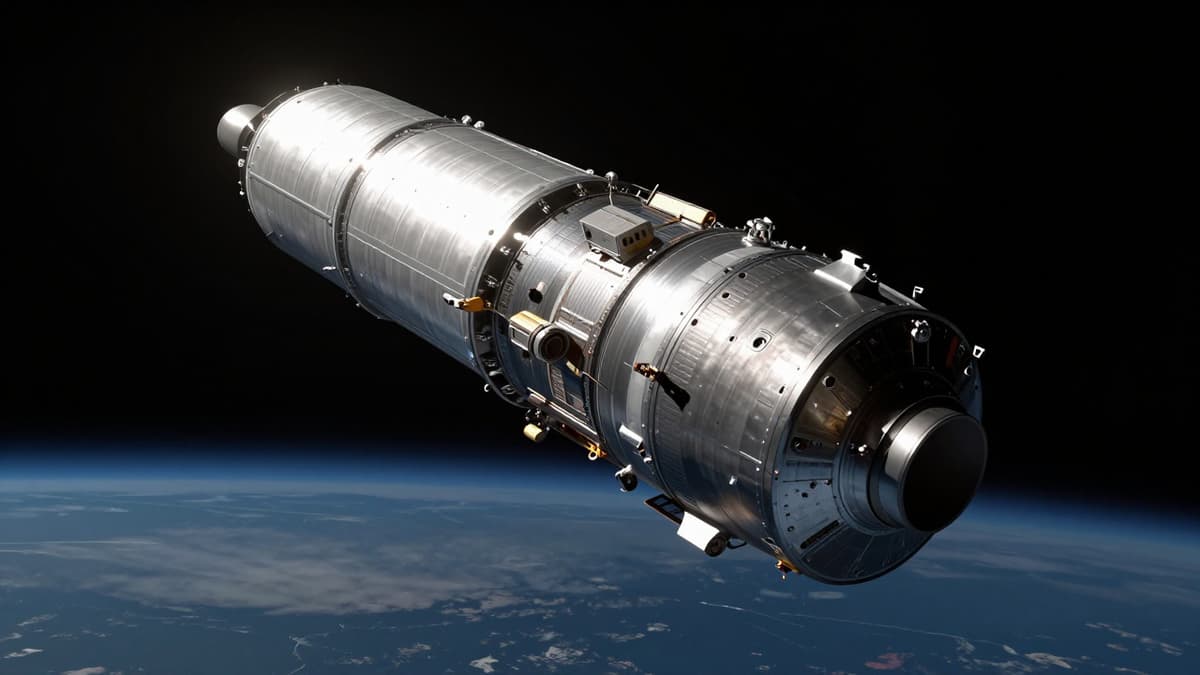
Day two of the Artemis II mission brings physical tests and a crucial manual docking practice for the Orion capsule as it journeys toward the moon.
The Artemis II crew has transitioned from the excitement of launch day to the structured routine of day two in space. Following the successful liftoff, the four astronauts aboard the Orion spacecraft are beginning a series of critical operational checks and physical maintenance. This phase of the mission involves rigorous physical training and the preparation for the vessel's first major engine firing, which will propel the crew toward the moon.
Immediately after the launch, the crew focused on maintaining their physical health in microgravity. NASA astronauts Reid Wiseman and Victor Glover began their day by setting up and testing the spacecraft's flywheel exercise device. This compact, shoebox-sized tool allows for rowing, squats, and deadlifts, essential for keeping muscles and bones strong. Christina Koch and Canadian astronaut Jeremy Hansen are scheduled to follow with their workouts later in the day. Each crew member commits to a 30-minute workout daily to combat the effects of zero gravity.
As the crew manages their physical needs, the mission's technical schedule advances toward a pivotal moment: the translunar injection burn. Christina Koch will dedicate significant time to preparing for this maneuver. This burn will increase the Orion spacecraft's velocity, allowing it to leave Earth's circular orbit and enter the oval-shaped path required to reach the moon. This firing from the service module, which handles power and propulsion, will be the last major engine burn of the entire mission, initiating a four-day trip around the moon before the return journey begins.
Simultaneously, a new chapter is unfolding for the six tiny cubesats hitching a ride with the crew. Just over five hours after launch, these shoebox-size satellites from Germany, South Korea, Saudi Arabia, and Argentina will deploy in one-minute intervals. These international payloads are designed to measure the harsh realities of the space environment. Germany's TACHELES will investigate how space affects electrical components for future lunar vehicles, while Saudi Arabia's CubeSat will monitor space weather and solar particles. South Korea's K-Rad Cube will utilize humanlike tissue to track radiation effects across Earth's Van Allen belts, and Argentina's ATENEA will test radiation shielding and long-range communication links.
Now that Orion has stabilized, the crew is preparing for one of the mission's first major milestones: the Artemis II manual test drive. This operation, known as the Orion Proximity Operations Demonstration, will allow the astronauts to practice piloting the capsule in manual mode. The target for this maneuver is the Interim Cryogenic Propulsion Stage (ICPS), the upper rocket segment that separated from Orion about three and a half hours after launch. The ICPS serves as a stand-in for spacecraft the crew may dock with on future missions.
Howard Hu, manager of NASA's Orion Program, emphasized the importance of this test. While Orion was designed with full autonomous capabilities, ensuring the crew can manually take control is vital for future safety. "The demonstration gives the crew an opportunity to really, I would say, test drive the car," Hu stated. The crew will practice flying toward and around the ICPS for approximately one hour. Starting at a distance of 328 feet, they will approach to within 32.8 feet, flipping the spacecraft as needed, before manually backing away to test reflectors on the upper stage.
This testing is made possible by the power of the Space Launch System rocket, which lifted the Artemis II mission from NASA's Kennedy Space Center. As the most powerful operational rocket currently flying, the SLS produced 8.8 million pounds of thrust at liftoff. While not as powerful as SpaceX's Starship, the SLS exceeds the capabilities of any rocket NASA has built previously, surpassing the Saturn V and the Space Shuttle. The rocket's strength is crucial for sending humans beyond Earth's orbit and to the lunar surface.
The success of the launch and the initial deployment of the cubesats marks a significant technological achievement. The International Space Station era has given way to deep space exploration vehicles like the Orion capsule, capable of sustaining life during long-duration missions. The data gathered from the cubesats will contribute to understanding the radiation environment of the Van Allen belts and space weather, knowledge essential for the safety of future astronauts on lunar and Martian missions.
The Artemis II mission continues to build momentum as the crew executes complex maneuvers and tests critical systems. The successful completion of the Orion Proximity Operations Demonstration and the deployment of international scientific payloads marks a definitive step forward in human spaceflight capabilities. As the crew prepares for the translunar injection burn, the long-term impact of this mission will be the validation of the technologies and procedures required for sustained lunar exploration. The data collected from the cubesats regarding radiation and space weather will directly influence the design of future habitats and vehicles, ensuring that the next generation of explorers can safely traverse the harsh environment of deep space. This trajectory confirms that the Space Launch System is proving its reliability, paving the way for the eventual return of humans to the moon and the establishment of a permanent presence there.
Jun 8, 2026 02:17 UTC
Magnitude 7.8 Quake Shakes Philippines, Urging Immediate Evacuations
Join 50,000+ readers getting the global briefing every morning.
No spam. Unsubscribe anytime.
Jun 8, 2026 02:17 UTC
Magnitude 7.8 Quake Shakes Philippines, Urging Immediate Evacuations
Jun 8, 2026 00:51 UTC
Trump Claims Iran Nuclear Deal Imminent Despite Diplomatic Fractures
Jun 8, 2026 00:47 UTC
Iran Fires Missiles at Israel After Beirut Strike
Jun 7, 2026 22:38 UTC
Congress Party Claims Unity for INDIA Bloc Delhi Meeting


