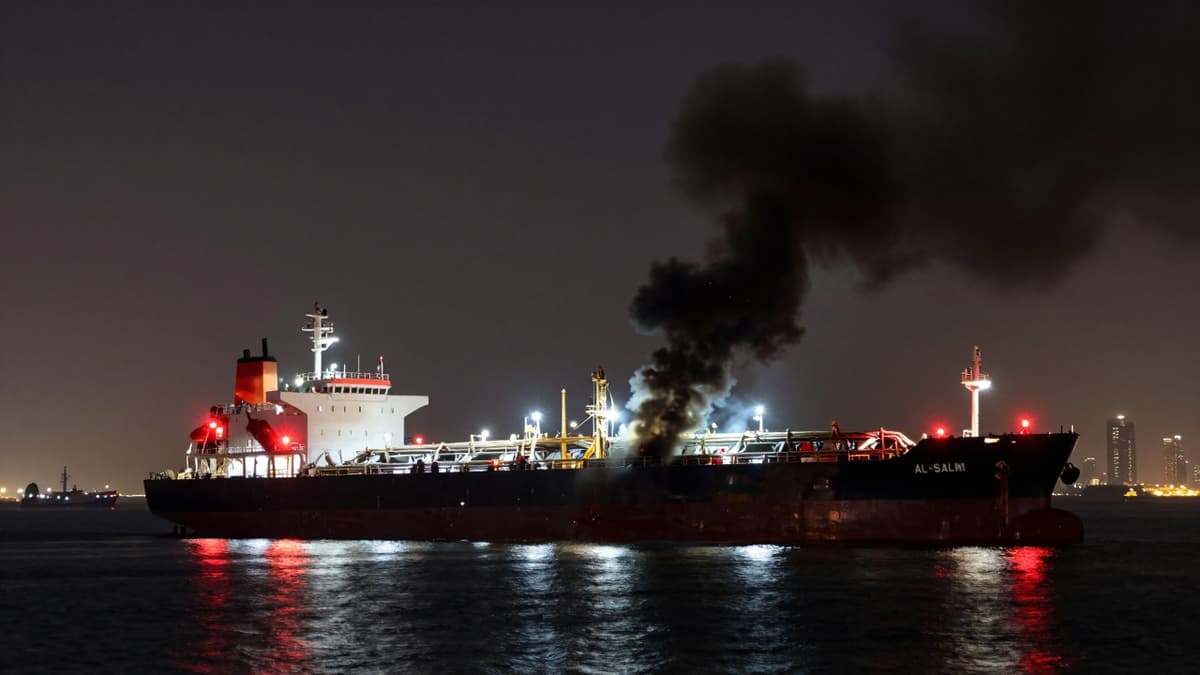
A Kuwaiti-flagged vessel named Al-Salmi caught fire in Dubai waters, marking a new escalation in the US-Israeli war with Iran that has already claimed thousands of lives.
Another image has surfaced showing the extent of damage to the oil tanker Al-Salmi reportedly struck by a projectile off the coast of the United Arab Emirates on Tuesday. BBC Verify has cross-referenced specific features of the vessel in these images with historical pictures of the Al-Salmi to confirm its identity, revealing significant fire damage to the ship's starboard side. These visuals were shared with BBC Verify by Nader Itayim, a reporter at the energy news outlet Argus Media, who obtained them from a source within Kuwait's state oil company. The fire on board the Kuwaiti-flagged vessel, which was en route to China with two million barrels of oil, has reportedly been contained without any oil spillage or loss of life. However, the incident marks a severe escalation in the US-Israeli war with Iran, which began on 28 February and has already caused thousands of casualties across the region.
In the wake of the strike, multiple people were reported injured following overnight raids in the Gulf States. In Dubai, the media office confirmed that four Asian nationals sustained injuries after debris from an intercepted projectile fell upon residential houses in the southern part of the city. This incident occurred shortly after warnings were issued for residents to seek shelter amid reports of earlier explosions. Similarly, in Saudi Arabia, the General Directorate of Saudi Civil Defense reported that drone fragments landing in Al-Kharj injured two individuals and damaged three houses along with several vehicles. These attacks underscore the widening scope of the conflict, which has now resulted in at least 24 deaths across the Gulf, including security personnel and foreign workers in the UAE, Kuwait, Oman, and Bahrain.
The human cost of the escalating violence continues to mount. In Iran, the group Human Rights Activists in Iran (HRANA) reports that 3,492 people have been killed since the war began, including 1,574 civilians, with at least 236 of those being children. Israel's Magen David Adom ambulance service (MDA) stated that 19 people have been killed by missile fire, while nine Israeli soldiers have died in Lebanon. Lebanon's health ministry has confirmed 1,247 deaths, including 124 children. Meanwhile, Israel's Prime Minister Benjamin Netanyahu declared that the military aims are "beyond halfway" complete, specifically regarding missions to wipe out Iran's nuclear programme and arms industry, though he clarified this did not refer to the duration of the war.
The strategic implications extend to the critical shipping lanes of the Middle East. A former naval commander, Tom Sharpe, warned that the US threat to open the Strait of Hormuz with force is unlikely to succeed, noting that Iran currently holds control over the situation. Sharpe told BBC Radio 4's Today programme that unless Iran agrees to stop attacking passing boats, military force is not the solution. This concern is compounded by reports from an IRGC-affiliated news agency stating that an Iranian parliamentary committee has approved plans to impose tolls on traffic in the strait. Under these proposed regulations, US and Israeli ships, along with vessels from countries participating in sanctions against Iran, would be barred from passing through the vital waterway.
Diplomatic and economic responses are intensifying globally. UK Prime Minister Keir Starmer is set to hold an emergency Cobra meeting to discuss the economic fallout of the war, having previously met with leaders from energy, shipping, and banking firms to address the blockade. Starmer emphasized that tackling the impact of the war requires a joint effort, as the government cannot manage the crisis alone. In the United States, President Trump was reported to be willing to end the military campaign against Iran even if the Strait of Hormuz remains largely closed, though the White House deferred to Secretary of State Marco Rubio, who stated the strait will "reopen one way or another."
The conflict has also severed digital connectivity for the Iranian population. Iran's internet blackout has entered its 32nd day, with most users cut off from the outside world for over 744 hours. According to NetBlocks, connectivity remains at just 1% of normal levels. While some officials and pro-establishment users retain unrestricted access, others are paying exorbitant fees to get online, with satellite internet like Starlink being a risky alternative that carries a potential prison sentence of up to two years. The situation reflects the broader chaos, where a new wave of strikes has been launched at Tehran, and authorities in the Gulf continue to intercept missiles and drones.
The ongoing attacks on the Al-Salmi tanker and the potential imposition of tolls signal a deepening crisis for global trade. As Iran retains control over the Strait of Hormuz and threatens to close it to specific nations, the region faces a precarious future. With the death toll rising and infrastructure under fire, the economic ripple effects are prompting urgent emergency responses from world leaders. If the current trajectory holds, the Strait of Hormuz could remain a contested choke point, forcing a realignment of global shipping routes and further destabilizing an already volatile geopolitical landscape.
Jun 8, 2026 00:51 UTC
Trump Claims Iran Nuclear Deal Imminent Despite Diplomatic Fractures
Jun 8, 2026 00:47 UTC
Iran Fires Missiles at Israel After Beirut Strike
Jun 7, 2026 22:00 UTC
US, Iran Peace Hops Fade 100 Days Into War
Jun 7, 2026 20:57 UTC
Iran Strikes Israel: IRGC Promises Week of Continuous Offensive
Jun 8, 2026 02:28 UTC
Trump Walks Out of Meet the Press After Rejecting Evidence Demands


