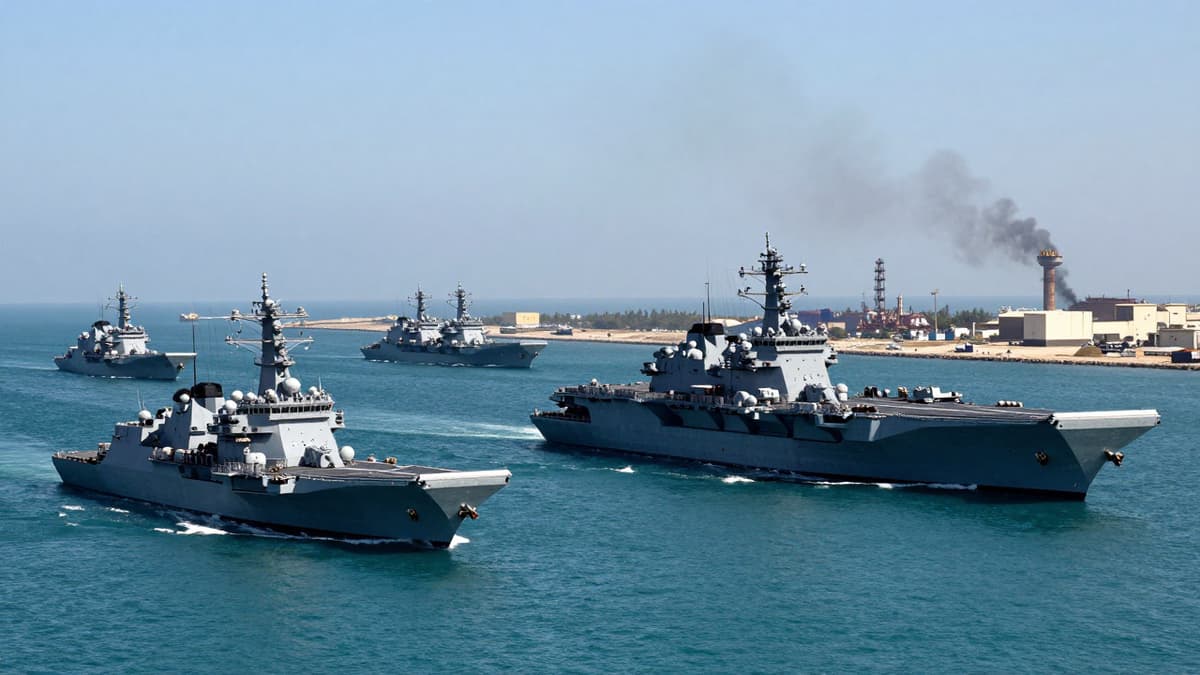
As the US-Iran conflict intensifies, Washington is deploying thousands of troops to the Middle East while claiming diplomatic negotiations, marking the largest military buildup in the region since the Iraq War.
Nearly four weeks into Operation Epic Fury, President Donald Trump claims Washington is negotiating with Tehran, a stance Iran categorically denies. Simultaneously, the US has amassed thousands of troops in the Middle East, marking a significant escalation in the region.
The conflict, which began on February 28 as a joint US-Israeli air campaign, has evolved into the largest deployment of soldiers to the area since the Iraq War. Over 9,000 targets across Iran have been struck, including facilities linked to the Supreme Leader and IRGC headquarters, according to US Central Command.
US Central Command reports that more than 140 Iranian vessels have been damaged or destroyed in response to the air strikes. Iran has retaliated with near-daily missile and drone attacks against Israel, Gulf Arab states, and US military bases. Crucially, Tehran has effectively closed the Strait of Hormuz to most commercial shipping, a narrow waterway carrying about 20 percent of the world's traded oil daily, turning it into the conflict's central strategic pressure point.
Against this volatile backdrop, Washington is reinforcing its ground presence. President Trump, who had warned in late January of a "big flotilla" heading toward Iran, ordered approximately 2,000 soldiers from the 82nd Airborne Division to move to the Middle East on Tuesday. Pentagon sources confirm that Defence Secretary Pete Hegseth authorized these reinforcements after US Central Command requested expanded operational options.
This move adds to two Marine Expeditionary Units already en route from opposite sides of the Pacific. Secretary of State Marco Rubio told a congressional briefing that the US may need to physically secure nuclear material inside Iran, stating, "People are going to have to go and get it," though he did not specify the units responsible. While no ground operation has been officially authorized, the convergence of Marine amphibious forces, elite paratroopers, and a division-level command structure signals a massive expansion of US military capabilities.
The reinforcement strategy relies on three distinct formations, each originating from different locations and following unique routes to the combat zone.
The first force is the Tripoli Amphibious Ready Group, centered on the America-class assault ship USS Tripoli and the 31st Marine Expeditionary Unit (MEU). Ordered out of Sasebo, Japan, on March 13, this group transited the Strait of Malacca and reached Diego Garcia by March 23, with an expected arrival in the CENTCOM area by late March or early April.
The USS Tripoli, weighing 45,000 tonnes and stretching 261 metres, serves as a light aircraft carrier for F-35B jets while simultaneously deploying Marines. The 31st MEU, comprising about 2,200 Marines and sailors, is the Marine Corps' only permanently forward-deployed unit, having previously participated in Operation Desert Fox in 1998.
The second formation is the Boxer Amphibious Ready Group, built around the Wasp-class assault ship USS Boxer and the 11th MEU based in Southern California. Departing San Diego between March 19 and 20, this group traveled approximately 22,200km and is not expected to reach the combat zone until mid-April at the earliest. The deployment was accelerated by three weeks compared to its original schedule. The 11th MEU has an extensive combat record, including operations in Iraq's Najaf province in 2004 and a 1990-91 amphibious deception plan during the Gulf War.
The third component is the 82nd Airborne Division's Immediate Response Force from Fort Bragg, North Carolina. Approximately 2,000 troops have been ordered to the Middle East. This brigade-sized formation, capable of deploying anywhere in the world within 18 hours, serves as the Army's primary forced-entry unit trained for parachute assaults and seizing airfields. However, it deploys without heavy armor in its initial phase, limiting its ability to hold territory against counterattacks.
Together, these forces bring nearly 7,000 additional troops to the region, with the two Marine groups providing 4,500 personnel. The 82nd Airborne was previously mobilized to the Middle East in January 2020 following the US killing of IRGC commander Qassem Soleimani.
Experts note that the current force composition suggests a focus on discrete, time-limited operations rather than a sustained ground campaign. Ruben Stewart of the International Institute for Strategic Studies highlighted that the deployment lacks the heavy armoured units and logistics depth required for a prolonged land war, consistent with rapid-response missions like raids or seizing key terrain.
As the US and Iranian US-Iran conflict enters a new phase with increased ground troop readiness, the immediate future of the region hangs in the balance. The closing of the Strait of Hormuz has already created a global oil market vulnerability, forcing a strategic pivot from air superiority to potential ground intervention.
While the US has not authorized a full-scale invasion, the presence of 7,000 troops and amphibious assets near the Gulf indicates a readiness for rapid, high-impact strikes, potentially to secure nuclear materials or reopen the shipping lane. If Iran maintains its closure of the strait or intensifies attacks, the US may be forced to transition from air and naval dominance to a physical ground occupation of critical infrastructure. Conversely, if negotiations resume as Trump claims, the massive buildup serves as a coercive leverage tool. The coming weeks will determine whether this deployment remains a temporary show of force or escalates into a prolonged ground engagement that redefines the geopolitical landscape of the Middle East.
May 9, 2026 21:40 UTC
Russia Cuts Heavy Armor From Victory Day Parade Amid War
Join 50,000+ readers getting the global briefing every morning.
No spam. Unsubscribe anytime.
May 9, 2026 21:40 UTC
Russia Cuts Heavy Armor From Victory Day Parade Amid War
May 9, 2026 21:28 UTC
Delhi Terror Threat: Security Intensified at BJP HQ on Deen Dayal Upadhyaya Marg
May 9, 2026 19:32 UTC
Hardliners Sabotage Iran-US Negotiations Amidst Fractured Regime
May 9, 2026 19:30 UTC
India Successfully Deploys MIRV Agni-5 Missile System


