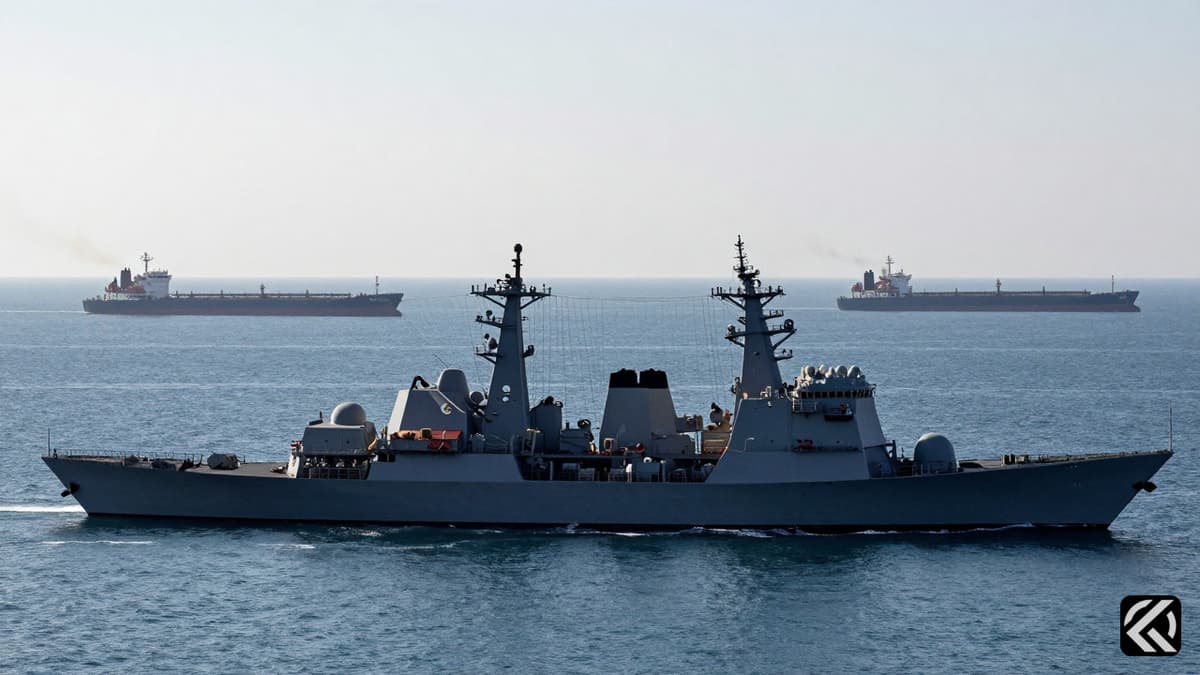
U.S. forces intercept Iranian oil tankers as the blockade deepens. VP Vance signals cautious optimism for negotiations while economists warn of global recession if the conflict drags on.
The U.S. Navy has escalated its response to the ongoing conflict, interdicting two oil tankers attempting to leave Iran's Chabahar port on Tuesday, April 14, 2026. This action occurred just one day after President Donald Trump's Iran blockade officially went into effect, marking a significant tightening of the U.S. strategy in the region.
The disclosure comes from a U.S. official speaking on condition of anonymity, who stated the warship contacted the vessels via radio communication. The ships had departed from the Gulf of Oman, and the U.S. instructed them to turn around immediately. While it remains unclear if further warnings were issued, the incident adds concrete detail to the initial enforcement of the blockade. This move aims to pressure Tehran into ending its effective closure of the Strait of Hormuz, a critical choke point responsible for roughly 20% of the world's oil supply. The intercept occurs as the U.S.-Iran war 2026 continues, with a fragile two-week ceasefire between the two nations still a week from expiring.
On the diplomatic front, Vice President JD Vance offered a nuanced perspective on the path forward. Speaking at a Turning Point USA event, Vance acknowledged the deep rift between Washington and Tehran. "There is a lot of, of course, mistrust between Iran and the United States of America. You are not going to solve that problem overnight," Vance stated. Despite this admission of difficulty, he expressed confidence in the current trajectory, noting that Iranian negotiators are eager to finalize an agreement. "I feel very good about where we are," Vance added, signaling a potential turning point in the crisis.
President Trump has indicated that high-stakes talks to end the war could resume in Pakistan within the next two days. This development follows the collapse of weekend negotiations, which had prompted the U.S. to impose the immediate blockade on Iranian ports. Vance, who participated in the earlier talks in Pakistan, remains a central figure in these diplomatic efforts. The situation remains volatile, with the fragile ceasefire holding only one week longer.
Economic implications of the conflict are already becoming starkly visible. Treasury Secretary Scott Bessent addressed the market, stating that the U.S. economy remains strong despite the war. He projected growth could still exceed 3% or 3.5% this year. Bessent also commented on the status of tariffs, noting that they could return to previous levels by July following a Supreme Court ruling in February that found President Trump had overstepped his authority in imposing sweeping global duties under an emergency law.
However, the global outlook is more grim. International Monetary Fund (IMF) Managing Director Kristalina Georgieva warned that while a rapid recovery is possible if the conflict ends in the coming weeks, the situation would deteriorate significantly if it drags through the summer. Georgieva noted that the IMF is actively in talks with countries suffering from higher energy prices and supply chain disruptions to address their financial needs. She specifically urged nations against building up their own oil reserves or blocking petroleum exports, warning that such actions would "make the supply shocks worse."
The IMF and World Bank have agreed to hold regular calls every two weeks with the International Energy Agency to monitor the disruption of global energy markets. In its semiannual Global Financial Stability Report, the IMF highlighted that the war has elevated global financial stability risks. Since February, global equity prices have declined 8%, and sovereign bond yields have risen sharply, driven by the jump in energy prices and market expectations of higher inflation.
Billionaire investor Ken Griffin issued a stark warning at the Semafor World Economy Forum, stating that the world could face a global recession if the Strait of Hormuz remains closed for a prolonged period. "This really is a very, very treacherous moment for the world economy," Griffin said, emphasizing that the resumption of the continued flow of energy products without tolls or harassment is the key criterion. He cautioned that if the waterway remains shut down for six to 12 months, the global economy will end up in recession.
Legal and diplomatic friction is also expanding beyond the immediate theater of war. An Israeli advocacy NGO, Shurat HaDin, has asked the International Criminal Court to consider legal action against Spanish Prime Minister Pedro Sanchez. The complaint alleges that Spain aided war crimes by exporting components to Iran required by the regime and its proxies for military purposes. This move follows an escalating diplomatic spat that began with the start of the Gaza war in October 2023.
In a related development, U.S. President Trump criticized Italian Prime Minister Giorgia Meloni for her unwillingness to help in the Iran war during an interview with Corriere della Sera. "I'm shocked at her. I thought she had courage, but I was wrong," Trump said of his political ally. Meloni, a key ally in Europe, had reportedly expressed reluctance to involve Italy in the conflict, even though Italy relies heavily on oil from the region.
Meanwhile, diplomatic progress is being noted elsewhere. Foreign ministers from 17 countries, including the U.K., urged Israel and Lebanon to seize the opportunity for peace ahead of their scheduled talks in Washington. State Department spokesperson Tommy Pigott confirmed that "productive discussions" led to an agreement for direct negotiations between the two nations. Lebanon's ambassador, Nada Hamadeh Moawad, called for a ceasefire and the return of displaced people during the constructive talks in Washington.
The human cost and legal risks continue to mount. An American-Kuwaiti journalist, Ahmed Shihab-Eldin, has been detained and charged in Kuwait, part of a broader crackdown in Gulf countries on those sharing footage of the war. In northern Iraq's Kurdistan region, a drone strike killed a woman in an Iranian Kurdish group, marking the first attack of its kind since the ceasefire took effect.
The convergence of naval enforcement, diplomatic negotiations, and economic warnings paints a precarious picture for the immediate future. The U.S. decision to renew the expiration of temporary sanctions on stranded Iranian oil suggests a hardening stance, effectively tightening the noose on Tehran's oil exports. If the planned talks in Pakistan and Washington yield a resolution before the fragile ceasefire expires, the IMF's hope for a rapid recovery may materialize, preventing a deep recession. However, if the Strait of Hormuz remains closed beyond the summer, the predicted tightening of funding markets and the 8% decline in equity prices could spiral into a prolonged global downturn. The world now waits on whether diplomatic courage, such as that urged by European ministers, will prevail over the momentum of the blockade and military escalations.
Jun 8, 2026 02:17 UTC
Magnitude 7.8 Quake Shakes Philippines, Urging Immediate Evacuations
Jun 8, 2026 00:51 UTC
Trump Claims Iran Nuclear Deal Imminent Despite Diplomatic Fractures
Jun 8, 2026 00:47 UTC
Iran Fires Missiles at Israel After Beirut Strike
Jun 7, 2026 22:00 UTC
US, Iran Peace Hops Fade 100 Days Into War
Jun 8, 2026 04:15 UTC
Trump Urges Netanyahu to Halt Iran Strike for Peace


