Section
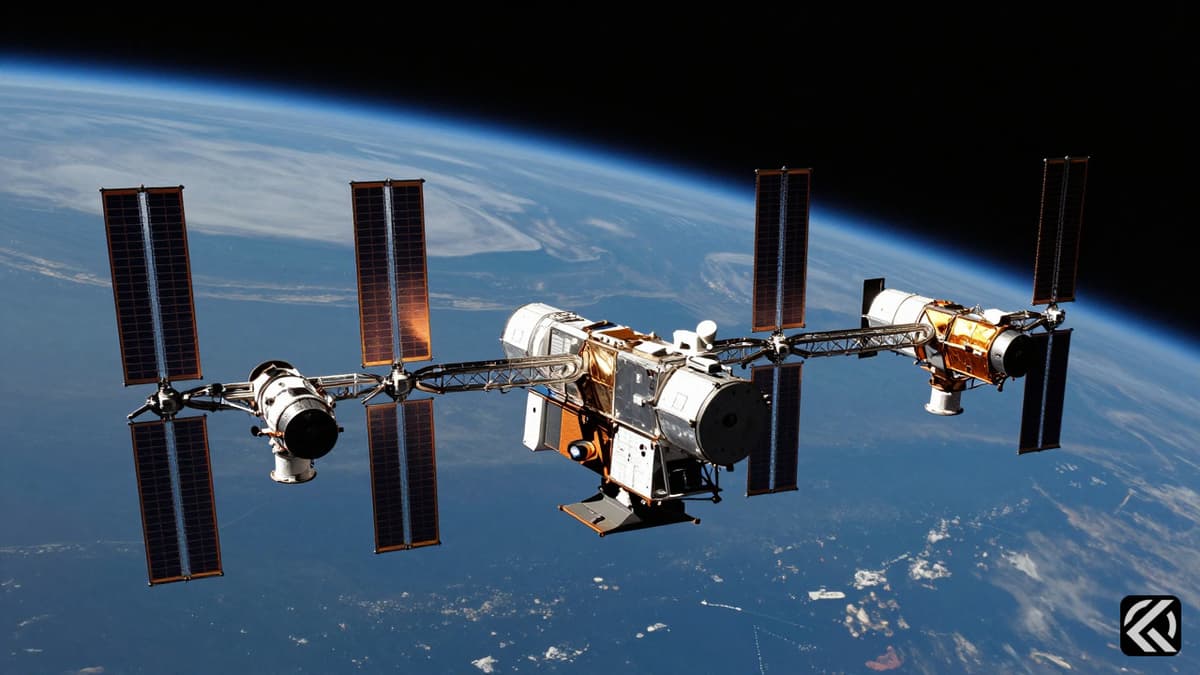
The US has officially confirmed the deployment of space weapons in Earth's orbit, marking a pivotal shift in global military strategy and space security dynamics.
The United States has officially acknowledged the deployment of space weapons in Earth's orbit, a confirmation that significantly alters the landscape of global military strategy and space security. This announcement, made by US Air Force Secretary Troy Meink, marks a decisive step in the militarization of space, shifting from theoretical capability to operational reality.
Meink confirmed the existence of these systems during the Air, Space and Cyber Conference, framing the deployment as a necessary measure to defend US forces against hostile actions from adversaries like China and Russia. By stating that the US now possesses "on-orbit space control weapons," the administration has effectively closed the gap on transparency regarding its military capabilities in the cosmos.
"This is why the United States now has on-orbit space control weapons capable of defending the Joint Force against hostile adversary action," Meink stated. While he did not specify the number of weapons or their exact technical designs, the admission signals a new era where Earth’s orbit is increasingly recognized as a contested military domain.
Experts analyzing the announcement suggest that these new systems are likely non-kinetic. Bleddyn Bowen, an associate professor in astropolitics at Durham University, told the BBC that the US is likely deploying electronic warfare or radio-jamming platforms rather than physical strike weapons.
"We don't know exactly what the mechanism of the weapon is. I would expect there to be some kind of electronic warfare or radio-jamming platform," Bowen explained. He noted that kinetic kill vehicles, which involve ramming satellites, would create dangerous debris fields. Such destructive methods are considered less likely given the risks involved in cluttering space with hazardous material.
Victoria Samson, chief director of Space Security and Stability for the Secure World Foundation, emphasized the significance of this admission. She noted that this is the first time an official has acknowledged an "actually designed weapon" has been placed in space, moving beyond the previous terminology of "systems with capabilities." This distinction is critical for understanding the current state of international space law and military doctrine.
The US Space Force defines "space control" as achieving space superiority, allowing US forces to operate freely while denying the same advantage to adversaries. This doctrine underscores the intent to protect critical infrastructure, including GPS, communications, and intelligence networks that both military and civilian sectors rely upon.
The confirmation of these capabilities has drawn sharp criticism from Beijing and Moscow. China’s Foreign Ministry warned against the "weaponisation of outer space," urging the US to stop expanding its military capabilities. Similarly, Kremlin spokesman Dmitry Peskov called for space to remain "free of any weapons," emphasizing the need for complete demilitarization.
Despite these objections, current international law provides no blanket ban on such deployments. The 1967 Outer Space Treaty prohibits nuclear weapons and weapons of mass destruction in orbit but does not explicitly forbid conventional weapons. This legal ambiguity has allowed nations to develop sophisticated counterspace capabilities, including jamming and spoofing technologies.
Independent reports indicate that both China and Russia are actively developing kinetic and non-kinetic counterspace weapons. The Center for Strategic and International Studies (CSIS) has identified that these rivals possess direct-ascent anti-satellite capabilities and are conducting maneuvers such as rendezvous and proximity operations near Western satellites.
The US Space Force spokesperson told ABC News that these capabilities can be used for both offensive and defensive purposes as directed by combatant commands. Washington has long warned about Russian and Chinese weapons testing since 2007, arguing that space is undeniably a warfighting domain.
Samson observed that while the technology itself may not be entirely new, the announcement normalizes the weaponization of space. "Space has always been a domain with the potential of being a flashpoint for conflict; this just turns up the heat there," she said.
The official acknowledgment of on-orbit weapons by the US Military signals a definitive end to ambiguity regarding the militarization of space. This move forces rival nations to accelerate their own counterspace development, potentially triggering a rapid expansion of electronic warfare and jamming technologies among other global powers like India and France. As transparency increases, the risk of miscalculation in space operations may rise, necessitating new international frameworks to prevent escalation while acknowledging the reality of space as a critical theater of modern warfare.
Oct 6, 2026 02:48 UTC
Yemen Forces Recapture Mocha in Major Counteroffensive
Oct 6, 2026 00:07 UTC
Teen Loses Hand in French School Protest Clashes Amid Escalating Violence
Oct 5, 2026 22:36 UTC
UAE Shares FlyDubai Crew Data After Pilot Seize Control Attempt
Oct 5, 2026 22:00 UTC
US Withdraws Heavy Bombers From UK Base Amidst Rising Tensions With Iran
Nov 5, 2026 20:16 UTC
Pia Dandiya Claims Landmark Florida Win in 2026 Midterms