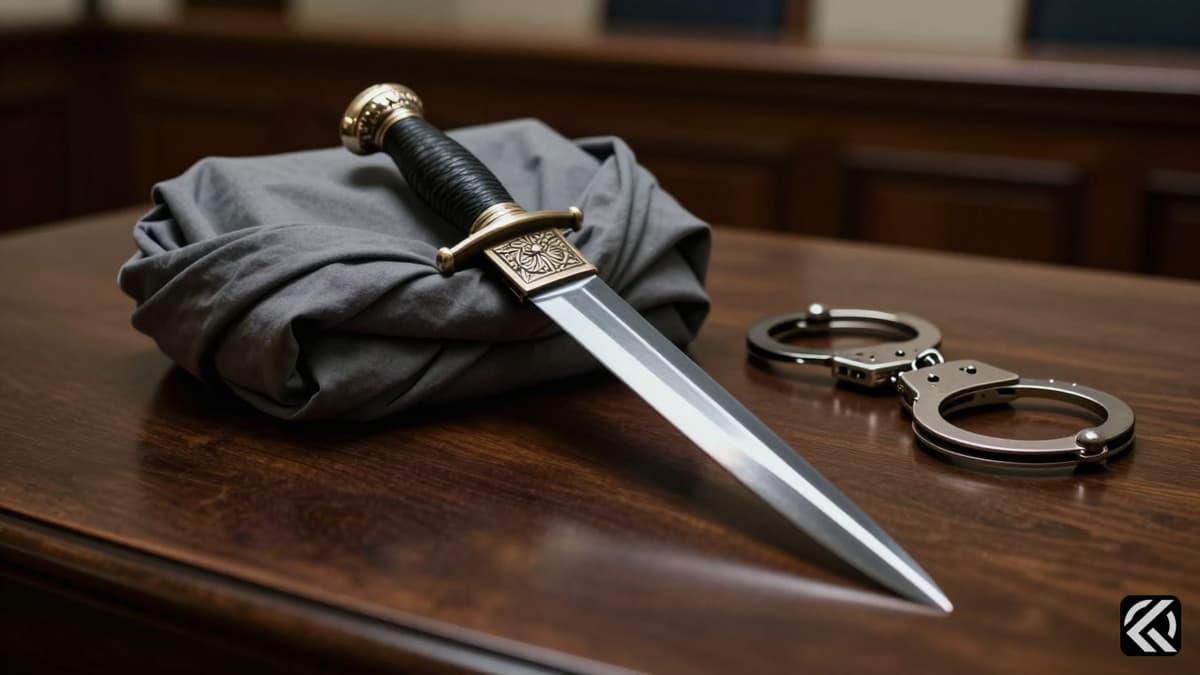
A viral video captures the tragic moment police arrested a dying teen, Henry Nowak, after he was stabbed by an attacker using a religious dagger.
The fatal stabbing of 18-year-old Henry Nowak in Southampton has triggered a profound national debate in the United Kingdom following the sentencing of the attacker. Viral footage released alongside the court proceedings reveals the tragic confusion faced by first responders at the scene.
The incident began when 23-year-old Vickrum Digwa stabbed Nowak but immediately misrepresented the event to arriving officers. Digwa falsely claimed that Nowak had racially abused him and forcibly removed his turban. Based on this deceptive account, Hampshire Police officers initially treated Nowak as the aggressor. In the widely circulated video, Nowak is seen lying on his back in a critical, dying condition, struggling to breathe while officers handcuffed his wrists. Despite his repeated pleas that he had been stabbed and could not breathe, one officer in the footage responded with disbelief, stating, "Don’t think you have, mate." It was only after this interaction that the true nature of the violence became clear.
In a Monday sentencing hearing, Judge William Mousley delivered a stern verdict for Vickrum Digwa, who was found guilty of the murder. The judge emphasized that Digwa had abused the religious privilege extended to Sikhs to carry a kirpan, a ceremonial dagger, for offensive purposes. Mousley stated that Digwa had dishonored his religion and put others at risk of repercussions for the community. Digwa was sentenced to life imprisonment with a minimum term of 20 years before becoming eligible for parole.
The case has drawn intense scrutiny regarding the use of religious articles in public spaces. The kirpan is one of the five holy items in Sikhism, worn as a symbol of faith. However, the UK's Offensive Weapons Act 2019 clarifies that while kirpans can be lawfully possessed for religious reasons, using them for violence is a severe crime. Judge Mousley stressed that it is a fundamental principle of Sikhism that any kirpan is worn for faith and never for offensive purposes.
The tragedy has sparked widespread political and social discourse. Far-right groups in the UK have utilized the event to call for restrictions on the right of Sikhs to carry the kirpan in public. In response, Home Secretary Shabana Mahmood addressed the House of Commons, urging the public not to blame the wider Sikh community for the actions of one individual.
Mahmood pointed out that existing laws already address long kirpans, extending defenses for religious possession while condemning violent use. "Carrying a knife for the purpose of religious observance is one thing, using it as so tragically occurred in this case is quite another," she stated. She warned against collective punishment, asserting that the nation stands together against the crime, not against those who share the faith or ethnicity of the perpetrator.
Several Sikh Members of Parliament intervened during the parliamentary debate. Labour MP Tanmanjeet Singh Dhesi strongly criticized Reform UK, Restore Britain, and other far-right groups for scapegoating the entire Sikh community. He highlighted that the kirpan was not used in the violent attack as the primary instrument of the initial claim, but rather was the object of Digwa's deception. Dhesi also noted the historical contributions of Sikh soldiers who fought alongside British forces in both World Wars while wearing their turban and kirpan.
Labour MP Gurinder Singh Josan expressed shock at the killing and requested a meeting with Mahmood to discuss constituent concerns. Josan emphasized that there is no religious justification for the actions and raised broader issues regarding safety, knife crime, and the freedom to practice faith. Mahmood responded by expressing openness to further discussions with community representatives to balance religious freedoms with public protection.
The conduct of Hampshire Police at the scene remains under intense review. The Independent Office for Police Conduct (IOPC) has confirmed that its investigation into the actions of officers will be carried out transparently. This inquiry aims to clarify how officers could have handcuffed a victim who was clearly in distress and repeatedly stating he was stabbed. The debate has also touched on concerns about "two-tier policing," with some lawmakers questioning whether certain communities receive preferential treatment. Mahmood rejected these suggestions, stating that security forces have a "sacred duty to police without fear or favour."
The Council of Southampton Gurdwaras issued a statement of solidarity with Nowak's family. The statement emphasized that Digwa's actions were in direct contradiction to Sikh teachings and values that have guided the community for centuries.
Digwa’s mother, 53-year-old Kiran Kaur, remains in custody for her role in removing the murder weapon from the crime scene in Portswood shortly after the attack on December 4. She is scheduled to be sentenced on July 17. Her involvement underscores the complexity of the case, which extends beyond the initial act of violence to the aftermath and evidence tampering.
Mark Nowak, Henry's father, addressed the media following the sentencing. He urged that the tragedy should not be viewed through the lens of race or religion. Mark Nowak expressed hope that his son's death would lead to safer streets and would not be used to fuel further division, hatred, or tension within the community. His plea reflects a desire for justice and unity rather than retribution or religious scapegoating.
The case highlights the delicate balance between religious rights and public safety in the UK. While the law protects the right to wear religious articles, the violent misuse of such items has led to calls for greater awareness and stricter enforcement of existing laws. The transparent investigation into the police conduct and the sentencing of both Digwa and his mother serve as critical steps in addressing the legal and social implications of this horrific event. The community's unified response against the politicization of the tragedy stands as a testament to the resilience of the Sikh community and the broader society against division.
The sentencing of Vickrum Digwa and the subsequent investigation into police conduct signal a potential shift in how religious artifacts are policed and prosecuted. While existing laws clarify the distinction between religious observance and violence, the public outcry may lead to tighter guidelines on carrying such items in high-risk areas. The government’s emphasis on dialogue with Sikh leaders suggests a path toward maintaining religious freedom while enhancing public safety measures to prevent future exploitation of faith-based privileges for criminal acts.
Jun 8, 2026 22:55 UTC
Netanyahu Vows Forceful Response to Future Iran Attacks
Join 50,000+ readers getting the global briefing every morning.
No spam. Unsubscribe anytime.
Jun 8, 2026 22:55 UTC
Netanyahu Vows Forceful Response to Future Iran Attacks
Jun 8, 2026 20:56 UTC
Netanyahu Halts Iran Fighting, Vows Future Force
Jun 8, 2026 20:54 UTC
Justice Department Moves to Strip Citizenship from 17 Individuals
Jun 8, 2026 18:37 UTC
Trump Denied War Pledge Despite Clear Campaign Records


