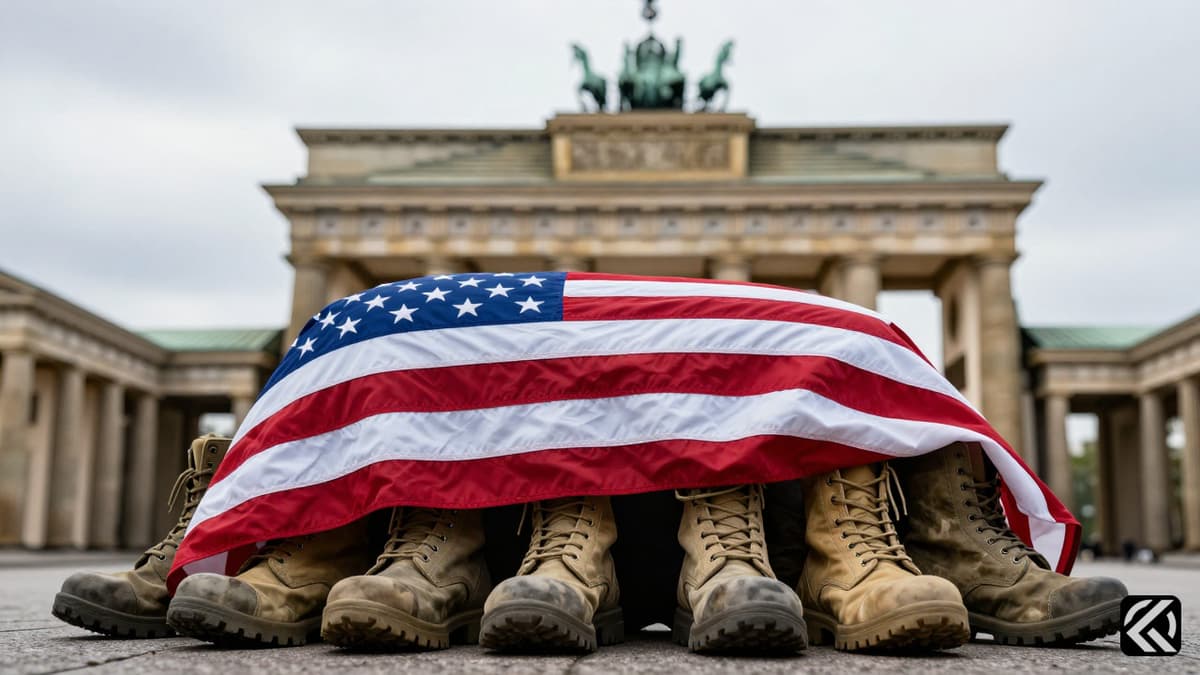
Amid escalating tensions over the Iran War, President Trump signals a potential reduction of American military presence in Europe, challenging European allies and NATO protocols.
The United States is navigating a critical geopolitical juncture as Donald Trump considers a significant reduction of American military forces stationed across Europe. This potential shift arises from mounting tensions with European nations over their criticism of Washington’s handling of the ongoing conflict with Iran.
In a span of just 48 hours, the President signaled that troops in Germany, Italy, and Spain could be withdrawn. These three countries have been vocal in their disapproval of the administration’s approach to the war, which began on February 28 and has severely disrupted global shipping through the Strait of Hormuz.
The immediate catalyst for this potential military restructuring involves sharp diplomatic exchanges between the Trump administration and European leaders. Earlier in the week, German Chancellor Friedrich Merz stated that the US was being “humiliated” by Iran in the ongoing war. Speaking to students in Marsberg, Germany, Merz criticized the administration for having “no truly convincing strategy” to end the conflict, noting that the war was costing Europe “a great deal of money” and directly impacting their economic output.
In response to these criticisms, Trump took to his Truth Social platform on Tuesday, attacking Merz directly. He claimed that Merz “thinks it’s OK for Iran to have a Nuclear Weapon” and asserted that the Chancellor “doesn’t know what he’s talking about!” The following day, Trump posted that the United States was “studying and reviewing the possible reduction of Troops in Germany, with a determination to be made over the next short period of time.”
When asked on Thursday if the pullout would extend to Italy and Spain, Trump confirmed that it was “probably” the case. He justified the move by stating, “Look, why shouldn’t I? Italy has not been of any help to us and Spain has been horrible, absolutely horrible.” This rhetoric marks a significant escalation in transatlantic relations, echoing previous tensions over US tariffs, the push for Greenland, and aid cuts to Ukraine.
If realized, the US Troops Withdrawal Europe would represent a major logistical and strategic retreat. As of December 2025, the US maintained approximately 68,064 active-duty military personnel in Europe, according to Pentagon data. These forces are spread across 31 permanent bases and 19 military sites, directed by US European Command (USEUCOM) in coordination with NATO.
The potential targets of this withdrawal host a combined total of nearly 53,000 troops. Germany hosts the largest contingent, with 36,436 active service members stationed in five garrisons, primarily centered around Ramstein Air Base, a logistical hub since 1952. Italy hosts 12,662 personnel across bases in Vicenza, Aviano, Naples, and Sicily. Spain hosts 3,814 personnel at Navy and Air Force bases near the Strait of Gibraltar.
Other European nations also host significant numbers. The United Kingdom hosts 10,156 service members, mainly Air Force personnel. Poland hosts 369 permanently assigned members plus about 10,000 rotational forces funded through the European Deterrence Initiative. Romania hosts 153 permanently assigned members alongside rotational forces, while Hungary hosts 77 permanent personnel. These bases serve not only as defensive outposts against Russia but as critical logistical hubs for US operations in the Middle East and Africa, including the current conflict with Iran.
Despite the President’s authority to direct military movements, a complete pullout faces substantial institutional hurdles. The president and the Department of Defense typically decide troop numbers, but Congress holds significant power to block or complicate major withdrawals through legislation and funding controls.
Historically, Trump has attempted similar moves. In 2020, during his first term, he threatened to pull 12,000 troops from Germany due to disputes over defense spending and the Nord Stream 2 pipeline. However, Congress pushed back against that decision, which was later overturned by former President Joe Biden.
The legal landscape for 2026 is even more restrictive. The 2026 National Defense Authorization Act (NDAA), passed by the Senate last year, includes a specific provision that bars US troop levels in Europe from being permanently reduced below 75,000. Since the total number of troops in Europe is approximately 68,064, this law effectively prevents a total withdrawal to zero, though it does not explicitly forbid a reduction from current levels if other statutory conditions are met.
The bases in Europe are deeply integrated into the global US military machine. They provide rent-free land and local staff salaries funded by host governments, effectively sharing the cost of stationing US forces. For instance, the Landstuhl Regional Medical Center in Germany is the largest American hospital outside the US, serving as the primary evacuation center for forces in Europe, the Middle East, and Africa.
The current friction extends beyond Germany. Trump has also criticized British Prime Minister Keir Starmer, describing him as “not Winston Churchill” after Starmer initially refused to allow US forces to use UK bases for strikes on Iran. Trump accused Starmer of failing to help reopen the Strait of Hormuz. Similarly, Italian Prime Minister Giorgia Meloni, once a favorite of Trump’s, faced public blastings after criticizing the war on Iran.
These tensions highlight the fragile nature of the current security architecture. The bases are critical for launching wars in the Middle East, including the current conflict. A withdrawal would not only damage diplomatic ties but could also disrupt the logistical support networks that sustain US military operations in the region.
The potential reduction of American forces underscores a growing divergence between Washington and its traditional European allies. As Trump criticizes European leaders for their stance on the Iran War, European nations may be forced to accelerate their own defense capabilities or seek alternative security arrangements. The legal cap of 75,000 troops in the 2026 NDAA suggests that while a total exit is impossible, a significant scaling down of the footprint is legally permissible if Congress allows funding for such a transition.
The outcome of this standoff will likely depend on congressional action and the evolving dynamics of the Iran War. If the conflict continues to baffle strategic planners and disrupt global economies, as German Chancellor Merz warned, the pressure to reassess the value of the current military presence in Europe will only intensify. European nations, having voiced strong criticism, may find themselves bearing a greater burden of continental security, challenging the post-WWII NATO framework that has relied on US troop deployments for decades.
May 1, 2026 21:53 UTC
Iran Devastates 16 US Military Sites Across Middle East
May 1, 2026 21:14 UTC
Trump Imposes 25% Tariffs on EU Cars, Escalating Trade War
May 1, 2026 17:36 UTC
Trump Rejects Iran Proposal as Strait of Hormuz Crisis Worsens
May 1, 2026 03:53 UTC
Hegseth Defends Iran War Actions Amid Stockpile and Legal Fears
May 1, 2026 23:07 UTC
Amit Shah Meets Sonam Wangchuk in Leh


