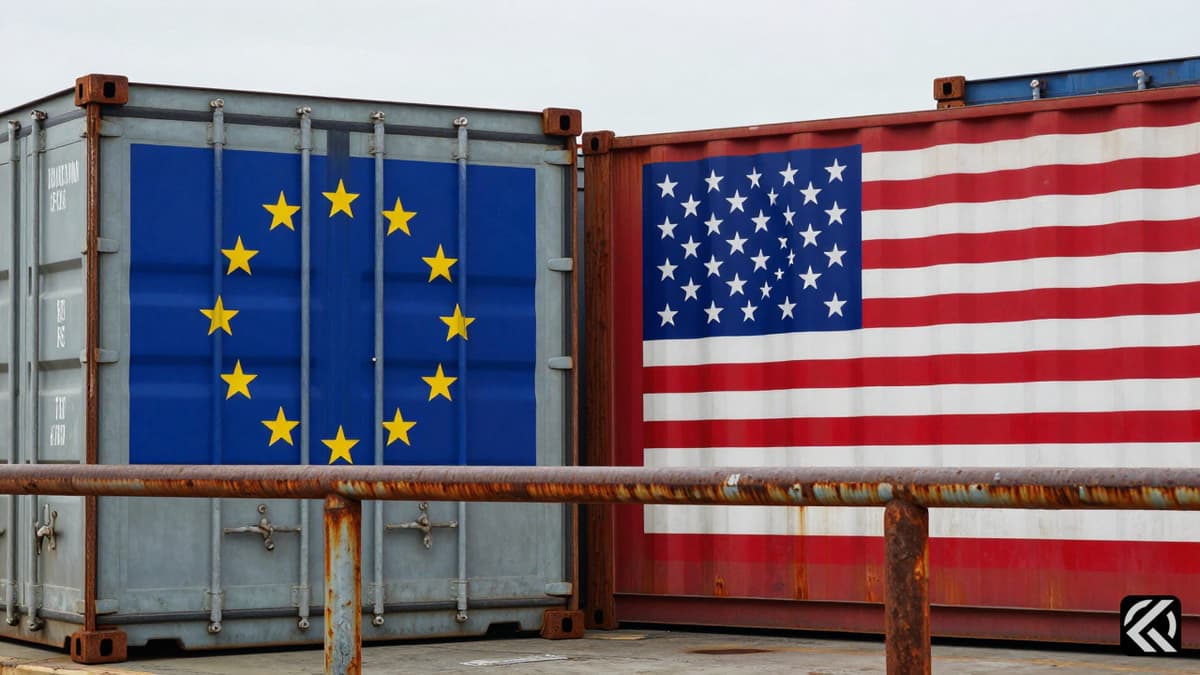
Trade tensions escalate as Donald Trump imposes a 25% tariff on EU cars, claiming breach of agreement. Brussels defends its record as diplomatic friction over Greenland and steel deepens the transatlantic rift.
Donald Trump is increasing the tariffs charged on cars and trucks imported from the European Union to 25% in a sharp escalation of trade tensions with Brussels. The US president accused the EU of "not complying with our fully agreed to trade deal" in a post on Truth Social, though he did not explain how the bloc failed to meet the terms. "I am pleased to announce that… next week I will be increasing Tariffs charged to the European Union for Cars and Trucks," Trump said on Friday, leaving the specific reasoning for the breach to speculation.
The European Commission responded by stating that the EU was adhering to its commitments but was also seeking "clarity" from the US around its own commitments. This sudden reversal comes less than a year after the EU and US agreed a deal at Trump's Turnberry golf course in Scotland, which had set levies on most European goods at 15%. That agreement had previously marked a reprieve for the EU from the 30% tariffs Trump had threatened to impose as part of his sweeping "Liberation Day" tariffs. In exchange for that lower rate, Europe had agreed to invest in the US and make changes expected to boost US exports.
However, the diplomatic landscape shifted dramatically in the following months. Tensions mounted significantly over President Trump's threats to annex Greenland, a self-governing Danish territory. This geopolitical friction led the European Parliament to suspend the approval of the trade deal in January. The deal was eventually approved by the European Parliament in March, but only after a critical clause had been added, allowing it to be suspended if the Trump administration was deemed to have "undermined the objectives of the deal, discriminated against EU economic operators, threatened member states' territorial integrity, foreign and defence policies, or engaged in economic coercion".
Since that legislative hurdle was cleared, talks have again stalled over a dispute about steel and aluminium. Major European economies such as Germany and France had rejected US plans to adjust tariffs on a wide range of goods. In its recent statement, the European Commission emphasized that the EU was implementing the deal "in line with standard legislative practice, keeping the US administration fully informed throughout". The Commission spokesman added: "We remain fully committed to a predictable, mutually beneficial transatlantic relationship. Should the US take measures inconsistent with the Joint Statement, we will keep our options open to protect EU interests".
Asked on Friday in what way the EU had failed to apply the terms of its deal with the US, Trump did not elaborate further than his initial accusations. He told reporters: "We have a trade deal with the European Union. They were not adhering to it. So I raised the tariffs on cars and trucks." In his Truth Social post, he added that it is "fully understood and agreed that, if they produce Cars and Trucks in U.S.A. Plants, there will be NO TARIFF". He highlighted that billions of dollars are being invested in car and truck plants across the country, figures he described as "a record in the history of car and truck manufacturing".
The escalation has drawn sharp criticism from European leadership. Bernd Lange, the chair of the European Parliament's international trade committee, told the BBC that Trump's statement demonstrated "just how unreliable the US" is as a trading partner. Lange dismissed the President's argument that the EU was not fulfilling its side of the deal, stating that the European Parliament was in the process of drafting necessary legislation which it aimed to finalize in June.
Mr Lange acknowledged that his committee had paused implementation of the deal because of US pressure over Greenland and the fallout of the US Supreme Court decision. However, he argued that the US has "repeatedly breached the agreement," pointing to products containing steel and aluminium which are now subject to average tariffs of 26%. Lange said: "This latest move demonstrates just how unreliable the US side is. We have already witnessed these arbitrary attacks from the US in the case of Greenland; this is no way to treat close partners. Now we can only respond with the utmost clarity and firmness, drawing on the strength of our position."
The current standoff highlights the fragility of the transatlantic trade relationship. While the Trump administration frames the 25% Donald Trump levy as a necessary correction for European non-compliance, European officials view it as an arbitrary attack that violates the spirit and letter of the recent agreement. The inclusion of the suspension clause in the March approval indicates that the EU had anticipated such volatility, yet the immediate return to aggressive tariff hikes suggests that the underlying trust in the partnership has severely deteriorated.
As the US moves to enforce the new levies, the European Commission maintains that it is acting within its rights to seek clarification while preparing potential countermeasures. The focus has shifted from cooperation to defense of economic interests, with the suspension clause potentially being invoked again if the situation regarding steel, aluminium, and now automotive goods continues to worsen. The path forward remains unclear, with both sides entrenched in their positions and no immediate diplomatic mechanism offered to resolve the dispute.
The imposition of these EU tariffs marks a significant deterioration in US-European economic ties, reversing recent diplomatic gains. If the European Union does not find a mechanism to negotiate a new framework that addresses US concerns regarding Greenland and industrial policy without further economic coercion, the region could face prolonged trade disruptions. The precedent set by this abrupt policy shift suggests that future agreements will require even stricter enforcement clauses, potentially isolating the US economy from traditional European markets in the long term.
May 1, 2026 23:50 UTC
Trump Signals US Troops Withdrawal Europe Amid Iran War Tensions
Join 50,000+ readers getting the global briefing every morning.
No spam. Unsubscribe anytime.
May 1, 2026 23:07 UTC
Amit Shah Meets Sonam Wangchuk in Leh
May 1, 2026 21:53 UTC
Iran Devastates 16 US Military Sites Across Middle East
May 1, 2026 19:02 UTC
Congress Slams PM Modi Over Commercial LPG Price Hike
May 1, 2026 17:36 UTC
Trump Rejects Iran Proposal as Strait of Hormuz Crisis Worsens


