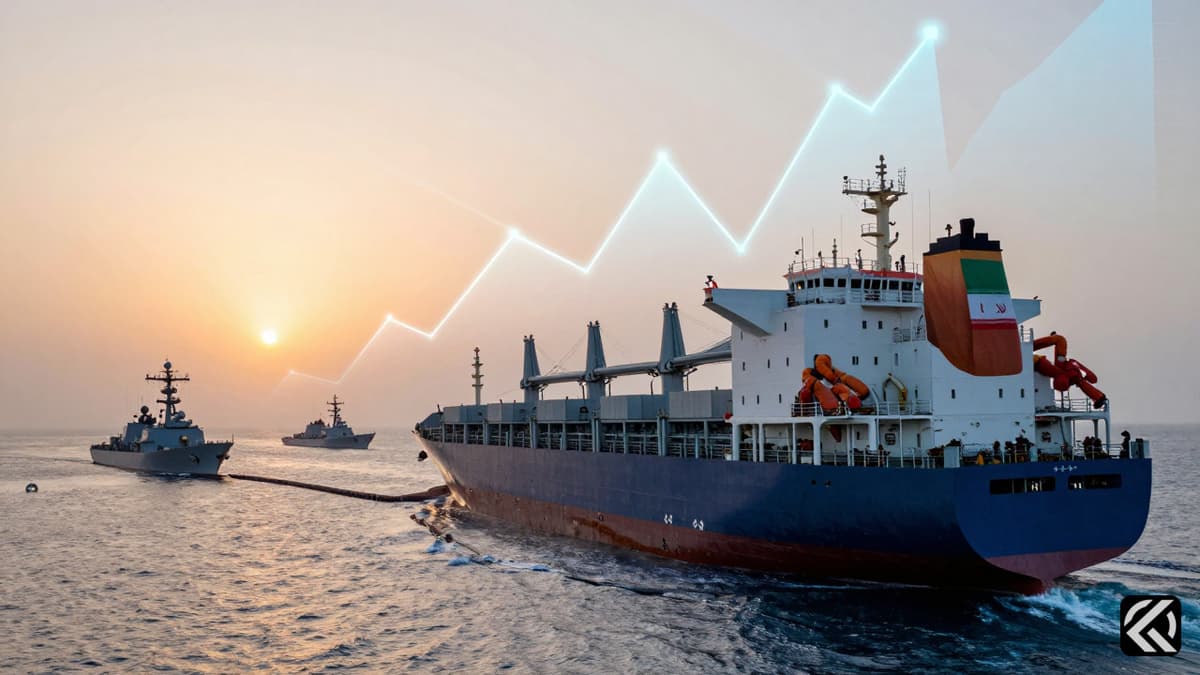
Global oil markets react instantly as President Trump confirms the seizure of an Iranian cargo ship, sending Brent crude and oil prices soaring amid fears of a closed Strait of Hormuz.
The global energy market experienced a significant shock this Monday as President Donald Trump announced that US forces had intercepted and seized an Iran-flagged cargo ship. This dramatic escalation occurred just as oil prices were climbing in early Asia trade, driven by renewed tensions in the region.
This development follows a Saturday announcement by Iran, which declared it was closing the vital Strait of Hormuz waterway to commercial vessels again. Tehran warned that any ship approaching the area would be targeted, signaling a dangerous escalation in the ongoing conflict between the two nations.
In response to the seizure and the threat, global energy markets saw immediate volatility. Brent crude futures jumped by 4.74% to reach $94.66 (£70.11) a barrel. Meanwhile, West Texas Intermediate futures rose even faster, climbing 5.6% to $88.55 per barrel. These figures represent a sharp divergence from the pre-conflict benchmark, which was trading at under $70 per barrel before the hostilities began. On 9 March, prices had already peaked near $120 before fluctuating.
The volatility in energy markets has been wild since the US and Israel launched attacks on Iran on 28 February. In retaliation, Tehran issued threats to target shipping in the strait, a chokepoint through which approximately 20% of the world's oil and liquefied natural gas (LNG) passes. Analyst Saul Kavonic from financial services firm MST Marquee noted that markets continue to gyrate in response to oscillating social media posts from both sides rather than the realities on the ground, which remain challenging for oil flows to resume rapidly.
On Monday, White House representatives were scheduled to be in Pakistan for negotiations. A White House official confirmed that Vice-President JD Vance would lead the US delegation. However, Iran's state media has stated that Tehran has "no plans for now to participate" in the talks, though Iranian officials have not yet clarified the country's official position on the matter.
The Strait of Hormuz remained closed on Sunday, a day after the Islamic Revolution Guard Corps (IRGC) ended a temporary reopening. The IRGC claimed the previous reopening violated the terms of their ceasefire agreement due to a US naval blockade. Iran has stated it will keep the strait closed until the US ends its naval blockade. President Trump had previously indicated on Friday that the blockade would continue until a deal was agreed upon by the two countries.
Futures contracts, which are agreements to buy or sell assets at a set price on a specified date in the future, are currently reflecting these tensions. The Brent futures contract being quoted is for crude oil to be delivered in June. The impact of this instability is felt most heavily in Asia, a region that relies on shipments passing through the Strait of Hormuz for around 90% of its energy needs.
Governments in the affected region have ordered employees to work from home, cut the working week, declared national holidays, and closed universities early to conserve energy supplies. Some South East Asian countries, including Singapore and Thailand, have specifically called on citizens to curb their use of air conditioning to save energy as the situation remains critical.
The immediate closure of the Strait of Hormuz combined with the naval seizure creates a prolonged risk of supply disruption for the global economy. If the US maintains its blockade and Iran refuses to negotiate, the region faces a sustained period of restricted oil flows, likely keeping oil prices elevated well above current levels. Given that Asia consumes the majority of the world's oil passing through this route, continued hostilities could force extended energy conservation measures and economic contraction across the continent. The lack of a confirmed diplomatic breakthrough suggests that the current volatility in Brent crude may persist as long as the blockade and threats remain in place, making the Strait of Hormuz the primary focal point for global energy stability in the coming weeks.
Jun 8, 2026 04:15 UTC
Trump Urges Netanyahu to Halt Iran Strike for Peace
Join 50,000+ readers getting the global briefing every morning.
No spam. Unsubscribe anytime.
Jun 8, 2026 02:28 UTC
Trump Walks Out of Meet the Press After Rejecting Evidence Demands
Jun 8, 2026 02:17 UTC
Magnitude 7.8 Quake Shakes Philippines, Urging Immediate Evacuations
Jun 8, 2026 00:51 UTC
Trump Claims Iran Nuclear Deal Imminent Despite Diplomatic Fractures
Jun 8, 2026 00:47 UTC
Iran Fires Missiles at Israel After Beirut Strike


