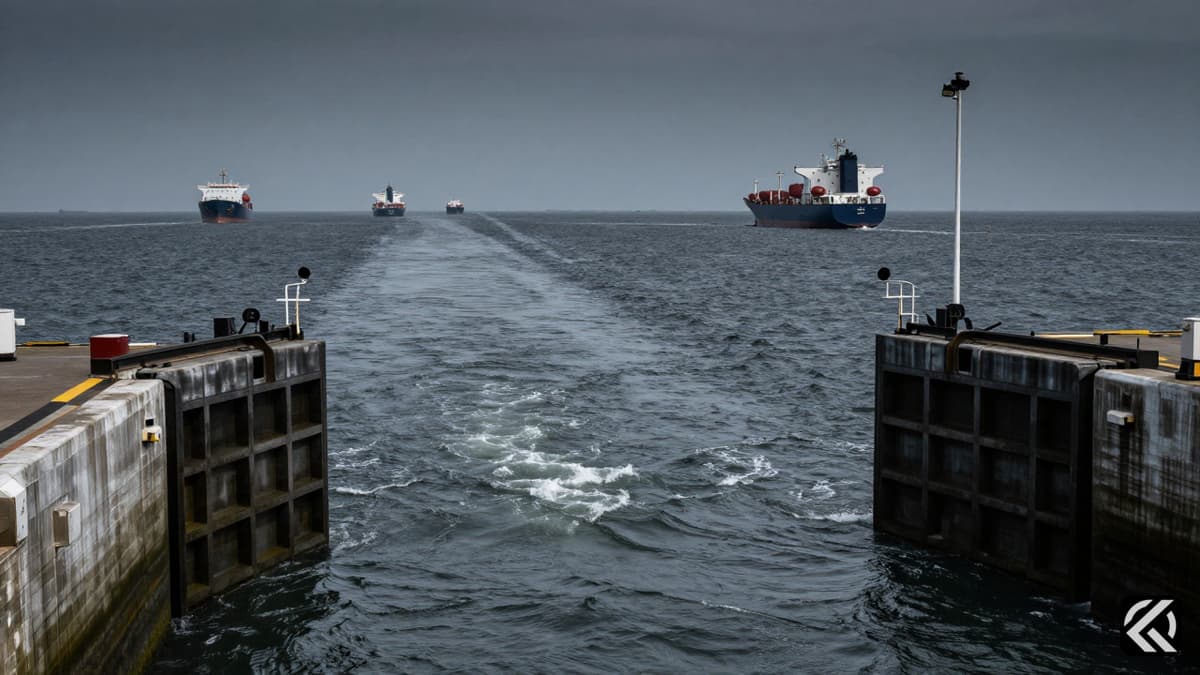
President Trump pauses a maritime aid mission to force Iran into a deal, warning of intensified aerial strikes if Tehran refuses to reopen the critical Strait of Hormuz.
In a significant shift in diplomatic strategy, U.S. President Donald Trump announced on Wednesday, May 6, 2026, that he has paused “Project Freedom,” a controversial operation launched earlier in the week designed to guide stranded merchant ships through the strategic Strait of Hormuz. The pause comes as the administration cites “great progress” in negotiations with Tehran, marking a delicate pivot from recent military posturing to economic and diplomatic coercion.
When Mr. Trump originally announced the Project Freedom initiative on Monday, May 4, 2026, he explicitly warned that any Iranian response would be met “forcefully.” This announcement followed escalating tensions, including Iran’s claim that it had fired at two U.S. destroyers in the strait, pushing them back, and the United Arab Emirates reporting that it was attacked twice by missiles and drones, with one of its tankers coming under fire. Now, however, the President has halted the naval escort mission, stating that while the blockade remains in full force, the temporary pause is intended to determine whether a final agreement can be signed.
“Based on the request of Pakistan and other countries..., and... the fact that great progress has been made toward a complete and final agreement with Iran, we have mutually agreed that, while the blockade will remain in full force and effect, Project Freedom will be paused for a short period of time to see whether or not the agreement can be finalised and signed,” Mr. Trump wrote in a social media post, highlighting the mediating role of Islamabad in these high-stakes talks.
The diplomatic landscape is shifting rapidly as both sides engage in proposal exchanges. Iranian Foreign Ministry spokesperson Esmail Baqaei confirmed in an interview that Tehran is currently reviewing the American response to its own proposal and will present its counter-response through Pakistani mediators. Pakistani Prime Minister Shehbaz Sharif welcomed the President’s announcement, stating that it advances “regional peace, stability and reconciliation,” signaling a potential thaw in the conflict that has dominated headlines since late February.
The origins of this crisis trace back to February 28, when the U.S. and Israel began attacking Iran, leading Tehran to effectively close the Strait of Hormuz. Active fighting ceased on April 8, when Mr. Trump announced a ceasefire, but economic warfare intensified shortly after. On April 12, the U.S. imposed a blockade on Iranian ports, heaping unprecedented economic pressure on the country. This blockade remains the primary lever of pressure in the current negotiations, with Mr. Trump making his intentions clear in a separate post on Wednesday.
“The war could come to an end and the Strait of Hormuz would be opened for all if Iran accepted a deal,” Mr. Trump stated. “Assuming Iran agrees to give what has been agreed to, which is, perhaps, a big assumption, the Epic Fury will be at an end, and the highly effective Blockade will allow the Hormuz Strait to be OPEN TO ALL, including Iran.” He followed this with a stark warning: “If they don’t agree, the bombing starts, and it will be, sadly, at a much higher level and intensity than it was before.”
This threat represents a notable escalation in rhetoric. In the first week of April, Mr. Trump had previously threatened to bomb Iran’s civilian infrastructure if Tehran did not reopen the strait, only to take a U-turn and announce a ceasefire days later. The current stance suggests that the ceasefire was conditional and that the window for diplomatic resolution is narrowing rapidly. The mention of “Epic Fury” links the current conflict to the code name of recent U.S. military operations, suggesting that the pause is tactical rather than a cessation of hostilities.
On the ground and at sea, Iran is preparing for a prolonged confrontation. The Iranian Islamic Revolutionary Guard Corps (IRGC) issued a statement on Wednesday claiming that transit through the strait would become safe as the security situation improves “with the aggressor’s threats neutralised.” The IRGC Navy thanked ship captains for complying with Iran’s regulations and asserted that “safe, stable passage through SOH will be ensured” under new protocols. This narrative is part of a broader effort to project strength and sovereignty despite the economic strangulation caused by the U.S. blockade.
To formalize its control, Iran’s state media reported that the country has officially launched a new mechanism to govern maritime traffic. Under this system, all vessels intending to transit the strait must receive an email from the official address info@PGSA.ir outlining the rules and regulations for passage. Ships are required to obtain a transit permit before crossing, effectively placing all maritime commerce under Tehran’s direct oversight.
Furthermore, legislative action is advancing in Iran’s Parliament to further isolate its adversaries. A draft law aims to impose a total ban on any ships associated with Israel, while vessels linked to the U.S. and “other hostile countries” would face restrictions. The legislation also establishes a tolling system for the passage of non-hostile vessels, indicating that Iran intends to monetize and regulate the strait even as it seeks to break the U.S. blockade.
The pause of Project Freedom suggests that the U.S. is prioritizing a diplomatic resolution over immediate military escalation, yet the underlying threat of intensified bombing remains a powerful coercive tool. If Iran accepts the terms mediated by Pakistan, the reopening of the Strait of Hormuz could stabilize global energy markets, which have been volatile due to the blockade. However, the implementation of strict transit permits and tolling systems by Iran indicates that Tehran is reluctant to fully relinquish control without significant concessions. The success of these negotiations hinges on the willingness of both sides to compromise; failure could result in the “higher level” bombing warned by Mr. Trump, potentially expanding the conflict beyond the Persian Gulf and causing severe disruptions to global supply chains. The international community, led by mediators like Pakistan, will likely watch closely to see if the “great progress” cited by the White House translates into a durable agreement or merely a temporary reprieve before renewed hostilities.
May 9, 2026 21:40 UTC
Russia Cuts Heavy Armor From Victory Day Parade Amid War
Join 50,000+ readers getting the global briefing every morning.
No spam. Unsubscribe anytime.
May 9, 2026 21:40 UTC
Russia Cuts Heavy Armor From Victory Day Parade Amid War
May 9, 2026 21:28 UTC
Delhi Terror Threat: Security Intensified at BJP HQ on Deen Dayal Upadhyaya Marg
May 9, 2026 19:32 UTC
Hardliners Sabotage Iran-US Negotiations Amidst Fractured Regime
May 9, 2026 19:30 UTC
India Successfully Deploys MIRV Agni-5 Missile System


