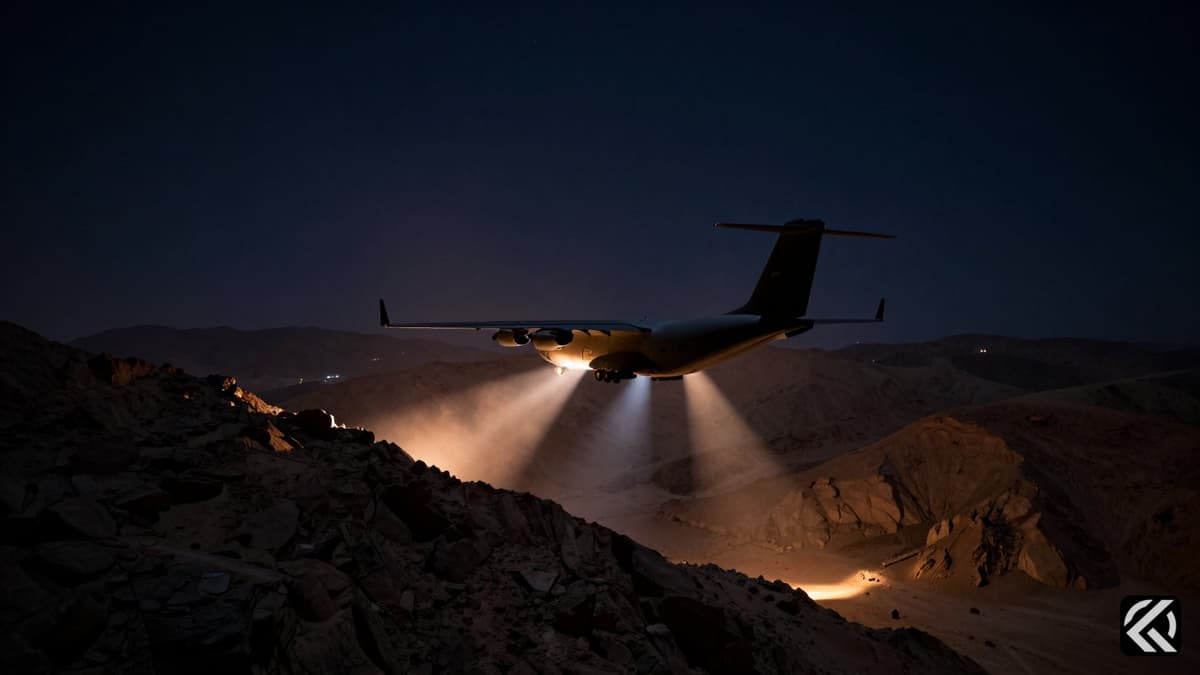
In a high-stakes mission during the Iran-Israel war, U.S. Special Operations forces successfully extracted a critically injured airman whose F-15E was downed in Iran.
In a statement released on Sunday, April 5, 2026, President Donald Trump confirmed that U.S. Special Operations forces successfully rescued a U.S. Air Force officer whose fighter jet was downed in Iran. The daring mission occurred on Saturday night, April 4, following the F-15E Strike Eagle being shot down over southern Iran on Friday, April 3, during the escalating Iran-Israel war.
The situation began on Friday when an F-15E, carrying a crew of two military officials, came under fire while flying over southern Iran. Both crew members ejected from the aircraft. One of the airmen was successfully rescued in an earlier operation on the same day. However, the second airman, identified as a highly respected Colonel, remained in the area. For more than 36 hours, he was stranded in the treacherous mountains of southern Iran, facing relentless pursuit by Iranian forces who were closing in on his location.
The subsequent extraction effort was described by President Trump as "one of the most daring Search and Rescue Operations in U.S. History." In a social media post, the President declared, "WE GOT HIM!" and detailed how, at his direction, the U.S. Military deployed dozens of aircraft armed with lethal weapons to retrieve the stranded officer. The operation was deemed particularly dangerous due to the large numbers of enemy forces searching the area.
The F-15E, which was downed in the conflict, marks a significant escalation as it is the first American jet shot down by Iran since the United States and Israel launched the war on Iran on February 28. The crash was not an isolated incident; on the same day the F-15E was hit, an A-10 Warthog aircraft was also struck over the Persian Gulf, forcing its pilot to eject before the plane crashed. Additionally, a U.S. Air Force UH-60 Black Hawk helicopter involved in the initial rescue of the first pilot was hit by Iranian fire but managed to land safely in Iraq.
President Trump later revealed that the rescued airman was "seriously wounded" but is now "safe and sound." He emphasized that no American service members were killed or wounded during the rescue operation. The President further claimed that the United States has "achieved overwhelming Air Dominance and Superiority over the Iranian skies" as a result of the engagement. He noted that the raid was seldom attempted due to the extreme danger to both personnel and equipment.
In direct contradiction to the U.S. account, Iran's military characterized the American effort as "a complete failure." A spokesperson for Iran's Khatam al-Anbiya Central Headquarters, Lieutenant Colonel Ebrahim Zolfaqari, stated that Iranian armed forces thwarted the rescue mission, which was allegedly planned as an immediate escape operation from an abandoned airport in southern Isfahan.
According to the Islamic Revolutionary Guard Corps (IRGC), the "enemy's flying objects were destroyed," leading to what they termed a "humiliating defeat" for the United States. The Iranian military claimed responsibility for destroying two U.S. MC-130J transport aircraft, two Black Hawk helicopters, and two drones-an MQ-9 Reaper and an Elbit Hermes-900-over Isfahan on Sunday. The MC-130J, equipped with advanced sensors for inserting and extracting troops, was reportedly destroyed after getting stuck at a remote base in Iran.
Iranian Parliament Speaker Mohammad-Bagher Ghalibaf reinforced this narrative on social media, sharing an image purportedly showing the charred remains of aircraft. He warned that "If the United States gets three more victories like this, it will be utterly ruined." U.S. media, quoting unnamed officials, reported that the military lost the two MC-130s during the operation. The first raid had occurred in broad daylight, lasting seven hours over Iranian airspace, which the President noted was also unusual for such a high-risk maneuver.
The successful U.S. Special Operations rescue concludes a tense sequence of events within the broader Iran-Israel war. The conflict, initiated on February 28, has seen the F-15E downed as a pivotal moment where American air power was directly challenged on Iranian soil. The conflicting narratives regarding the success of the mission highlight the chaotic nature of the air campaign, where both sides are claiming dominance over specific engagements.
The loss of the MC-130J transport planes and the claim of destroying multiple helicopters and drones suggests significant material losses for the U.S. force during the extraction. While President Trump maintains that the operation was a triumph resulting in the safe recovery of a wounded officer, Iran's assertion of a "complete failure" underscores the intense difficulty of the terrain and the hostile environment the pilots faced.
The aftermath of this U.S. Special Operations rescue is likely to influence future military strategies in the region. With the U.S. claiming "overwhelming Air Dominance" despite reported losses of equipment, future missions may involve even heavier air support to counter the dense Iranian ground defenses. The conflicting reports of success versus failure could lead to a hardening of positions on both sides, potentially escalating the duration and intensity of the Iran-Israel war. As Iran vows further retaliation and claims victory in destroying advanced U.S. assets, the immediate future of the conflict appears volatile, with no clear path to de-escalation in sight. The serious injuries sustained by the rescued airman also raise questions about the physical toll on military personnel engaging in such high-risk, deep-penetration operations over hostile territory.
Jun 8, 2026 02:17 UTC
Magnitude 7.8 Quake Shakes Philippines, Urging Immediate Evacuations
Jun 8, 2026 00:51 UTC
Trump Claims Iran Nuclear Deal Imminent Despite Diplomatic Fractures
Jun 8, 2026 00:47 UTC
Iran Fires Missiles at Israel After Beirut Strike
Jun 7, 2026 22:00 UTC
US, Iran Peace Hops Fade 100 Days Into War
Jun 8, 2026 04:15 UTC
Trump Urges Netanyahu to Halt Iran Strike for Peace


