Section
Commuters face gridlock as Haryana police divert traffic from the Amritsar-Delhi GT Road due to security arrangements, creating chaos on the Lehli-Lalru stretch.
A massive traffic jam crippled the Ambala-Chandigarh National Highway on Tuesday following the closure of the Shambhu barrier. This closure was implemented by Haryana police to secure the route for a proposed farmer's march toward Delhi. The security arrangements caused significant disruption to daily commuters and emergency services.
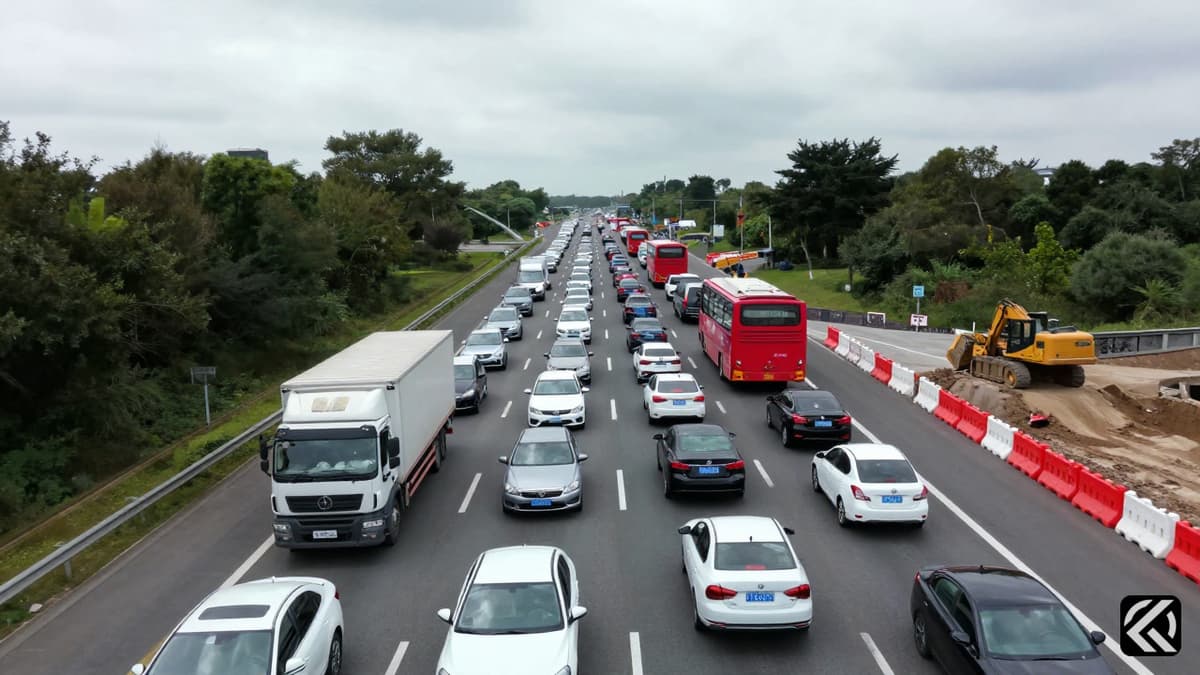
The congestion was triggered when Haryana Police tightened security on the GT Road, erecting barricades and using heavy earthmoving machinery for temporary road closures. Consequently, a significant volume of traffic was diverted from the Amritsar-Delhi GT Road toward the Ambala-Chandigarh National Highway. This redirection led to severe congestion on the Lehli-Lalru stretch, affecting thousands of office-goers, students, and local residents.
Traffic Special Police (SP) Navneet Singh Mahal explained the situation, stating, “As Shambhu barrier was closed for forward movement of farmers towards Delhi, the entire traffic was diverted towards Lehli-Lalru highway causing major traffic jam. Our police are deployed at the spot and are managing the flow.” Despite these efforts, the heavy influx of diverted vehicles kept the area heavily congested throughout the day.
The worst congestion was witnessed on the Lehli-Lalru stretch, where vehicles remained stuck in kilometers-long queues for several hours. Trucks, buses, private cars, and two-wheelers crawled through the jam at a snail’s pace. Service lanes along the highway were also packed with traffic, exacerbating the gridlock. Eyewitnesses reported that traffic began building up in the morning and worsened as the day progressed, leaving many motorists stranded.
The impact of this Lehli-Lalru highway traffic jam extended beyond mere inconvenience. The gridlock disrupted emergency services, as ambulances found it difficult to pass through the congested highway. Many motorists attempted to use alternative routes, but these routes also witnessed heavy traffic due to the increased vehicle load from the main diversion. The situation highlighted the vulnerability of regional infrastructure to large-scale political demonstrations.
Commuters expressed significant frustration over the prolonged delays. Rajiv Jain, a commuter traveling to Delhi, shared his experience: “Such protests are very disturbing. We were to reach Delhi by 1pm and now we are stuck here for two hours now. Protestors must think about the common man also as they always put them in trouble.” His sentiment was shared by many others who spent hours on the road, highlighting the tension between political expression and public utility.
Police personnel were deployed at key intersections to regulate traffic, but the sheer volume of diverted vehicles continued to overwhelm local capacity. The closure of the Shambhu barrier was a critical node in the regional highway network, and its restriction for security purposes created a cascading effect on surrounding roads. The deployment of a large police force aimed to maintain law and order, but the logistical challenge of managing thousands of stranded vehicles remained immense.
The incident underscores the complex intersection of security protocols and public infrastructure management. When major highways are repurposed for political processes, the ripple effects on daily life can be substantial. The reliance on alternative routes proved insufficient, as the volume of traffic exceeded the capacity of nearby roads. This suggests that future such events may require more robust contingency planning from authorities to mitigate the impact on essential services and commuters.
The closure of the Shambhu barrier for security purposes has resulted in a prolonged and severe Lehli-Lalru highway traffic jam, affecting thousands of commuters. The diversion of traffic from the Amritsar-Delhi GT Road to the Ambala-Chandigarh National Highway created a bottleneck that emergency services struggled to navigate. If similar security arrangements are implemented in the future without adequate alternative routing infrastructure, similar gridlocks are likely to recur. Authorities must balance security needs with public transit efficiency to prevent prolonged disruptions to daily life and emergency response capabilities.
Oct 3, 2026 04:08 UTC
FlyDubai Co-Pilot Banned in Oman Over Extremism Concerns
Oct 3, 2026 00:50 UTC
Israel-Mumbai Campaign Honors Captain Smit After Flydubai Incident
Oct 2, 2026 18:13 UTC
Captain Smit Machchhar’s Courage Saves Flydubai Flight FZ1073 From Disaster
Oct 2, 2026 16:45 UTC
Captain Smit Machchhar Saves Plane Mid-Fall
Sep 20, 2026 06:56 UTC
Five Die in Chatsworth Bus Collision and Helicopter Crash