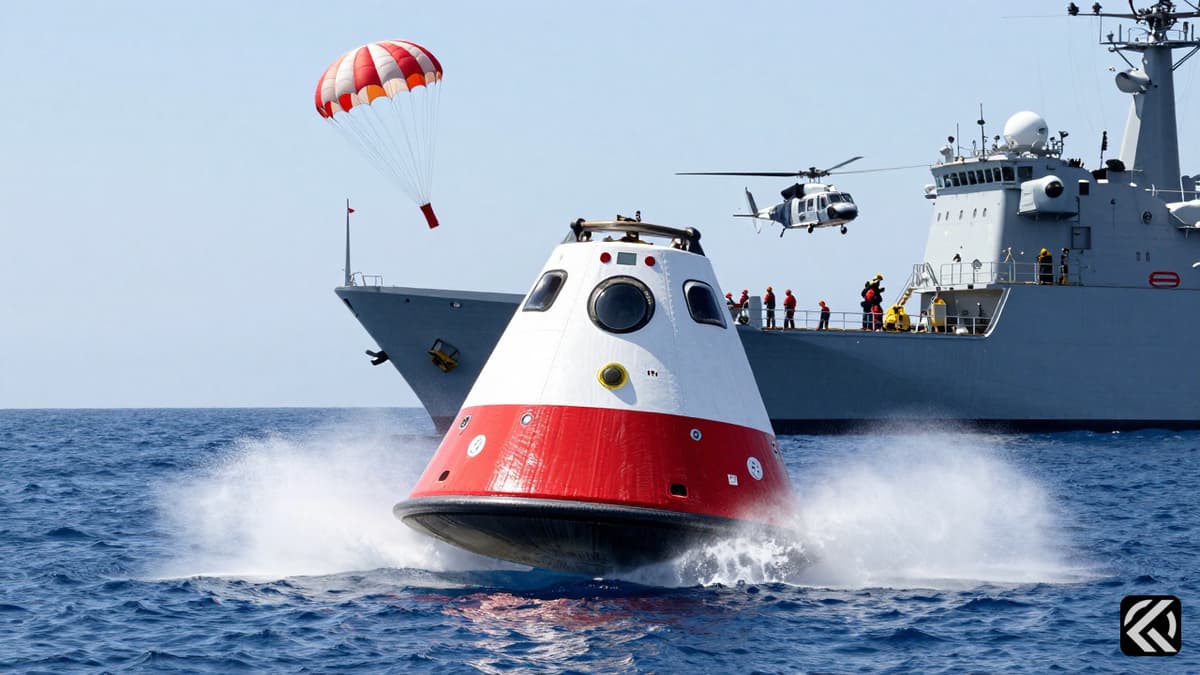
Four astronauts have returned safely to Earth after a historic nine-day voyage around the Moon, marking a flawless conclusion to the Artemis II mission and clearing the path for future lunar exploration.
Four astronauts from NASA's Artemis II mission have returned safely to Earth, completing a historic nine-day journey around the Moon. The crew splashed down in the Pacific Ocean after a flawless return, marking the end of the most extensive deep-space voyage in human history. The team is now aboard a waiting ship, recovering from the extreme conditions endured during their descent.
The return journey was fraught with challenges, most notably the intense heat generated as the capsule re-entered Earth's atmosphere. The Orion spacecraft traveled at more than 24,000mph (38,600km/h) upon impact with the upper atmosphere, subjecting its heatshield to temperatures half as hot as the surface of the Sun. This extreme thermal load caused the capsule, which the astronauts named Integrity, to lose contact with mission control in Houston for six minutes.
Tension mounted as the capsule approached Earth, with a specific angle of attack required to ensure a safe entry. If the angle were too shallow, the craft would skip off the atmosphere; if too steep, the heat would cause catastrophic damage. According to NASA's TV coverage, the angle of attack was perfect, guiding the capsule to a narrow target of sky southeast of Hawaii as it headed toward the Californian coast. The moment of maximum jeopardy passed when the red-and-white parachutes deployed, sending the capsule sailing majestically through the sky before it hit the water for a "perfect bull's eye splashdown," according to commentator Rob Navias.
The mission's success clears the way for the next stage of the Artemis programme, which aims to land humans on the lunar surface and eventually build a permanent base. While this specific mission did not place boots on the Moon, it confirmed that the hardware works, the trajectory holds, and the crew can withstand the journey. The Artemis II mission began its final descent at 19:33 EDT when the European Space Agency-built service module detached, leaving the capsule to push gracefully homeward.
A significant concern prior to the flight was the condition of the spacecraft's heatshield, following unexpected damage observed during the uncrewed Artemis I test flight in 2022. Engineers had modified the re-entry path to reduce the thermal load on the shield, and this mission marked the first time this new return path was tested in flight. Although full data analysis is pending, Flight Director Rick Henfling noted that the crew was happy and healthy once the side hatch opened, relieving the anxiety that had built up among the recovery team.
Upon splashing down, the astronauts-Commander Reid Wiseman, pilot Victor Glover, mission specialist Christina Koch, and Canadian astronaut Jeremy Hansen-were carefully extracted and flown by helicopter to the USS John P Murtha. There, they underwent medical evaluations before being prepared for their flight to Houston. President Donald Trump welcomed them home, describing the trip as "spectacular" and inviting the crew to visit the White House. The astronauts were seen smiling and chatting on the ship's deck, posing for photos with the recovery team.
Lori Glaze, acting associate administrator at NASA, praised the crew's "teamwork" and "camaraderie," noting that they brought an amazing sense of what humanity was trying to achieve. Associate Administrator Anit Kshatriya emphasized that the precision of the landing was not luck, but the result of 1,000 people doing their jobs. "The team hit it," Kshatriya stated, contrasting the precision of the return with the 250,000-mile journey to the Moon.
The successful conclusion of the Artemis II splashdown confirms the viability of the current hardware and trajectory for deep-space travel. While the immediate future will focus on the crew's reunion with families in Houston and their first public appearance, the broader implications for space exploration are profound. With the flight crew demonstrating their ability to handle the extreme re-entry conditions, the program is now positioned to tackle the most difficult challenge yet: landing on the lunar surface. The data gathered from the heatshield's performance will likely inform future modifications, ensuring that subsequent missions can build a permanent base on the Moon. As NASA moves forward, the confidence instilled by this mission serves as the critical stepping stone for the next generation of lunar explorers.
Jun 8, 2026 00:51 UTC
Trump Claims Iran Nuclear Deal Imminent Despite Diplomatic Fractures
Jun 8, 2026 00:47 UTC
Iran Fires Missiles at Israel After Beirut Strike
Jun 7, 2026 22:00 UTC
US, Iran Peace Hops Fade 100 Days Into War
Jun 7, 2026 20:57 UTC
Iran Strikes Israel: IRGC Promises Week of Continuous Offensive
Jun 8, 2026 02:28 UTC
Trump Walks Out of Meet the Press After Rejecting Evidence Demands


