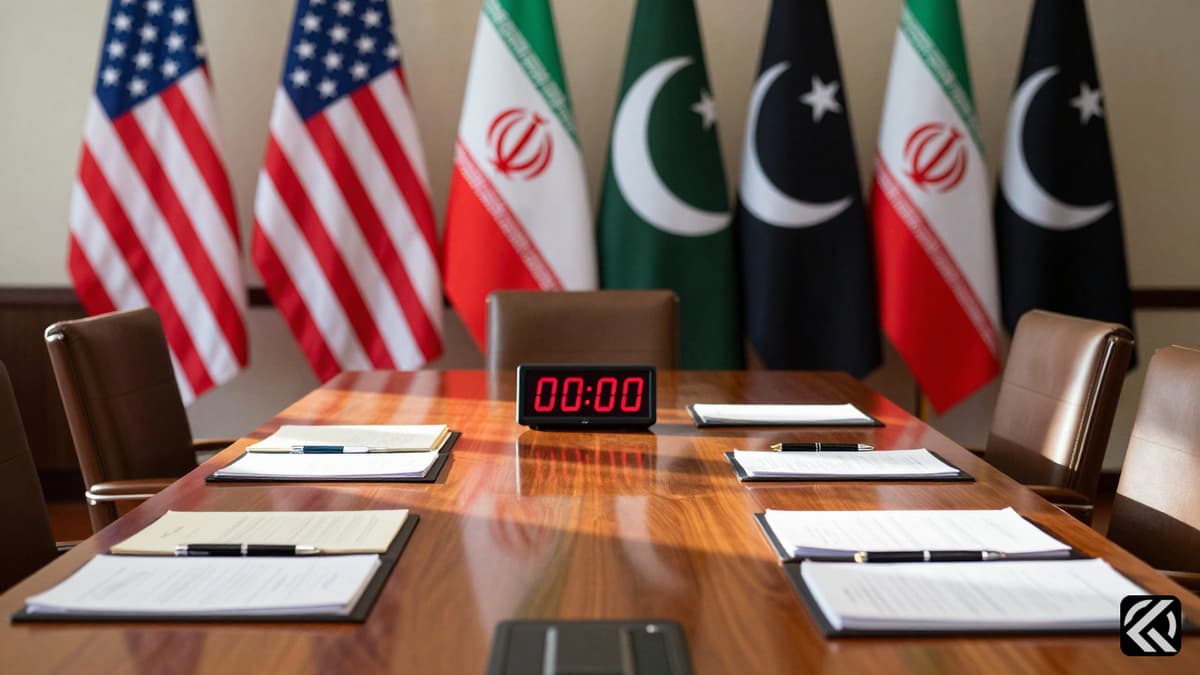
Amidst an Easter lunch at the White House, President Trump joked about assigning JD Vance the difficult task of securing a deal to end the Iran war, setting a high bar for the VP's upcoming mission.
In the midst of an Easter lunch at the White House, President Donald Trump broke his prepared remarks to address the heavy burden placed on Vice President JD Vance. The President joked that he would blame Vance if a deal to end the war in Iran does not materialize, while simultaneously claiming full credit if it does, a remark that underscored the precarious position of the Vice President. Vance is currently leading a US delegation in Islamabad, Pakistan, for what is being described as the most challenging assignment of his vice-presidency, characterized by limited upside and significant risks if the negotiations fail.
The diplomatic mission in Islamabad serves as a political minefield for Vance, who must navigate a landscape fraught with conflicting interests among various stakeholders. These parties, all distrustful of one another following a six-week military campaign that has engulfed the Middle East and destabilized the global economy, require Vance to satisfy competing demands to reach a permanent agreement. A European official speaking on condition of anonymity noted that allies are watching Vance closely, emphasizing that he must step into the room and deliver something to avoid being diminished.
Any successful agreement must first and foremost secure the support of President Trump, whose foreign policy stance has vacillated between calls for peace and threats to destroy Iran's civilization. The deal also requires the backing of a weakened but still-standing regime in Tehran, which has tightened control over the Strait of Hormuz, as well as an ally in Israel that remains wary of a region-wide ceasefire. Furthermore, Vance must convince US allies in Europe, who oppose the war and have been reluctant to assist in reopening the strait, that their interests are being addressed.
Adding to the complexity, Vance faces immense pressure to satisfy Trump's Make America Great Again (MAGA) base, many of whom are opposed to foreign interventions. This group will be scrutinizing his trip for clues regarding how he might handle foreign policy if he runs for president in 2028. Despite being a former Marine and a vocal opponent of US entanglements in the past, Vance reportedly expressed deep skepticism about launching strikes on Iran during private meetings with Trump.
JD Vance has signaled a desire for restraint in American foreign policy, a stance that is difficult to reconcile with the ongoing American war against Iran, according to Jeff Rathke, president of the American-German Institute. In Islamabad, the central question for Vance is whether he can make all parties happy and what success actually looks like-whether it is a fully-formed peace deal or just productive initial talks that do not scuttle the temporary ceasefire.
A White House official confirmed that Trump tasked the vice-president to lead the negotiations, with Ivanka's husband, Jared Kushner, and special envoy Steve Witkoff accompanying him to Pakistan. Before departing Washington, Vance tamped down expectations, telling reporters that the US is willing to extend an open hand if the Iranians negotiate in good faith, though he warned against any attempts to "play us." Despite Trump providing "some pretty clear guidelines," the president's propensity to change his mind poses a significant challenge for the team representing a mercurial boss.
The volatility of Trump's negotiating style was evident in the days leading up to the recent Iran war ceasefire deal. In a single 36-hour span, Trump gave Iran one day to strike a deal, warned on Truth Social that a "whole civilisation will die" if they refused, and then announced a ceasefire with less than two hours remaining before his deadline to escalate the war. This tense period was described by a senior European diplomat as being as nerve-wracking as any moment in Trump's second term.
US-Islamabad talks are expected to be equally difficult, requiring Vance to navigate a volatile region while addressing complex issues like reopening the Strait of Hormuz and ending Iran's nuclear programme. While Vance has not been involved at a detailed level in previous indirect talks, his inclusion on the team signals to Iran that the Trump administration is serious about reaching a deal. Retired Israeli brigadier general Assaf Orion welcomed the news, noting that Vance's presence shows America is seriously coming to the table for a durable peace.
President Trump's decision to tap JD Vance to lead the delegation to Islamabad, despite Vance's past public opposition to foreign wars and his recent rhetoric diverging from Trump's, raises questions about the strategic intent behind the choice. While the vice-president has positioned himself as a loyal lieutenant willing to serve as a sharp-elbowed ambassador for "America First," the current mission forces him to publicly back an intervention he has previously argued against. As the negotiations proceed in Islamabad, the coming days will determine if Vance can balance the demands of a volatile boss, skeptical allies, and a domestic base opposed to foreign entanglements, all while attempting to secure a fragile truce in a region that has been roiled by war for six weeks.
Jun 8, 2026 02:17 UTC
Magnitude 7.8 Quake Shakes Philippines, Urging Immediate Evacuations
Join 50,000+ readers getting the global briefing every morning.
No spam. Unsubscribe anytime.
Jun 8, 2026 02:17 UTC
Magnitude 7.8 Quake Shakes Philippines, Urging Immediate Evacuations
Jun 8, 2026 00:51 UTC
Trump Claims Iran Nuclear Deal Imminent Despite Diplomatic Fractures
Jun 8, 2026 00:47 UTC
Iran Fires Missiles at Israel After Beirut Strike
Jun 7, 2026 22:38 UTC
Congress Party Claims Unity for INDIA Bloc Delhi Meeting


