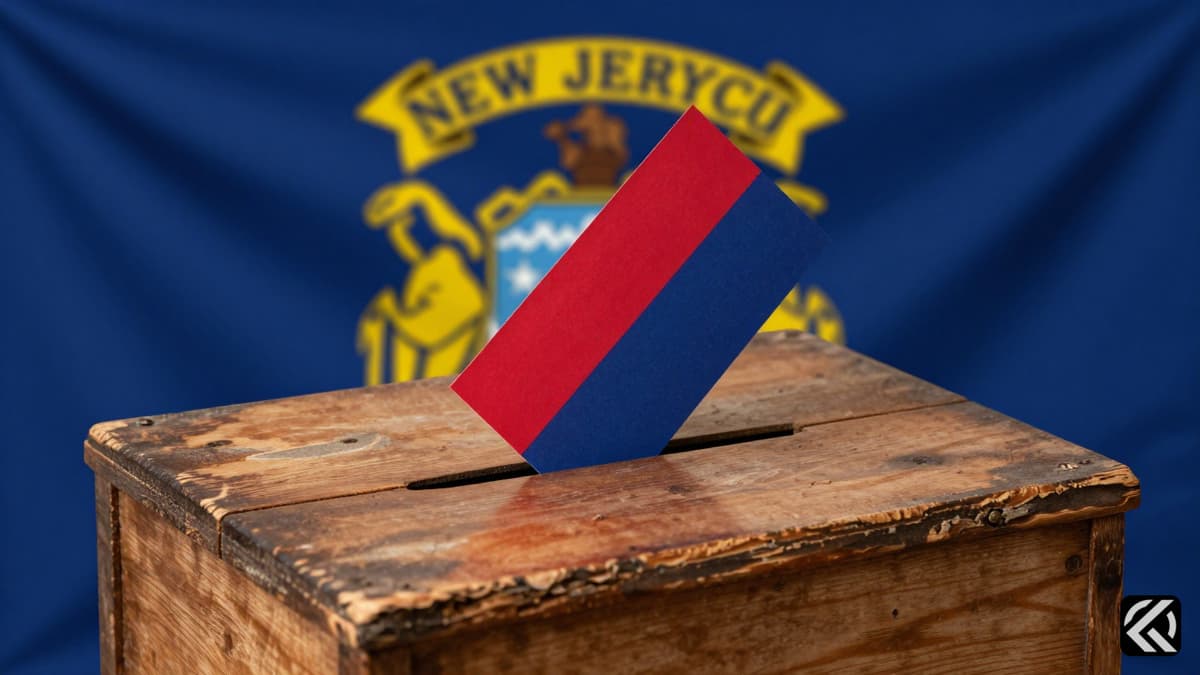
Voters in New Jersey's 11th District decide Thursday who joins Congress. The result hinges on a progressive upset and the fallout from national interest group interference.
New Jersey voters will decide Thursday whether to send progressive Analilia Mejia to Congress, a special election that could further erode the already thin Republican majority in the US House. This pivotal vote comes just two months after Mejia secured the Democratic nomination, following a tumultuous primary where former Congressman Tom Malinowski was defeated. The race pits Mejia, backed by a unified Democratic party, against Republican council member Joe Hathaway, who is positioning himself as a moderate alternative in a district with a significant registration advantage for Democrats.
The context of this special election is deeply rooted in the recent Democratic primary, where AIPAC-aligned groups played a controversial role in the defeat of Tom Malinowski. Malinowski, a two-term former congressman and the early favorite, raised the most money and had a strong pro-Israel voting record. However, the United Democracy Project, a super PAC aligned with AIPAC, spent $2 million on ads attacking Malinowski and portraying him as supportive of immigration enforcement, citing a 2019 vote on a funding bill. The strategy backfired, as Malinowski's willingness to place conditions on aid to Israel rather than offering a "blank check" led to his loss. This defeat opened the door for Mejia, the only candidate to agree with human rights groups regarding genocide allegations in Gaza, to consolidate support and unite the party.
Mejia's campaign has focused on grassroots organizing and economic concerns, a strategy that propelled her to victory in the primary. She describes herself not as a member of "The Squad," but as a "scrappy New Jersey soccer mom" willing to stand up for voters. Her victory on Thursday is viewed as a significant boon for progressives, including Senator Bernie Sanders, who endorsed her after she served as his national political director in 2020. Mejia argues that the economic pressures on voters-rising gas prices and grocery costs-make sending a Republican to Congress, whom she accuses of doing Donald Trump's bidding, too dangerous.
In contrast, Hathaway has run as a moderate, describing himself as a "commonsense, independent" former mayor willing to buck the Republican Party line. He is hoping to capitalize on the district's deep Democratic registration, which currently stands at about 65,000 more registered Democrats than Republicans according to the state's Department of Elections. Hathaway suggests that Democrats concerned about Mejia's progressive stance have a unique opportunity to "test drive a Republican for six months." His campaign aims to convince voters that he represents a viable alternative to a representative he views as too far left for the district.
The outcome of this election carries immediate consequences for the balance of power in Washington. House Speaker Mike Johnson currently possesses a margin that allows him to lose two GOP defections on party-line votes and still pass legislation. A victory for Mejia would shrink this margin further, adding to the razor-thin nature of the GOP majority. This special election is essentially a referendum on the effectiveness of the AIPAC strategy, with many Democrats arguing that the group's attempt to punish a moderate ally only strengthened the progressive flank.
"If you were going to define me as anything, it's a scrappy New Jersey soccer mom that is willing to stand up for you," Mejia said, defining her appeal to the district. This sentiment contrasts with Hathaway's approach, where he acknowledged the difficulty of the path but highlighted the unique opportunity for voters to influence the direction of the state's representation. The political landscape in the 11th District, which is currently represented by Governor Mikie Sherrill after her election, remains in flux. Sherrill vacated the seat in November, triggering the special election that has now become a focal point for national political groups and local voters alike.
The special election represents a critical test of how national interest group interference can alter local political outcomes and subsequently impact federal legislative power. With Hathaway and Mejia both running for full two-year terms in the June primaries, the dynamics established in this special race will likely dictate the trajectory of their respective campaigns for the general election. Should Mejia secure the seat, the progressive movement, bolstered by the fallout from the Malinowski campaign, will gain a new voice in a House where every vote counts. Conversely, if Hathaway manages to sway enough Democratic voters to secure a win, it would signal a viable path for moderate Republicans in deep-blue districts, challenging the national party's traditional strategies. The immediate effect will be a further reduction in the House GOP's majority, potentially tightening the legislative path for Speaker Johnson and his colleagues as they navigate a more fractured political environment.
Jun 8, 2026 02:17 UTC
Magnitude 7.8 Quake Shakes Philippines, Urging Immediate Evacuations
Join 50,000+ readers getting the global briefing every morning.
No spam. Unsubscribe anytime.
Jun 8, 2026 02:17 UTC
Magnitude 7.8 Quake Shakes Philippines, Urging Immediate Evacuations
Jun 8, 2026 00:51 UTC
Trump Claims Iran Nuclear Deal Imminent Despite Diplomatic Fractures
Jun 8, 2026 00:47 UTC
Iran Fires Missiles at Israel After Beirut Strike
Jun 7, 2026 22:38 UTC
Congress Party Claims Unity for INDIA Bloc Delhi Meeting