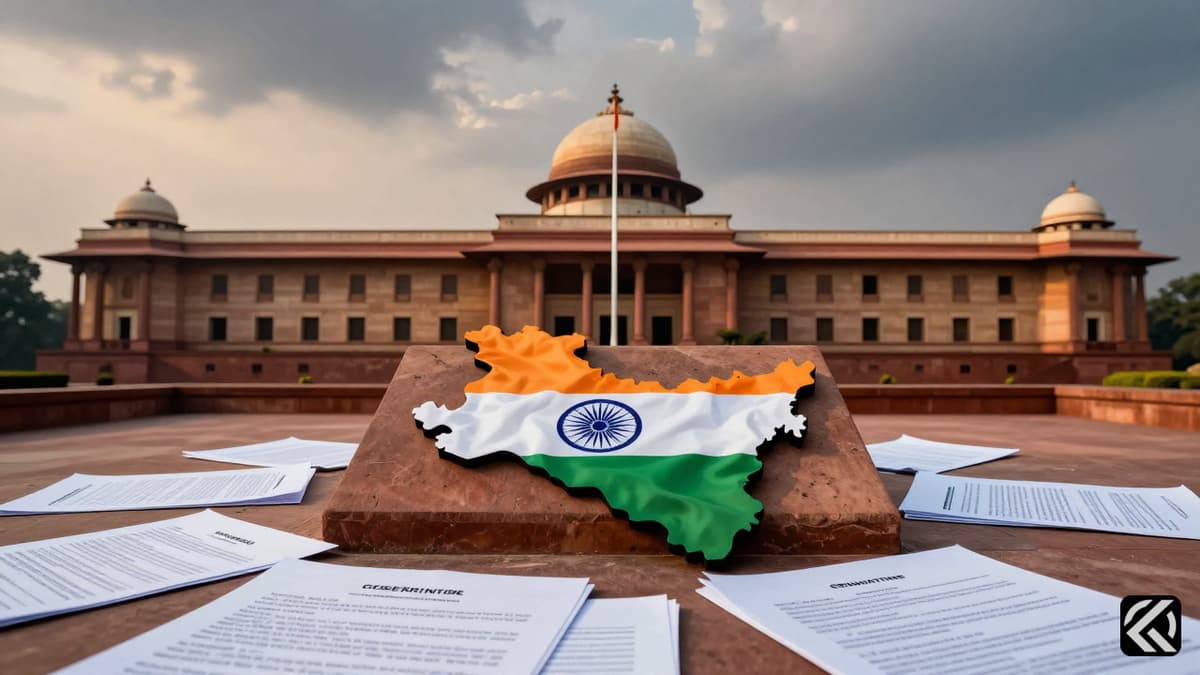
Bihar's political landscape fractures as CM Nitish Kumar prepares to resign, triggering a fierce power struggle between allies JD(U) and BJP to select the next Chief Minister.
NEW DELHI: Political instability grips Bihar as Chief Minister Nitish Kumar prepares to resign from the top job to take a Rajya Sabha seat. According to sources, the veteran leader is expected to vacate his official residence and submit his resignation on April 14. This move follows a high-stakes assembly election months prior and has ignited a fierce power play between the ruling NDA partners, JD(U) and BJP, regarding who will succeed him. The upcoming cabinet meeting on April 14 is rumored to be the final gathering of the current council of ministers before the transition begins.
The catalyst for this upheaval is Nitish Kumar’s decision to seek a Rajya Sabha seat, confirmed by his oath-taking ceremony at Parliament House administered by Rajya Sabha Chairman CP Radhakrishnan. Sources told news agency ANI that this development signals an imminent end to his current term. Sanjay Kumar Jha, the working president of the Janata Dal (United), indicated that the process for forming a new government would "roll out after April 13." He noted that details would require consultation with state government officials, suggesting a chaotic timeline for the JD(U) political crisis.
A significant faction within the JD(U) is reportedly pushing for internal family succession. Workers affiliated with "Nitish sevaks" have plastered posters across Patna urging Nitish's son, Nishant Kumar, to enter active politics. The messaging on these posters describes Nishant as a "youth leader" and a "young jansevak," calling for him to "come out of the shadows." While party sources acknowledge Nishant's potential, they also highlight that the leader himself is unlikely to push for his son. Instead, the cadres are demanding that the family secure the same benefits the BJP currently holds, such as two deputy chief minister posts, the speakership, and the crucial Home portfolio.
Conversely, the BJP is asserting its dominance in the selection process. JD(U) leader Vijay Kumar Chaudhary stated that the new chief minister will be elected by NDA legislators based on a recommendation from the BJP. He emphasized that the BJP has its own internal process for these decisions and that their plan will dictate the next steps. Deputy Chief Minister Samrat Chaudhary, who is considered a likely candidate to replace Nitish, has already visited the CM's residence. Additionally, Union Minister Shivraj Singh Chouhan has been appointed as the central observer for the BJP legislature party leader election, signaling a tight central oversight on the process.
Complicating the narrative are allegations from the opposition RJD. National Working President Tejashwi Yadav claimed that Nitish Kumar is stepping down under "pressure" from within his own party. Yadav alleged that bigwigs in the JD(U) struck a deal to remove Nitish long before the assembly polls to avoid backlash. He pointed to the veteran leader's recent visit to Delhi, where he was reportedly stopped by Sanjay Jha from speaking to the media, as evidence of "insult and pressure." Yadav further suggested that JD(U) leaders were either allured by the BJP or intimidated by central agencies like the ED and CBI.
The visual evidence of this internal fracturing is palpable in the interactions around the CM's residence. BJP leaders, including Lakhendra Paswan, have made appearances, fueling media speculation that the party is pushing for a Dalit leader for the top post. Meanwhile, JD(U) workers have expressed deep misgivings about the role played by Sanjay Jha and other close aides of Nitish in the recent developments. Party sources admitted that workers insisted the top post should not go to the BJP even after Nitish steps down, reflecting a deep-seated sentiment of distrust within the party cadre.
The BJP has reportedly been acting with "swagger" in this transition. JD(U) sources criticized the "alacrity" with which they nominated Harivansh Narayan Singh to the Rajya Sabha just days after denying him a third consecutive term, viewing this as a tactical maneuver. The standoff over the Nitish Kumar resignation has created a volatile environment where the future leadership of the state hangs in the balance. With the date of the new CM's selection set for April 15, the political theater in Bihar continues to unfold, driven by competing ambitions and historical alliances.
The immediate aftermath of the Nitish Kumar resignation points toward a fractured alliance that may struggle to maintain stability without the veteran leader's direct hand. If the BJP successfully dictates the choice for Bihar new CM, it could permanently alter the balance of power in the state, marginalizing the JD(U) leadership to secondary roles. The internal dissent within JD(U) regarding Nishant Kumar and the perceived betrayal by Sanjay Jha suggests that the party may face prolonged infighting, potentially weakening its electoral standing in future state polls. Furthermore, if Tejashwi Yadav's claims of intimidation prove accurate, the political narrative may shift from a cooperative transition to a contentious power grab, leading to legal challenges or further protests within the capital. The appointment of a central observer by the Union government indicates that the central authorities are monitoring the situation closely, suggesting that the outcome will have significant implications for the broader NDA coalition's national stability.
Jun 8, 2026 02:17 UTC
Magnitude 7.8 Quake Shakes Philippines, Urging Immediate Evacuations
Join 50,000+ readers getting the global briefing every morning.
No spam. Unsubscribe anytime.
Jun 8, 2026 02:17 UTC
Magnitude 7.8 Quake Shakes Philippines, Urging Immediate Evacuations
Jun 8, 2026 00:51 UTC
Trump Claims Iran Nuclear Deal Imminent Despite Diplomatic Fractures
Jun 8, 2026 00:47 UTC
Iran Fires Missiles at Israel After Beirut Strike
Jun 7, 2026 22:38 UTC
Congress Party Claims Unity for INDIA Bloc Delhi Meeting