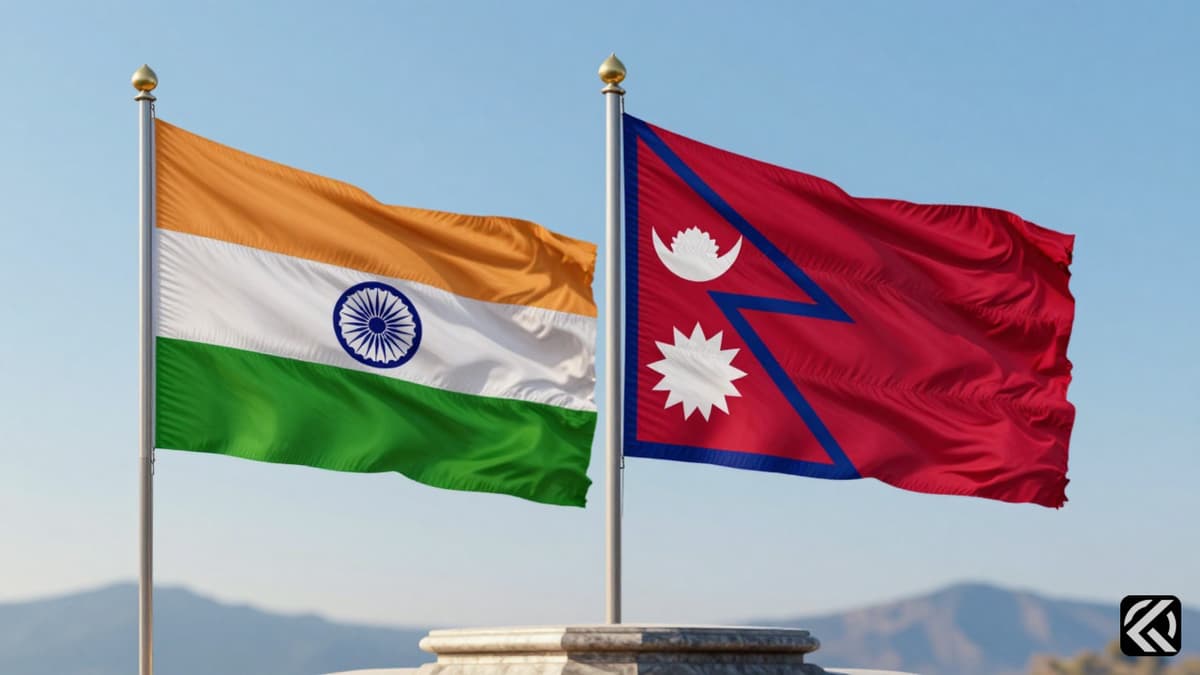
Nepal firmly rejects external mediation in the border conflict, prioritizing direct diplomatic engagement and historical claims with India under a new political era.
Foreign Minister Shisir Khanal confirmed in New Delhi on Sunday that the Nepali government is strictly focused on establishing its historical claim to the Kalapani-Lipulekh-Limpiyadhura trijunction, explicitly denying any intention to seek mediation from third parties. Addressing a press conference at the Embassy of Nepal, Khanal clarified that Kathmandu’s strategy relies on accessing historical documents from libraries in the U.K., rather than inviting external intervention. This clarification addresses confusion surrounding remarks by Prime Minister Balendra Shah, who had previously stated that Nepal is in contact with the U.K. and China regarding the dispute. Khanal emphasized that the new administration, backed by a strong mandate, aims to deliver uncompromising good governance and is determined not to tie bilateral relations to "old baggage" from the twentieth century.
The border issue between India and Nepal had begun to simmer recently, sparked by India’s announcement on April 30, 2026, regarding the Kailash-Manasarovar yatra for 2026. The Ministry of External Affairs declared that the pilgrimage would be conducted through the Lipulek pass, a region claimed by Nepal, as well as the Nathu La pass in Sikkim. This announcement triggered immediate protests from Nepal, which communicated its objections to both India and China via official diplomatic notes. In these notes, Nepal reiterated that the land belongs to it based on historical claims. Khanal explained that the problems persisting from the era of British India leave Britain with a perceived role, a sentiment reflected in Prime Minister Shah’s parliamentary remarks that had previously stirred online debates and attracted a rebuttal from the Indian Ministry of External Affairs.
Despite the diplomatic tensions, Khanal highlighted a significant shift in the vocabulary of India-Nepal relations under the current government. He noted that the Rastriya Swatantra Party (RSP), which rose to power following the Gen-Z uprising that overthrew the previous government in September 2025, refuses to view India through a "distorted, hyper-sensitive lens" of old geopolitics. Instead, the new leadership aims to square relations on "Development Diplomacy." This shift was underscored by Khanal’s formal meeting with External Affairs Minister S. Jaishankar on Saturday, June 6, 2026. During their discussions, the two sides officially announced the operationalization of Peer-to-Peer (P2P) cross-border payment transactions under a Memorandum of Understanding between Nepal Clearing House Limited and the National Payments Corporation of India.
Khanal stated that his visit has restarted the track of high-level visits between the two nations, signaling a move away from the friction that characterized previous eras. He confirmed that Finance Minister Swarnim Wagle is expected to visit Delhi "very soon," further cementing this diplomatic reset. When asked about a timeline for Prime Minister Shah’s visit to India, Khanal noted that the Prime Minister is primarily focused on the "domestic front" to show early results due to the strong mandate received in the May election. The rise of Shah’s administration followed a period of intense political upheaval, including a crackdown on the digital ecosystem by former Prime Minister K.P. Sharma Oli in September 2025, which fueled the public uprising that led to the current government’s formation.
Khanal described his administration as representing a "completely new political reality" driven by strict meritocracy and direct accountability. He emphasized that this new generation of leadership is "absolutely unencumbered by the past," distinguishing their approach from the dominant political players like the Nepali Congress and Maoist parties that were defeated in the recent elections. Addressing the historical context of the dispute, Khanal referred to the report of the Eminent Persons Group (EPG), which was established over a decade ago to provide guidelines for handling bilateral issues. He clarified that the final report currently languishes in a cupboard in Kathmandu, intended for the Prime Ministers of both countries.
Regarding the EPG report, Khanal stated he has no authority to make it public, accept it, or take any action independently. He explained that the group was commissioned by an agreement between two Prime Ministers, and thus the report can only be submitted to two Prime Ministers for their decision on whether to make it public. This stance reinforces the bilateral nature of the dispute resolution, aligning with India’s long-standing position that there is no scope for third-party intervention in the Kalapani-Lipulek matter.
The current diplomatic engagement marks a decisive moment in the evolution of bilateral ties, prioritizing functional cooperation over territorial rhetoric. By focusing on digital connectivity through the P2P payment system and initiating high-level ministerial visits, the administration is laying the groundwork for a relationship defined by mutual economic benefit rather than historical grievance. The refusal to engage third parties, including the U.K. and China, suggests a mutual understanding between New Delhi and Kathmandu to manage disputes internally. As the new government consolidates its power, the trajectory of relations will likely depend on the successful implementation of developmental initiatives. The eventual decision regarding the Eminent Persons Group report remains a critical variable; if both Prime Ministers choose to utilize its guidelines, it could provide a structured framework for resolving lingering territorial ambiguities. However, the immediate focus on "Development Diplomacy" indicates that economic integration and cross-border mobility will take precedence, potentially reducing the salience of border disputes in the public discourse while institutional mechanisms handle the underlying complexities.
Jun 8, 2026 20:56 UTC
Netanyahu Halts Iran Fighting, Vows Future Force
Jun 8, 2026 14:20 UTC
Xi Jinping Returns to North Korea for Strategic Leverage
Jun 8, 2026 12:37 UTC
Iran Halts Strikes on Israel, Warns of Harsher Retaliation
Jun 8, 2026 06:24 UTC
Magnitude 7.8 Earthquake Shocks Philippines, Killing Four in General Santos
Jun 9, 2026 00:00 UTC
INDIA Bloc Leaders Gather in Delhi to Forge Strategic Unity


