Tamil Nadu's Chief Minister M.K. Stalin staged a dramatic protest in Namakkal, burning the Delimitation Bill he labels a conspiracy.
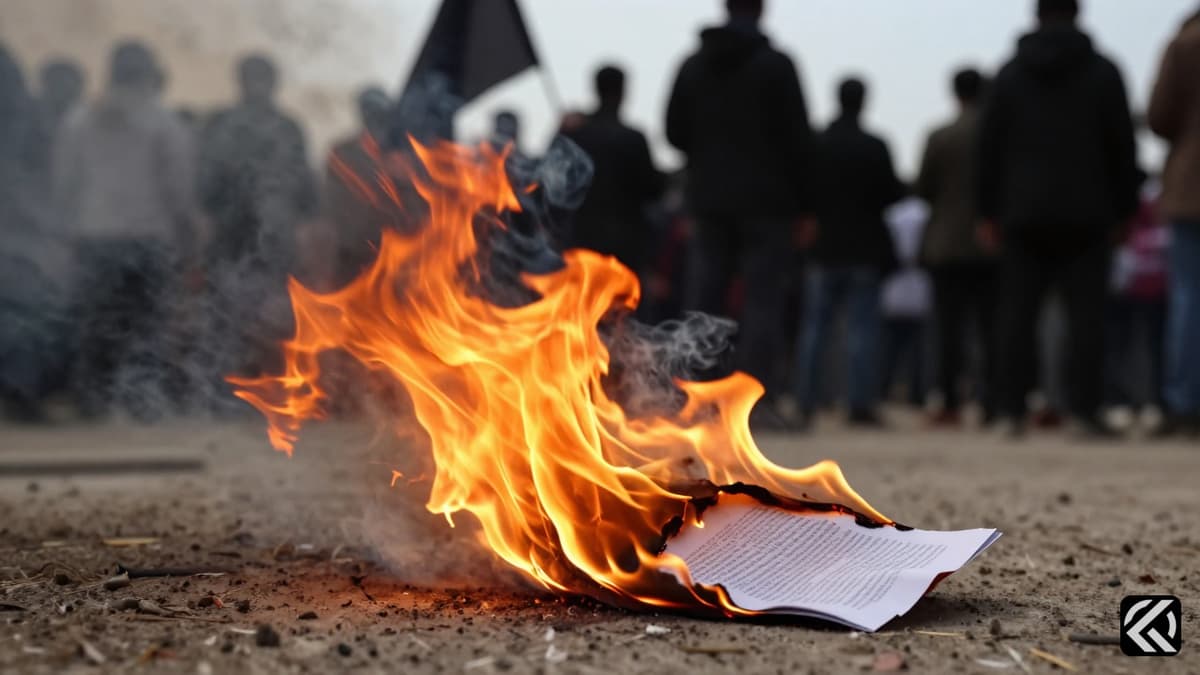
Tamil Nadu Chief Minister M.K. Stalin staged a dramatic and symbolic protest in Namakkal on Thursday, April 16, 2026. The event marked a significant moment of political defiance as the Chief Minister personally burned a copy of the Delimitation Bill. This act was not merely a solitary gesture but served as the centerpiece of a larger statewide protest against the proposed legislative changes. The timing was deliberate, occurring just before the bill was scheduled to be tabled in Parliament on the same day, highlighting the urgency of the opposition's stance.
The Chief Minister did not hold back in his rhetoric during the proceedings in Namakkal. He explicitly characterized the proposed amendment as a "conspiracy" and a "black law." These strong descriptors were used to define the nature of the legislation in the eyes of his supporters and the general public. By using such charged language, M.K. Stalin framed the Delimitation Bill not just as a policy disagreement, but as a fundamental threat that required immediate and visible resistance. His condemnation was direct and intended to mobilize the populace against what he perceived as a malicious legislative attempt.
Following his scathing critique, M.K. Stalin issued a clear call to action for the citizens of the state. He urged every individual to hoist black flags in their homes and at all public places on Thursday, April 16, 2026. This directive transformed the protest from a singular event led by the Chief Minister into a widespread movement. The instruction to display black flags was intended to create a visible, unified front of dissent across the state, ensuring that the opposition to the Delimitation Bill was seen everywhere, from private residences to public squares. The visual impact of this coordinated action was meant to underscore the depth of the opposition's anger and determination.
The context of this protest is rooted in the upcoming legislative session. The Bill, which has sparked such intense controversy, was set to be tabled in Parliament on the very day of the protest. This synchronization suggests a strategic move by the DMK president to generate maximum pressure and public awareness just as the legislation was about to be formally introduced to the nation's lawmakers. The burning of the copy of the Delimitation Bill served as a pre-emptive symbolic rejection of the text before it could even be debated in the formal parliamentary setting. It was a declaration that the political leadership in Tamil Nadu would not accept the proposed changes quietly.
The visual elements of the protest in Namakkal were stark and immediate. The burning of the document was the central visual, representing the destruction of what the Chief Minister called a "black law." As the fire consumed the paper, the surrounding environment was filled with the symbolic act of hoisting black flags. This dual action of burning and displaying flags created a potent narrative of rejection. The state's political atmosphere was charged with the anticipation of the bill's tabling in Parliament, a move that M.K. Stalin viewed as a conspiracy that needed to be exposed and opposed through public spectacle.
The implications of this event extend beyond the immediate day of the protest. By labeling the Delimitation Bill a conspiracy, M.K. Stalin has set the tone for the upcoming political discourse. The call for black flags was not limited to a single location but was mandated for every home and public place in Tamil Nadu. This widespread mobilization indicates that the leadership intends to sustain the pressure on the issue throughout the day and potentially beyond. The unity of the message-burning the bill and flying black flags-suggests a coordinated strategy to demonstrate the sheer scale of opposition within the state.
The reaction from the ruling administration's representative in Tamil Nadu sets a clear precedent for the state's political stance. The act of burning a copy of a proposed bill before it enters Parliament is a bold move that signals deep disapproval. It suggests that the DMK leadership views the Delimitation Bill as so fundamentally opposed to the interests of the state that it must be symbolically destroyed rather than merely debated. This approach aligns with the historical context of strong regional political stances in Tamil Nadu, where local concerns often drive intense public demonstrations against central legislative proposals.
The event in Namakkal serves as a critical juncture for the political relationship between the state government and the central legislative process regarding the Delimitation Bill. The explicit labeling of the bill as a "black law" and a "conspiracy" by the Chief Minister indicates that the opposition will likely be fierce and sustained. The widespread call for black flags suggests that the state is mobilizing its entire citizenry for a visual display of dissent that will accompany the bill's introduction in Parliament.
Looking ahead, the immediate impact of this protest will be a heightened political atmosphere in Tamil Nadu. The coordinated display of black flags across the state will likely dominate local media and public discourse, keeping the issue at the forefront of the political agenda. The burning of the bill copy acts as a symbolic precursor to what could be a prolonged period of resistance. If the bill is indeed tabled in Parliament as planned, the state of Tamil Nadu appears poised to present a unified and vocal front against it, driven by the directives issued by M.K. Stalin. The future trajectory of the Delimitation Bill in Tamil Nadu will likely be defined by this initial act of defiance, potentially influencing how the state interacts with the legislation in subsequent parliamentary debates. The intensity of the protest suggests that the state government is prepared to use all available political tools to challenge the proposed amendment, ensuring that the opposition remains a dominant narrative in the coming days.
Jun 8, 2026 04:15 UTC
Trump Urges Netanyahu to Halt Iran Strike for Peace
Join 50,000+ readers getting the global briefing every morning.
No spam. Unsubscribe anytime.
Jun 8, 2026 02:28 UTC
Trump Walks Out of Meet the Press After Rejecting Evidence Demands
Jun 8, 2026 02:17 UTC
Magnitude 7.8 Quake Shakes Philippines, Urging Immediate Evacuations
Jun 8, 2026 00:51 UTC
Trump Claims Iran Nuclear Deal Imminent Despite Diplomatic Fractures
Jun 8, 2026 00:47 UTC
Iran Fires Missiles at Israel After Beirut Strike