Section
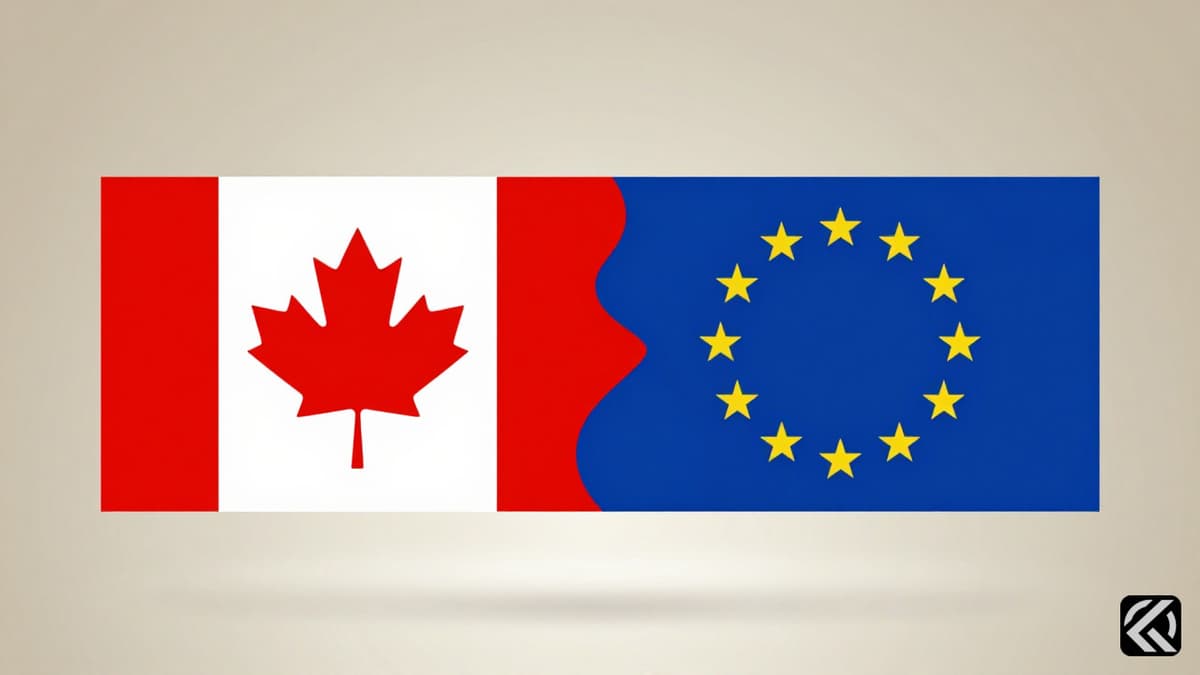
Canadians are increasingly favoring stronger political and economic bonds with Europe as Ottawa seeks to diversify relationships amidst rising geopolitical uncertainties.
Prime Minister Mark Carney addressed the European Parliament in Strasbourg on Thursday, outlining a vision for deeper integration between Canada and the European Union. During his speech, he welcomed the EU's ambition for Canada to become its first "associate member" and urged closer cooperation on critical sectors such as defense and energy. Carney emphasized that Canada and Europe must remain "stronger together" to navigate current geopolitical ruptures, a sentiment that resonated with many in his audience.
The proposal has sparked significant discussion across Canada, particularly among younger demographics and those previously focused on North American integration. Carney stated, "We should deepen our people-to-people ties, allowing our youth to live, work and study where they want on either side of the Atlantic." This pledge was immediately picked up by Canadian commuters and residents, with Miriam Levin-Gold from Toronto telling the BBC that such opportunities are "great for young people to explore different parts of the world and work in different places." The prospect of streamlined mobility has generated excitement, with many Canadians viewing it as a path to broader personal and professional experiences.
However, the path to such close integration is complex. The status of "associate member" does not currently exist within the EU framework, meaning its implementation could take years. All 27 EU member states would need to approve any such arrangement, making it a long-term diplomatic goal rather than an immediate policy shift. Despite these procedural hurdles, the enthusiasm among the Canadian public remains palpable. Alex Nash from Montreal noted that closer ties would remove obstacles like work visas, stating it would be "really nice for that to be easier, more convenient and to be able to visit more easily."
Social media reactions highlight a broader shift in Canadian identity and priorities. In a Facebook group called A Canadian Outlook, users expressed desires for their grandchildren to study at European universities at better rates and for easier property management in France. One user referred to "snow birds," Canadians who migrate to warmer climates for winter, suggesting they would benefit significantly from such reforms. These sentiments are not merely about travel; they hint at a growing dissatisfaction with Canada’s current bilateral relationship with the United States.
For decades, the US has been Canada’s primary cultural and economic anchor. David Jardine, a resident near Toronto’s CN Tower, recalled a past where he viewed New York as an epicenter of culture. However, he now expresses skepticism toward the US, citing trade wars and rhetoric about annexation under President Donald Trump. "I would say I think not only does it make more sense to associate closely with Europe, it is a place that I would rather be associating with given the way things are these days," Jardine explained. This shift in sentiment is echoed by others who feel the traditional cultural gravity is becoming unsustainable.
Maggie Stainton, who manages a pub in Toronto’s St Lawrence Market district, described Canada’s ties with the US as "too volatile." She believes there is "some stability in Europe," contrasting the unpredictable nature of southern relations with the perceived reliability of northern ones. Stainton noted that while Canada has historically felt more American due to media influences, her own ideals lean toward European values. "I think we're forced to feel more American simply by the influences that we have... However, I think deep down, I definitely lean towards feeling more European in my ideas and ideals," she said.
The push for deeper Canada-EU trade ties is driven by stark economic realities. Up to 72% of Canadian exports currently go to the US, a heavy reliance that has become increasingly risky amid ongoing trade tensions. Carney, elected on a promise to take a tough stance against Trump and broaden Canada’s economic horizons, is actively seeking to diversify these partnerships. The EU appears to be a natural fit given historical demographics; over half of Canada’s population reported having European origins in the 2021 census.
Public opinion surveys support this strategic direction. A recent Abacus Data survey conducted before Carney’s speech found that 80% of Canadians believe the country should deepen strategic cooperation with the EU. Furthermore, more than half of respondents feel closer to Europe than to America. This statistical backing provides Carney with significant domestic mandate to pursue these new avenues of cooperation, signaling a potential recalibration of Canada’s foreign policy priorities away from exclusive reliance on its southern neighbor.
Despite the enthusiasm, critics urge caution. Opposition Conservative MPs have called for more concrete details on what this closer relationship entails. Adam Chambers, MP for Simcoe North, questioned whether the proposal was a "concrete, meaningful proposal" or merely "words and vibes." He highlighted the existing Comprehensive Economic and Trade Agreement (CETA), noting that it still awaits ratification by multiple EU nations. This suggests that even existing frameworks face bureaucratic delays, making the realization of new "associate member" status a distant prospect.
Nevertheless, the narrative is shifting. While the relationship with the US remains critical, there is a growing acknowledgment that diversification is necessary for stability. Ahmed Khalil, a long-time Ontario resident, acknowledged that "America's always been the neighbor," but the emotional tone of the conversation has undeniably changed. The combination of economic vulnerability, cultural reassessment, and political initiative marks a pivotal moment in Canada’s international relations, suggesting a future where European integration plays a much larger role in defining national identity and economic security.
As Carney’s government pursues these initiatives, the long-term impact will likely redefine Canada’s global role. If implemented, closer US-Canada trade tensions resolution may depend heavily on successful EU integration. The diversification of export markets and cultural affinities could reduce vulnerability to American policy shifts. However, the complexity of EU ratification processes means that immediate benefits will be limited. Success will depend on sustained diplomatic effort and political will to navigate the extensive legal and political frameworks required for such a historic alliance.
Oct 3, 2026 04:08 UTC
FlyDubai Co-Pilot Banned in Oman Over Extremism Concerns
Oct 3, 2026 00:50 UTC
Israel-Mumbai Campaign Honors Captain Smit After Flydubai Incident
Oct 2, 2026 18:13 UTC
Captain Smit Machchhar’s Courage Saves Flydubai Flight FZ1073 From Disaster
Oct 2, 2026 16:45 UTC
Captain Smit Machchhar Saves Plane Mid-Fall
Oct 3, 2026 06:56 UTC
Supreme Court Hears Cases on Guns, Voting Rights, and Climate