Section
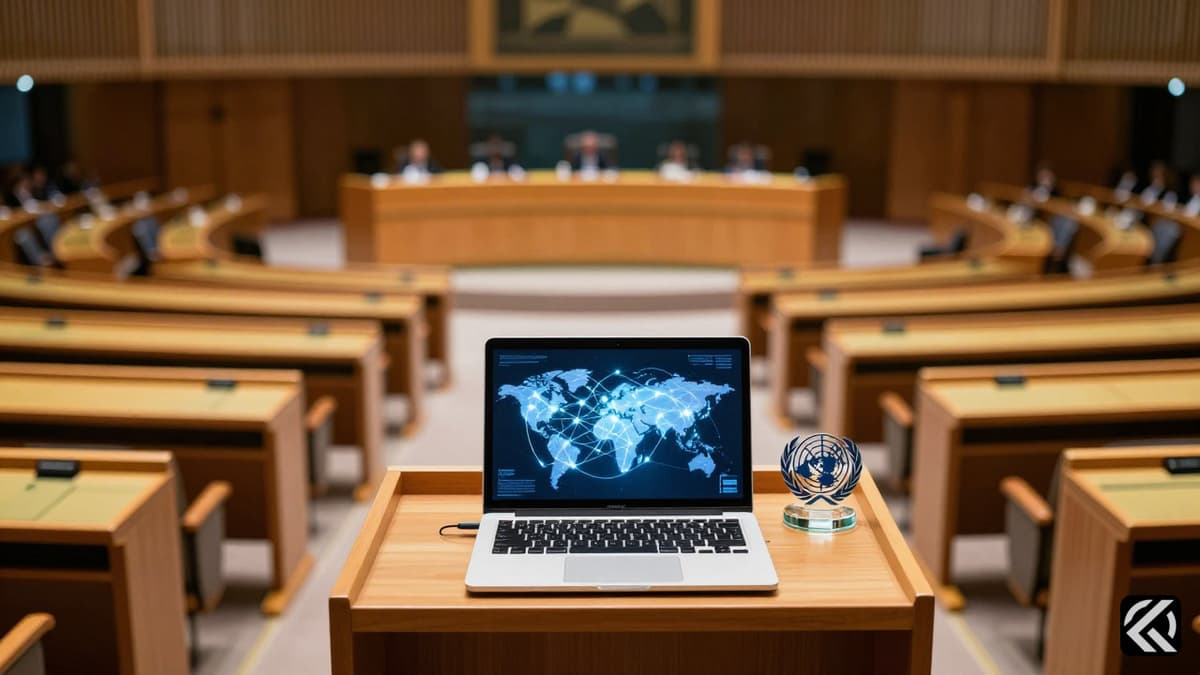
French President Emmanuel Macron warns the world against a return to barbaric power dynamics, urging global unity through international law and shared AI technology at the UN.
French President Emmanuel Macron delivered a decisive final address to the UN General Assembly on Tuesday, September 22, 2026, issuing a stark warning to the international community. In this pivotal speech, he urged world leaders to choose a path of civilized international cooperation over a resurgent and dangerous "law of the jungle." This address stands as his last major diplomatic intervention in his role as the head of state of France, aiming to shape the global order during a period of significant geopolitical instability.
The French President’s speech was marked by a fierce critique of current global power dynamics. He described the current era as one where the rhetoric of defeat is paving the way for an abuse of power by empires, which directly threatens the sovereignty of smaller nations. Macron explicitly questioned the credibility of the international community, asking whether the world desires to live in a state of nature defined by brute force or in a civilized society governed by rules. His message was clear: nations must stand firm and refuse to yield to the escalating tensions that threaten global stability.
A significant portion of Macron’s rhetoric focused on the ongoing conflicts in Ukraine and Gaza. He voiced strong condemnation regarding the humanitarian situation in Gaza, highlighting the failure of peace efforts to open up humanitarian deliveries. He described the situation as a spectacle that shames the entire international community, questioning what value credibility holds if nations remain inactive in the face of such suffering. His comments reflect a deep concern over the erosion of humanitarian principles in modern warfare.
In the context of the Ukraine-Russia war, the French President raised the issue after a meeting with U.S. President Donald Trump on Monday, September 21, 2026. During their discussions, Macron reiterated his stance as a stalwart supporter of Ukraine. He specifically called for Moscow and Kyiv to agree to a moratorium on strikes against civilian and energy infrastructure. He characterized the destruction of civilian infrastructure and the accompanying human rights violations as "barbaric acts" indicative of a new, darker era in global conflict.
Macron argued that protecting the civilian population is paramount and expressed support for a "double moratorium" targeting both energy grids and civilian infrastructure. His proposal aims to mitigate the humanitarian toll of the war, suggesting that international pressure must be applied to halt these specific types of attacks. By linking the protection of civilians to the broader concept of civilized international society, he attempts to frame the conflict not just as a military dispute, but as a moral test for global leadership.
Beyond immediate geopolitical conflicts, Macron addressed the rapidly evolving landscape of technology, specifically artificial intelligence. Following other leaders who had expressed alarm over the risks posed by AI, he proposed a structural alternative to the current competitive landscape. He warned against the possibility of any nation becoming a vassal to one of the great powers, implicitly referencing the technological dominance of countries like the United States and China.
To counter this, he advocated for a collaborative approach to technological development. He stated that nations must come together to build a cutting-edge, open-source frontier model for AI. This proposal suggests that investment capabilities should be pooled globally to create a shared model that is openly available, rather than dependent on a single entity or nation. This strategy is designed to prevent monopolistic control over critical technology and ensure that the benefits of AI are distributed more equitably.
The French President’s speech highlights a dual challenge: halting the descent into chaotic warfare and preventing technological hegemony. By calling for a "civilized international society," Macron seeks to reinforce the institutions that have historically maintained peace, even as they face unprecedented strain. His call for a double moratorium on strikes in Ukraine underscores the urgency of humanitarian protection in active conflict zones. Simultaneously, his proposal for a pooled, open-source AI model represents a significant shift in how nations might cooperate on existential technological risks.
The implication of Macron’s final address is that isolationism and unilateral power projection are leading the world toward a "law of the jungle." By urging countries to recommit to international laws and shared technological frameworks, he offers an alternative based on collective security and mutual dependence. If the international community heeds this call, it could lead to a more stable geopolitical environment where sovereignty is respected and technological advancement serves the global public good rather than the strategic interests of a few empires. The success of this vision depends on whether world leaders prioritize civilized cooperation over the abusive exercise of power in the coming years.
Oct 3, 2026 04:08 UTC
FlyDubai Co-Pilot Banned in Oman Over Extremism Concerns
Oct 3, 2026 00:50 UTC
Israel-Mumbai Campaign Honors Captain Smit After Flydubai Incident
Oct 2, 2026 18:13 UTC
Captain Smit Machchhar’s Courage Saves Flydubai Flight FZ1073 From Disaster
Oct 2, 2026 16:45 UTC
Captain Smit Machchhar Saves Plane Mid-Fall
Oct 3, 2026 10:04 UTC
UAE Official: Flydubai Co-Pilot’s Attack Was Terror Act