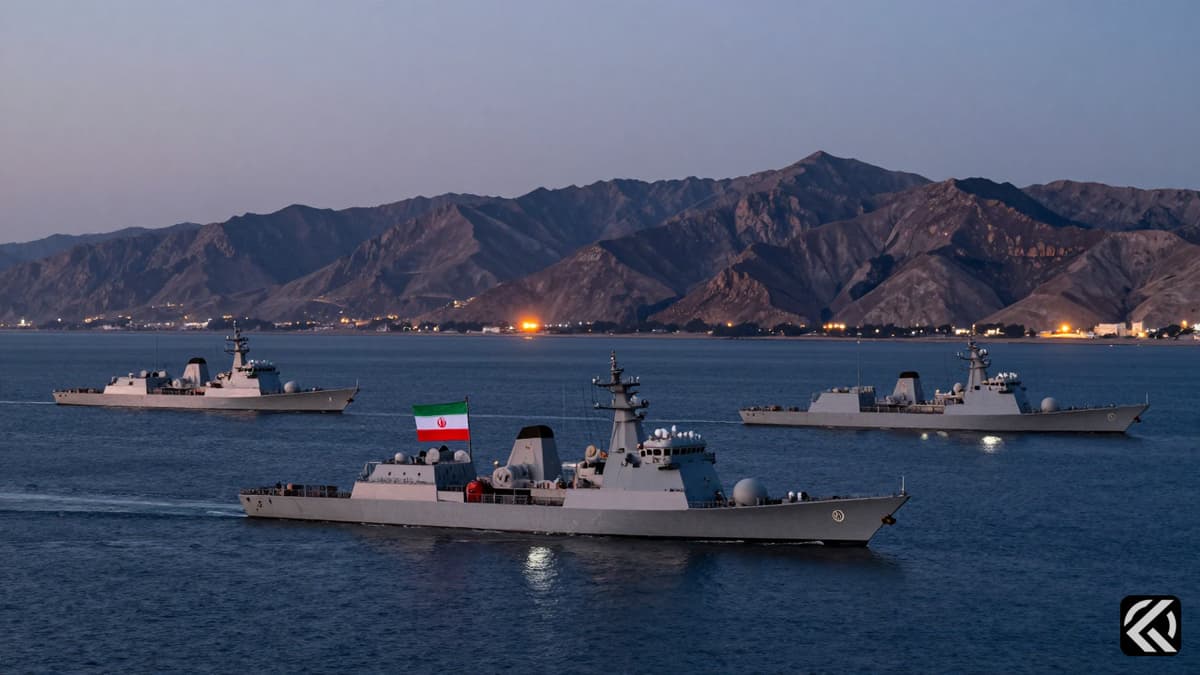
Following intense threats from President Trump, Iran's IRGC asserts the Strait of Hormuz has undergone irreversible strategic changes, ending US dominance in the Persian Gulf.
On Monday, April 6, 2026, the Islamic Revolutionary Guard Corps (IRGC) announced that the strategic landscape of the Strait of Hormuz has fundamentally shifted. The IRGC stated that the waterway connecting the Persian Gulf with the Gulf of Oman has undergone "irreversible strategic changes" and will never revert to its prior status. This declaration arrives amidst heightened tensions, specifically noted in the latest Iran-Israel war updates circulating on this date.
The IRGC Navy's statement followed a series of escalatory actions by U.S. President Donald Trump over the weekend. Just hours before the IRGC announcement, Trump released an aggressive social media post demanding the reopening of the passage. He threatened to designate Tuesday as "Power Plant Day" and "Bridge Day" in Iran, explicitly using expletives to demand Iran "Open the F*** Strait, you crazy b****, or you'll be living in Hell." This rhetoric followed Trump's Sunday comments on April 5, where he claimed the U.S. was in talks with Iran for a potential deal by April 6, while simultaneously threatening to "blow up everything" if the deadline was missed. Trump has a history of issuing such deadlines regarding the reopening of the Strait, often promising severe bombing in retaliation.
In direct response to these American threats, the IRGC declared that the era of foreign hegemony over the critical waterway is definitively over. The military force asserted that recent regional developments have created a new reality where the United States can no longer dictate terms within Iran's immediate maritime environment. The statement specifically highlighted that the Strait of Hormuz will never return to its previous condition, particularly concerning the U.S. and what the IRGC referred to as the "Zionist regime." The force emphasized its continued commitment to defending national sovereignty and ensuring the security of the Persian Gulf.
To solidify this new security posture, the IRGC outlined plans to establish a new indigenous security architecture for the Persian Gulf. This strategic shift is predicated on the principle that regional security and stability must be guaranteed exclusively by the littoral states themselves, rather than external powers. The IRGC Navy detailed that these preparations involve a significant enhancement of naval deployments within the region. Furthermore, the force is implementing advanced monitoring systems to track maritime activities and establishing coordinated rapid-response capabilities. These measures are explicitly designed to safeguard Iran's territorial waters while ensuring the uninterrupted flow of energy through the critical strait.
The shift in power dynamics suggests a long-term restructuring of how the waterway is managed. By claiming that the U.S. can no longer dictate terms, the IRGC signals a move away from the traditional reliance on American naval dominance in the region. The focus on an "indigenous security architecture" implies a self-reliant approach where local states, led by Iran in this context, take full responsibility for maintaining order. The inclusion of "advanced monitoring systems" and "coordinated rapid-response capabilities" indicates a technological and operational upgrade intended to deter any future attempts at coercion or blockade by foreign entities.
The intensity of the verbal confrontation, highlighted by Trump's expletive-laden demands and the IRGC's equally firm rebuttal, underscores the volatility of the current situation. The threat of "Power Plant Day" and "Bridge Day" represents a specific escalation in the potential for kinetic conflict, aiming to destroy critical infrastructure rather than merely engaging in naval skirmishes. However, the IRGC's confidence in their new security measures suggests they are prepared to counter such threats militarily and technologically. The assertion that the status quo has "irreversibly" changed indicates that even if the immediate crisis subsides, the underlying power balance has permanently shifted.
The Iranian military's move to replace foreign oversight with a domestic security framework represents a pivotal moment in regional geopolitics. By anchoring their argument in the principle that littoral states must guarantee their own stability, the IRGC challenges the decades-long precedent of international intervention. As the Iran-Israel war context evolves, this declaration serves as a definitive boundary marker. The implementation of indigenous monitoring and rapid-response units suggests that future disputes over the Strait will be met with localized, swift military force rather than reliance on diplomatic appeals to Washington. This structural change aims to ensure that the flow of energy continues on Iran's terms, effectively neutralizing the leverage previously held by external powers to threaten the region's economic lifeline. The future outlook suggests a continued period of high tension, where the balance of power is actively contested and redefined by the physical and digital defenses of the littoral states themselves.
Jun 8, 2026 02:17 UTC
Magnitude 7.8 Quake Shakes Philippines, Urging Immediate Evacuations
Jun 8, 2026 00:51 UTC
Trump Claims Iran Nuclear Deal Imminent Despite Diplomatic Fractures
Jun 8, 2026 00:47 UTC
Iran Fires Missiles at Israel After Beirut Strike
Jun 7, 2026 22:00 UTC
US, Iran Peace Hops Fade 100 Days Into War
Jun 8, 2026 04:15 UTC
Trump Urges Netanyahu to Halt Iran Strike for Peace


