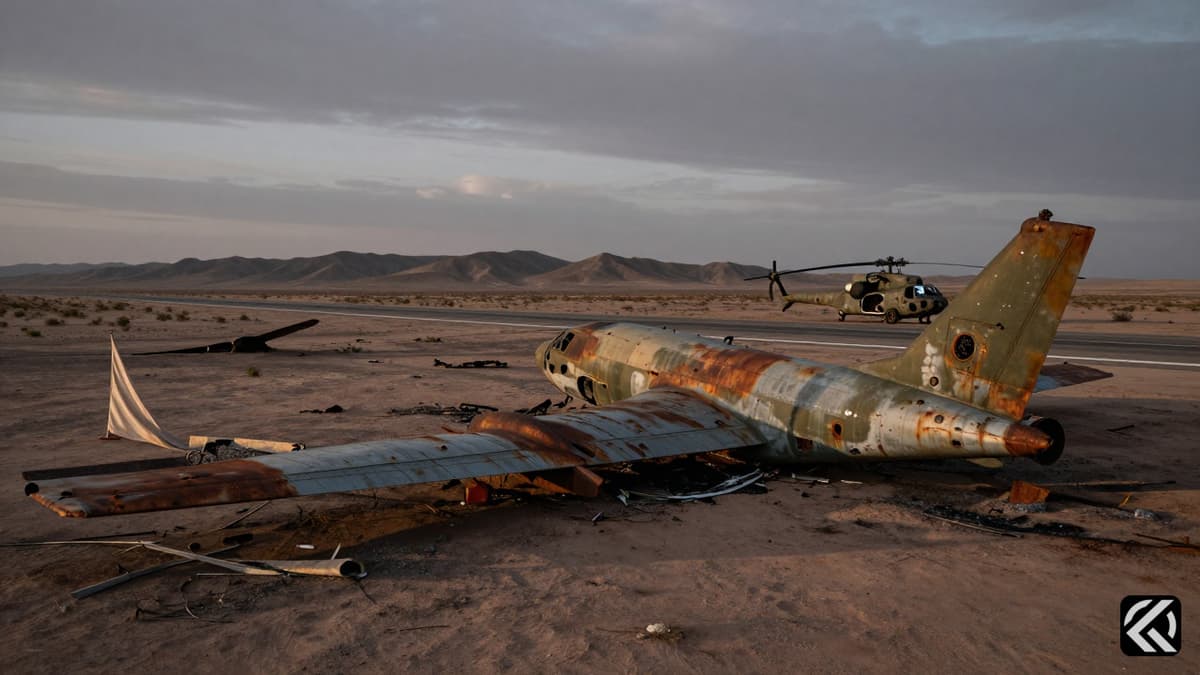
Iran's military confirms the U.S. rescue operation Iran was foiled at an abandoned airfield, destroying multiple aircraft while claiming the F-15E Strike Eagle downed mission was a deception.
Iran's military announced on Sunday, April 5, 2026, that a mission by U.S. forces to recover a missing airman was entirely thwarted. The confrontation took place at an abandoned airport in southern Isfahan province, which Iranian commanders identified as the target of a deceptive American strategy. According to the military's central command, the operation was labeled a "complete failure" due to the destruction of the American assets involved.
The timeline of the conflict began when an American F-15E Strike Eagle fighter jet was shot down over Iranian territory on Friday, April 3, 2026. Two days later, U.S. Special Operations forces launched a daring search and rescue mission. President Donald Trump described the effort on Sunday as "one of the most daring search and rescue operations in U.S. history," celebrating the successful extraction of the officer. However, Iranian officials provided a starkly different account, characterizing the same event as a "deception and escape mission" that was foiled before the pilot could be recovered.
Ebrahim Zolfaghari, the spokesman for the military's central command, Khatam Al-Anbiya, issued a detailed statement on Sunday evening regarding the outcome of the engagement. He asserted that the so-called U.S. military rescue operation was planned under the pretext of recovering the pilot of the downed aircraft but was completely neutralized by Iranian defenses. Zolfaghari explicitly detailed the losses sustained by the American team during the incident, confirming that the U.S. rescue operation Iran resulted in the destruction of multiple high-value assets.
The spokesman specified that Iranian forces destroyed two C-130 military transport planes and two Black Hawk helicopters during the confrontation. Additionally, the military statement noted that two drones were also neutralized as part of the successful interception. This detailed inventory of destroyed equipment underscores the intensity of the Isfahan airport ambush and contradicts the narrative of a swift, unchallenged extraction of the airman.
The conflicting narratives highlight the immediate tension surrounding the incident. While the White House framed the operation as a triumph of Special Operations capabilities, the Iranian military stance paints a picture of a strategic trap that successfully repelled an invading force. The location of the operation, an abandoned airfield in southern Isfahan, was central to the Iranian defense strategy, turning a potential rescue zone into a graveyard for the attacking fleet.
The discrepancy in reporting serves as a focal point for the ongoing diplomatic and military narrative between the two nations. President Trump's statement emphasized the bravery of the rescue team and the historical significance of the event. In contrast, the Iranian command's assertion of total victory suggests a significant escalation in the region's geopolitical standing. The military spokesman's specific mention of the date, April 5, 2026, anchors these conflicting accounts to a precise moment in time, leaving little room for ambiguity regarding the claimed outcomes.
The presence of C-130 transport planes and Black Hawk helicopters indicates a substantial logistical effort was mounted for the operation. The destruction of these specific aircraft types by local forces implies a sophisticated level of interception capability within the Isfahan region. This level of engagement suggests that the target was not merely a passive airfield but a prepared defensive perimeter that successfully countered a heavy air assault.
The incident has reignited discussions regarding the safety of American military personnel in the region and the efficacy of rapid response teams. The fact that an officer was reportedly recovered by the U.S. side, even while the broader operation is deemed a failure by Iranian standards, adds a layer of complexity to the event. The F-15E Strike Eagle downed on April 3 serves as the catalyst for this intense exchange of claims and counter-claims.
Both sides are now using this event to assert dominance and legitimacy. The American narrative focuses on the valor of the rescuers, while the Iranian narrative emphasizes the total annihilation of the assault force. This dual narrative approach is typical in high-stakes international conflicts where information control is a critical component of the broader strategic landscape.
This confrontation marks a significant escalation where a rescue mission devolved into a major asset-destroying engagement. The Iranian claim of destroying four aircraft and two drones suggests a high probability of retaliatory strikes or increased militarization in the Isfahan province. Given the explicit denial of the rescue success by Iranian command, future diplomatic efforts may face severe hurdles as both nations cite opposite outcomes for the same event. The region can expect a heightened state of alert as the validity of these claims is scrutinized by international observers, potentially leading to further instability in southern Iran and the surrounding airspace.
Jun 8, 2026 00:51 UTC
Trump Claims Iran Nuclear Deal Imminent Despite Diplomatic Fractures
Jun 8, 2026 00:47 UTC
Iran Fires Missiles at Israel After Beirut Strike
Jun 7, 2026 22:00 UTC
US, Iran Peace Hops Fade 100 Days Into War
Jun 7, 2026 20:57 UTC
Iran Strikes Israel: IRGC Promises Week of Continuous Offensive
Jun 8, 2026 02:28 UTC
Trump Walks Out of Meet the Press After Rejecting Evidence Demands


