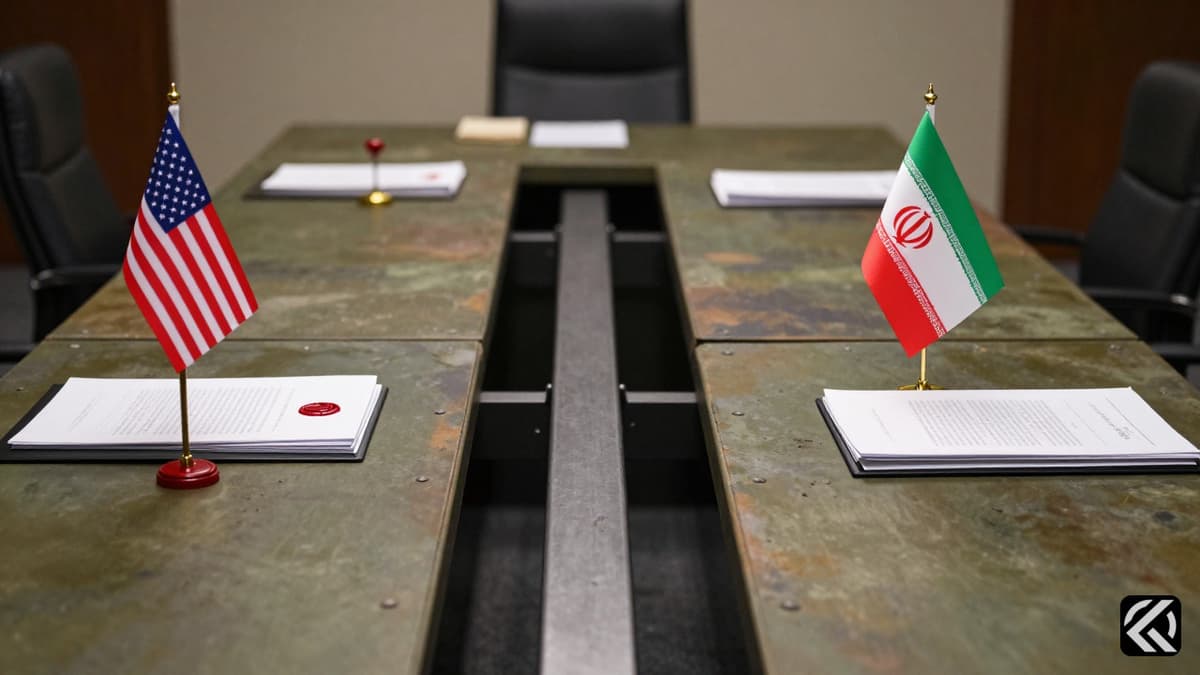
President Trump asserts a breakthrough is imminent in negotiations with Iran, claiming Tehran has conceded to forgo nuclear weapons despite recent diplomatic fractures and military posturing.
President Trump declared on Sunday that the United States and Iran are "very close" to finalizing a deal to end their three-month war, asserting that Tehran has agreed in principle to abandon its pursuit of a nuclear weapon.
The president’s optimistic assessment of the negotiations stands in stark contrast to statements made by the Iranian government earlier in the week, where officials signaled a breakdown in diplomatic channels and escalated military rhetoric.
Speaking to Kristen Welker on NBC's Meet the Press, Trump framed the ongoing talks as nearly complete, stating, "We're very close," and noting, "They've conceded the fact that they will not have nuclear weapons." However, this portrayal clashes with reports from Iran's state-affiliated Tasnim News Agency, which reported on Monday that Tehran was halting back-channel exchanges with Washington. The Iranian government cited continued ceasefire violations as the reason for suspending these discussions.
Prior to Trump’s interview, Iran had signaled it would move to fully shut the Strait of Hormuz, a critical chokepoint through which roughly a fifth of the world's oil flows. Iranian Foreign Minister Abbas Araghchi further escalated tensions on Friday, warning that U.S. bases in the region used to attack Iran would be considered legitimate military targets.
In the NBC interview, Trump described the remaining gap in the negotiations as "small but substantive." He explained that he is pushing to expand the language of the proposed agreement to ensure Iran is barred not only from developing a nuclear weapon but also from acquiring or purchasing one from other nations. To facilitate an agreement, Trump stated the U.S. would assist Iran in destroying its stockpile of highly enriched uranium.
"If we make a deal that now we're friendly, we'll all go together. It'll be our equipment. We'll take it out and destroy it, whether it's on-site or whether we take it off-site," Trump said. He warned that absent such an agreement, the U.S. would take "military action very harshly," adding, "And we'll wait till we do that before we go, in which case we'll have safety either way."
Despite the President's confidence, negotiators remain stuck on several major issues. According to CNN, key sticking points include the amount of sanctions relief Iran will receive, the fate of its existing enriched-uranium stockpile, and whether the U.S. naval blockade ends simultaneously with Tehran reopening the Strait of Hormuz.
The proposed framework, which Trump described on Truth Social on May 23 as "largely negotiated, subject to finalization," would extend the ceasefire by 60 days and open formal talks on Iran's nuclear program. However, the administration faces significant pushback from within Trump's own party. Republican Senators Ted Cruz, Lindsey Graham, Roger Wicker, and Thom Tillis have recently warned that the emerging terms could leave Iran in a stronger strategic position than it occupied before the war began.
Public opinion also appears heavily against the conflict. An Ipsos survey conducted in mid-May revealed that a 52% majority of Americans believe the U.S. military action in Iran has not been worth it, compared to only 23% who view it positively.
Trump also provided his direct assessment of Iran’s new leadership, specifically Mojtaba Khamenei, the son of former Supreme Leader Ali Khamenei and his reported successor. Describing Mojtaba Khamenei as "younger" and "more rational" than his father, Trump noted that the new leader has not appeared in public since the war began.
Trump stated he understood Mojtaba Khamenei to be "pretty badly injured" but praised what he described as the new leader's "bravery" for pursuing a deal while wounded. When pressed by Welker on whether he knew Mojtaba Khamenei's exact location, Trump declined to confirm, saying, "There's a good probability that I do," but he confirmed he had not yet held a direct conversation with him.
On the subject of U.S. military presence, Trump said he had no plans to bring forces home soon. He placed the number of troops deployed to the region at 50,000 and assessed that Iran's prewar missile stockpile had been reduced to "21%, 22%." He argued that pulling troops out before a deal is reached would be "foolhardy" because the threat of additional military action serves as crucial leverage in the negotiations.
The interview was taped on Friday at a farm in Chippewa Falls, Wisconsin. NBC News reported that Trump ended the session after about 50 minutes, becoming visibly frustrated when Welker asked questions about election interference and his criticism of the press.
If the proposed agreement holds, the immediate effect would be a 60-day extension of the ceasefire and the formal dismantling of Iran’s nuclear capabilities with U.S. assistance. However, the lingering resentment from suspended talks and the strategic concerns raised by Republican senators suggest that political instability remains high. Should the deal collapse, the threat of harsh military retaliation remains active, potentially escalating regional hostilities through the Strait of Hormuz. The deep public dissent indicates that any long-term peace will require sustained diplomatic engagement beyond mere military leverage to regain domestic and international legitimacy.
Jun 8, 2026 00:47 UTC
Iran Fires Missiles at Israel After Beirut Strike
Jun 7, 2026 22:00 UTC
US, Iran Peace Hops Fade 100 Days Into War
Jun 7, 2026 20:57 UTC
Iran Strikes Israel: IRGC Promises Week of Continuous Offensive
Jun 7, 2026 18:43 UTC
Trump Demands Compliance Before Iran Deal Progress
Jun 8, 2026 00:47 UTC
Iran Fires Missiles at Israel After Beirut Strike


