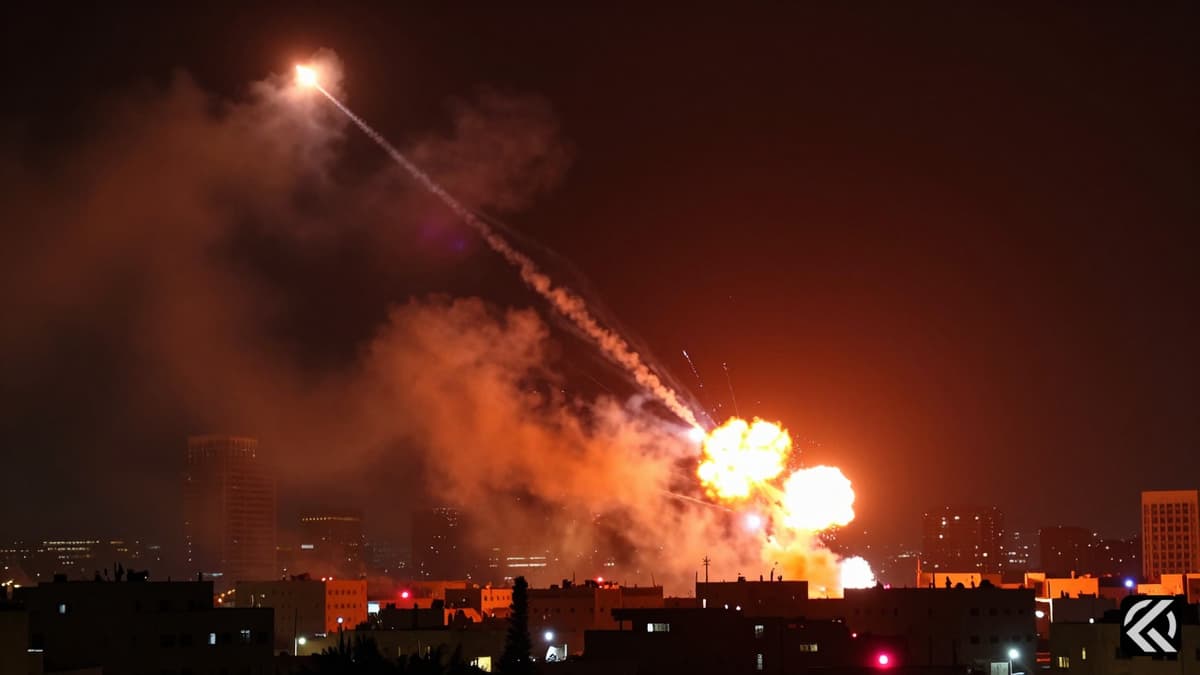
Air raid sirens wailed across Israel as Iranian Iranian missiles struck for the first time since the April ceasefire, signaling a dangerous new escalation in West Asia.
Air raid sirens echoed across Israel on Sunday, June 7, 2026, marking a significant and violent rupture in the regional peace. This event represents the first time Iranian Iranian missiles have been launched at the Jewish state since a ceasefire agreement took hold in April, signaling a rapid deterioration of the fragile status quo in West Asia. The sudden barrage triggered widespread defensive operations as the Israeli military scrambled to intercept the incoming threats, raising fears that the dormant conflict was reigniting with renewed intensity and potentially greater lethality.
The military response in Israel was immediate, with air defenses activating to counter the barrages. Simultaneously, the geopolitical landscape shifted sharply as the Iranian Revolutionary Guards publicly characterized the assault not as an all-out war, but as a calculated "warning." This designation suggests a strategic calculation by Tehran to test red lines and respond to recent Israeli actions without necessarily seeking an immediate, total war, although the line between warning and escalation remains perilously thin. The trigger for this renewed hostilities was identified as an earlier Israeli strike on Beirut’s southern suburbs, which Tehran viewed as a direct provocation requiring a symmetrical or superior response.
Following the missile launch, Israeli military chief Lieutenant General Eyal Zamir conducted a situational assessment, underscoring the gravity of the moment. In a stern statement, Zamir vowed that the Israel Defense Forces (IDF) would strike Iran “with force” the moment authorization is given. “The IDF will strike the enemy with force as soon as the green light is given,” Mr. Zamir declared, indicating that Israel is poised for immediate retaliation. This readiness implies that while the physical counter-strike has not yet occurred, the diplomatic and military channels for escalation are fully open, with the ball largely in the court of political leadership to decide the timing and scale of the response.
The broader context of this escalation involves significant United States involvement, which Iran has explicitly cited as a grievance. Iran’s top negotiator, in a post on X, declared that U.S. bases and Israeli assets in West Asia have become legitimate targets. The negotiator pointed to the U.S. naval blockade of Iran and Washington’s recent green light for Israel to escalate attacks in Lebanon as evidence of bad faith. “They are neither committed to a ceasefire nor believe in dialogue, and through the naval blockade and violation of agreements regarding Lebanon, they showed that they only understand the language of power,” Mr. Qalibaf stated. This rhetoric highlights a deepening perception among Iranian leadership that diplomatic channels are closed and that only military pressure can force a change in U.S. and Israeli policy.
The role of the United States cannot be understated in this latest flare-up. The imposition of a naval blockade represents a significant tightening of economic and military pressure on Tehran. By giving Israel clearance to escalate in Lebanon, the U.S. has effectively expanded the theater of conflict beyond the direct Iran-Israel axis into Lebanon, drawing in Hezbollah and other proxy elements. This multi-front pressure appears to have precipitated the Iranian missile launch, serving as a reactive measure to what Iran perceives as a coordinated strategy of containment and aggression.
As the region holds its breath, the implications of the Iranian warning are profound. The declaration that U.S. and Israeli assets are legitimate targets raises the stakes for American personnel and infrastructure in the Gulf region. Any miscalculation by either side could lead to a wider regional war involving direct state-on-state combat, threatening global energy supplies and stability. The tight grip Iran maintains on the Strait of Hormuz, noted in parallel reporting, adds an economic dimension to the military standoff, suggesting that economic coercion will likely remain a key tool in this conflict.
The launch of Iranian missiles into Israel marks a critical turning point in the West Asia conflict, moving beyond proxy engagements to direct state confrontation. The Iranian Revolutionary Guards framing of the attack as a warning indicates a desire to de-escalate after striking, but the vow from Israeli Chief Eyal Zamir to respond with force suggests a high risk of protracted retaliation. With the U.S. naval blockade in place and political dialogue effectively halted, the potential for a prolonged and intense cycle of violence is imminent. The next 24 hours are crucial, as the execution of Israeli counter-strikes will likely determine whether this "warning" remains contained or spirals into a broader regional conflagration affecting Gulf allies and global markets.
Jun 8, 2026 00:51 UTC
Trump Claims Iran Nuclear Deal Imminent Despite Diplomatic Fractures
Join 50,000+ readers getting the global briefing every morning.
No spam. Unsubscribe anytime.
Jun 7, 2026 22:38 UTC
Congress Party Claims Unity for INDIA Bloc Delhi Meeting
Jun 7, 2026 22:00 UTC
US, Iran Peace Hops Fade 100 Days Into War
Jun 7, 2026 20:57 UTC
Iran Strikes Israel: IRGC Promises Week of Continuous Offensive
Jun 7, 2026 20:10 UTC
Congress Asserts Opposition Unity Despite INDIA Bloc Cracks


