Iran's military has declared a complete failure of the U.S. rescue attempt, claiming a daring extraction was thwarted with significant losses on the ground.
In a stark contradiction to Western reports, Iran's military announced on Sunday that a U.S. attempt to recover a pilot from a downed fighter jet was entirely thwarted at an abandoned airfield. The Iran U.S. rescue operation allegedly took place in southern Isfahan province, where the Iranian defense forces claim to have successfully neutralized the threat. The incident stems from the downing of an American F-15E Strike Eagle on Friday, which prompted a rapid response from U.S. Special Operations forces.
The conflict began with the interception of the American jet, followed by a daring extraction attempt on Saturday night. President Donald Trump characterized the event as "one of the most daring search and rescue operations in U.S. history," asserting that the airman was successfully recovered. However, the Iranian narrative offers a drastically different account of the same timeline, asserting that the American mission was not only a failure but a pre-planned deception. The Iranian military claims the U.S. forces intended to use the rescue as a pretext to enter the location, only to be met with a robust and effective defensive response.
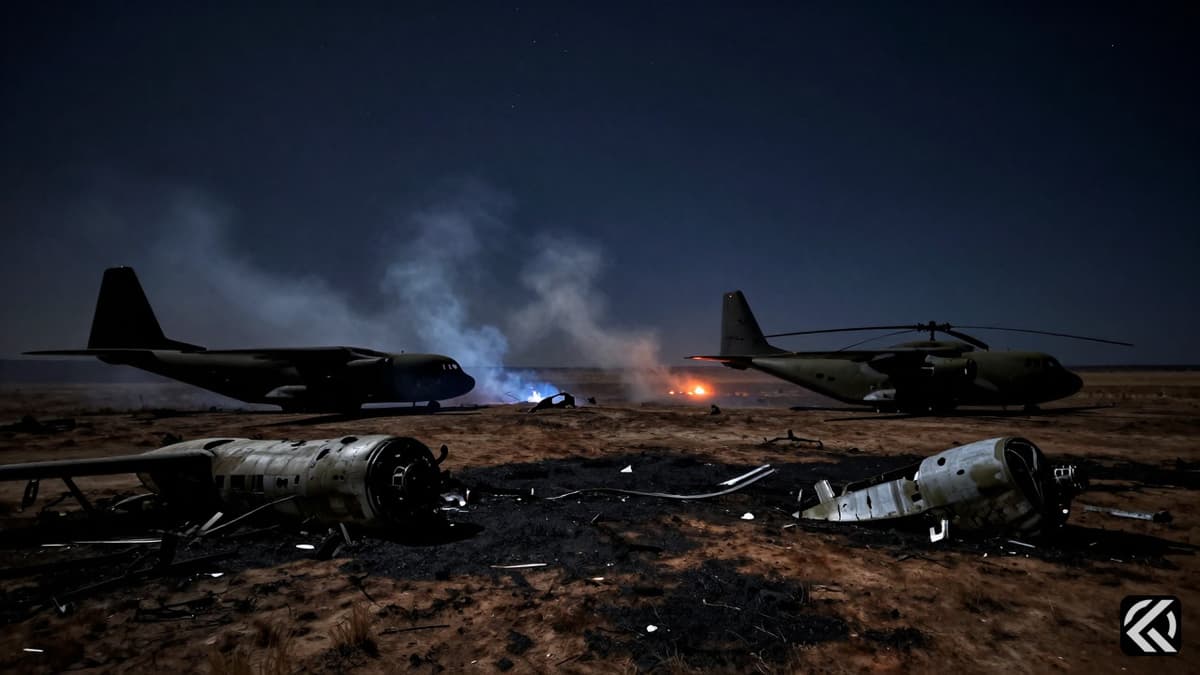
Central to this account is the statement issued by Ebrahim Zolfaghari, the spokesman for the military's central command, Khatam Al-Anbiya. Speaking on Sunday regarding the events of the previous night, Zolfaghari detailed the specific casualties the American side suffered. He stated that two C-130 military transport planes and two Black Hawk helicopters were destroyed during the engagement. Furthermore, he noted that two drones were also lost, painting a picture of a comprehensive denial of the American mission's objectives. The location of this confrontation was identified specifically as an abandoned airport in southern Isfahan province, a site chosen perhaps for its strategic isolation but ultimately becoming the site of significant equipment loss for the U.S. contingent.
The Iranian military characterized the American strategy as a "deception and escape mission" launched under the false pretext of recovering the pilot of a downed aircraft. According to Zolfaghari, this plan was "completely foiled," effectively neutralizing the operational capability of the U.S. forces involved in the rescue. The destruction of four heavy aircraft and two drones suggests a highly effective defensive posture by the Iranian forces, who managed to prevent the extraction and inflict significant material damage on the raiding party. This stands in sharp contrast to the U.S. administration's claim of success, creating a direct narrative conflict regarding the status of the pilot and the outcome of the mission.
While the U.S. President maintains the operation was a success, the details provided by the Iranian defense establishment suggest a catastrophic defeat for the rescue team. The specific mention of the abandoned airport in Isfahan highlights the localized nature of the engagement, where the terrain and the strategic layout likely played a crucial role in the defense's success. The loss of C-130s and Black Hawks indicates a high-intensity battle, far exceeding the scope of a simple retrieval mission. The inclusion of drone losses further underscores the technological engagement that took place, as both sides likely utilized aerial surveillance and strike capabilities in the dark of night.
The divergence in these reports underscores the volatility of the situation. On one side, the narrative is one of triumph and heroism, where a stranded airman is saved against all odds. On the other, the narrative is one of strategic victory, where an enemy incursion was repelled with force. The specific details provided by the Iranian spokesman provide a granular account of the equipment lost, which adds a layer of specificity often missing in high-level summaries of military engagements. The date of the incident, spanning from Friday's initial downing to Sunday's official statement, illustrates the rapid escalation of the situation and the immediate need for military clarification from both sides.
The outcome of the confrontation at the abandoned facility in southern Isfahan province has reshaped the immediate understanding of the rescue attempt. If the Iranian report of destroying two C-130s and two Black Hawks is accurate, it suggests that the U.S. Special Operations forces were heavily engaged in a combat environment rather than a stealthy retrieval. The use of the term "deception" by the Iranian military implies a calculated political or strategic motive beyond the immediate rescue of the pilot, suggesting the location was targeted to test defenses or to establish a foothold under the guise of humanitarian aid. The immediate destruction of such significant assets indicates that the Iranian forces were prepared for a large-scale incursion. Looking forward, this clash of narratives will likely define the diplomatic and military posture between the two nations for the foreseeable future. The status of the pilot remains the critical unknown, as the U.S. claims success while Iran claims the pilot was never successfully extracted, or was extracted after a costly failure. The long-term implications of such a direct confrontation at a specific airfield in Isfahan could lead to heightened tensions, increased surveillance in the region, and a recalibration of rescue protocols for the U.S. military in contested airspace. The event serves as a potent reminder of the risks involved in high-stakes military operations where the truth of the battlefield is often contested by the opposing command.
Jun 8, 2026 04:15 UTC
Trump Urges Netanyahu to Halt Iran Strike for Peace
Join 50,000+ readers getting the global briefing every morning.
No spam. Unsubscribe anytime.
Jun 8, 2026 02:28 UTC
Trump Walks Out of Meet the Press After Rejecting Evidence Demands
Jun 8, 2026 02:17 UTC
Magnitude 7.8 Quake Shakes Philippines, Urging Immediate Evacuations
Jun 8, 2026 00:51 UTC
Trump Claims Iran Nuclear Deal Imminent Despite Diplomatic Fractures
Jun 8, 2026 00:47 UTC
Iran Fires Missiles at Israel After Beirut Strike


