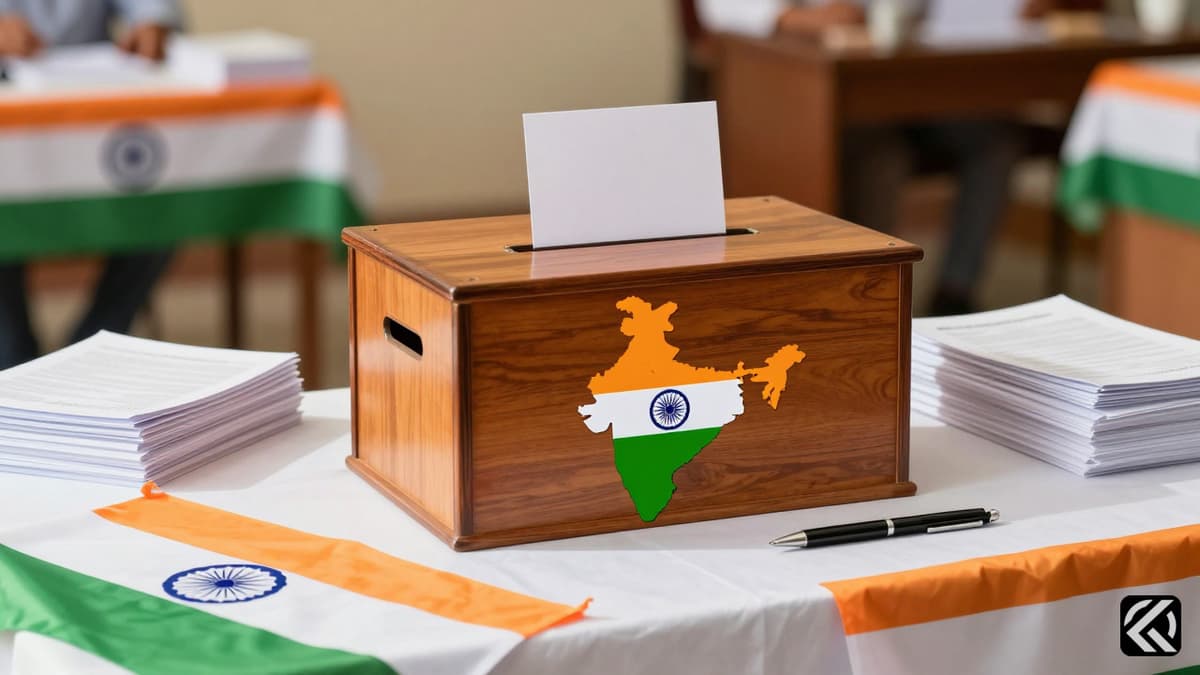
The high-voltage political campaigns conclude today, leaving 2.71 crore voters in Kerala, Assam, and Puducherry to decide the fate of 883 candidates.
The high-voltage political campaigns in Assam, Kerala, and Puducherry concluded on Tuesday evening, shifting the focus entirely to the electorate. As the curtain falls on the final push for votes, 2.71 crore eligible voters are poised to cast their ballots on April 9. This marks the climax of a rigorous election cycle where parties in these three regions have deployed their top leadership to sway public opinion ahead of the crucial polling date.
For 299 seats across two states and a union territory, the Bharatiya Janata Party (BJP) mounted an extensive campaign featuring Prime Minister Narendra Modi, Home Minister Amit Shah, Defence Minister Rajnath Singh, and various state chief ministers. Simultaneously, the Indian National Congress mobilized its senior leadership to bolster its standing. In the south, the state of Kerala is witnessing a unique trifecta battle. Rechristened as "Keralam" to honor its cultural heritage, the state is seeing a contest between the Left Democratic Front (LDF), the United Democratic Front (UDF), and the BJP, which aims to establish a foothold where it previously had none.
The LDF, led by Chief Minister Pinarayi Vijayan, is banking on its existing welfare schemes to secure a third consecutive term. In contrast, the Congress-led UDF is framing the election as a referendum on governance, finances, and accountability, riding on a promise of change and a "yearning for change." Senior Congress figures, including Rahul Gandhi and Priyanka Gandhi Vadra, have increased their engagements, signaling the national opposition's strategic importance for this state. Meanwhile, the BJP is attempting to disrupt the state's entrenched bipolarity with an aggressive campaign targeting incremental gains in closely fought constituencies.
In Assam, the assembly polls present a direct battle between the BJP and the Congress. Chief Minister Himanta Biswa Sarma is seeking a "hat-trick" term, aiming to secure a majority for the BJP by consolidating gains through governance and welfare outreach. The Congress, led by Gaurav Gogoi, is attempting a reset to remain relevant in a state that was once its stronghold, leveraging anti-incumbency and social coalitions. The electoral arithmetic here is complex due to post-delimitation realities, which have redrawn constituency boundaries and altered dynamics, particularly in minority-dominated seats. The opposition views the BJP-led alliance completing a decade in power as a potential vulnerability, while the BJP continues to dominate the discourse on illegal migration.
The Puducherry polls mirror this intensity, featuring a direct contest between the ruling National Democratic Alliance (NDA) of the All India NR Congress (AINRC) and BJP, and the Congress-DMM alliance. The NDA, led by Chief Minister N Rangasamy, seeks a second consecutive term, while the Congress and DMK, who finalized their seat-sharing arrangement at the last moment, aim to reclaim power. A significant wildcard in this race is actor-turned-politician "Thalapathy" Vijay and his party, TVK, which joined forces with the Neyam Makkal Kazhagam (NMK).
The scale of the electorate is massive, with the Election Commission reporting 2.71 crore eligible voters in Kerala alone, comprising 1.32 crore men, 1.39 crore women, 273 transgender persons, and over 2.42 lakh overseas voters. A total of 890 candidates are contesting for the 140 assembly seats. Historically, Kerala's electoral rhythm has resisted continuity, but the LDF broke this trend in 2021 with a historic victory. This time, the state is shaping up for a far more competitive contest as anti-incumbency quietly builds.
In Assam, the voter base stands at 25,054,463, with polling stations spread across 126 assembly constituencies. Among the 722 candidates, 59 are women. The Congress has fielded the highest number of candidates at 99, followed by the BJP with 90. The exit of senior Congress leaders has exposed organizational weaknesses, which could benefit the ruling party, especially as voter concerns around governance, employment, and rising prices become decisive.
The Puducherry assembly consists of 30 elected seats and three nominated seats. In the 2021 polls, the AINRC-BJP alliance won 16 seats, while the Secular Progressive Alliance secured 8. The upcoming counting is scheduled for May 4, alongside the results for Tamil Nadu and West Bengal.
The convergence of these three elections creates a pivotal moment for Indian democracy. The intense competition in Kerala suggests a shift from the traditional dominance of two fronts to a more fragmented political landscape, potentially altering the balance of power in the national opposition. In Assam, the interplay between the long-term incumbency of the BJP and the anti-incumbency sentiment among voters will determine if the ruling party can maintain its decade-long hold or if social and governance issues will force a change. Similarly, in Puducherry, the last-minute alliance and the wildcard entry of political newcomers suggest that local dynamics will heavily influence the outcome, potentially disrupting the established NDA-Congress duopoly.
As the voting commences on April 9, the focus shifts from rhetoric to the practical realities of governance and welfare. The results will not only decide the fate of 883 candidates but also set the tone for political strategies in the upcoming years across southern and northeastern India. The electorate's decision on governance, accountability, and social issues will likely define the trajectory of regional politics for the foreseeable future.
As the polls close on April 9, the anticipation builds for the May 4 counting day. The outcome will reveal whether the incumbents can overcome the rising tide of anti-incumbency or if the opposition's strategic resets in Assam and Puducherry, combined with Kerala's shifting allegiances, will herald a new era. The intricate interplay of delimitation, social coalitions, and leadership changes will ultimately dictate the political landscape of these regions, influencing national politics for years to come.
Jun 8, 2026 00:51 UTC
Trump Claims Iran Nuclear Deal Imminent Despite Diplomatic Fractures
Jun 8, 2026 00:47 UTC
Iran Fires Missiles at Israel After Beirut Strike
Jun 7, 2026 22:00 UTC
US, Iran Peace Hops Fade 100 Days Into War
Jun 7, 2026 20:57 UTC
Iran Strikes Israel: IRGC Promises Week of Continuous Offensive
Jun 8, 2026 02:28 UTC
Trump Walks Out of Meet the Press After Rejecting Evidence Demands