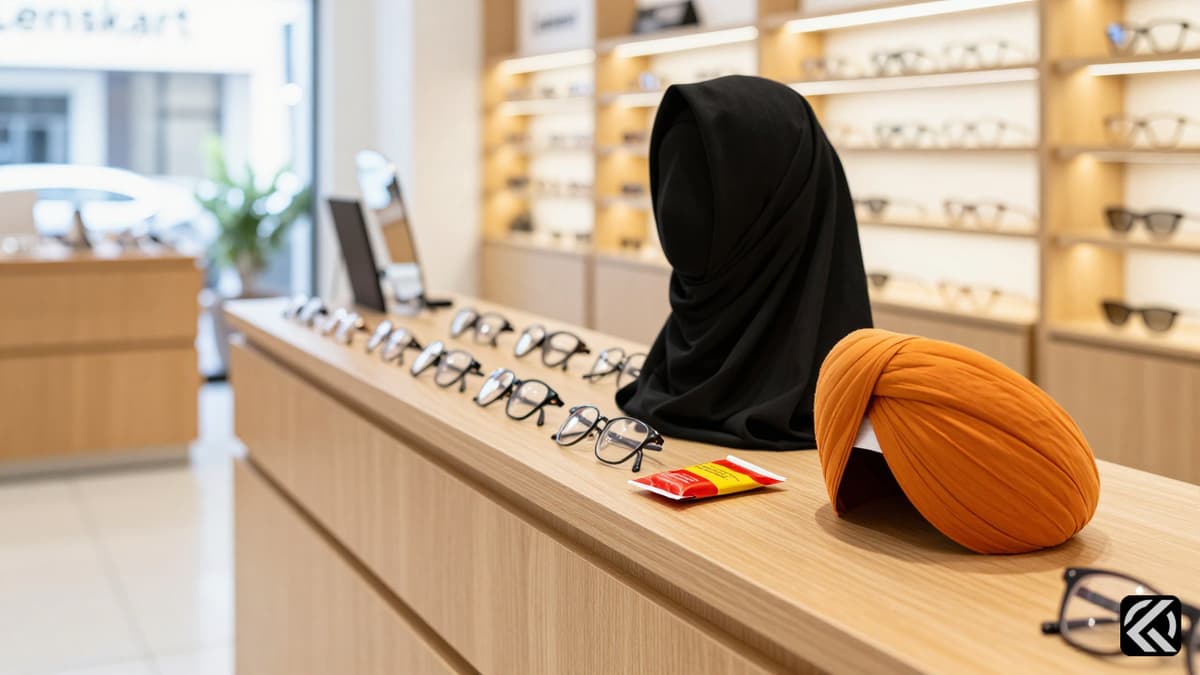
BJP leader Nazia Elahi Khan entered a Lenskart store in Mumbai to apply tilak to staff, escalating the Lenskart dress code controversy and demanding the right to religious symbols.
NEW DELHI: Amidst a growing Lenskart dress code controversy, BJP minority morcha leader Nazia Elahi Khan entered an eyewear brand store in Mumbai on Monday to confront staff and management. Accompanied by her team, Khan proceeded to apply tilak to several employees, asserting that religious identity should never be compromised in the workplace. The incident was part of a broader clash regarding the handling of religious symbols within the retail chain's internal policies.
The confrontation was triggered by a video that surfaced showing Khan demanding a meeting with the store manager. When the manager, identified as Mohsin Khan, appeared, she immediately questioned him about allegations that Hindu employees were being discouraged from wearing religious symbols. According to the account, she accused the manager of selectively restricting Hindu expressions while allegedly allowing Islamic attire such as the hijab. She further demanded that Hindu staff members identify themselves by stepping forward.
During the exchange, Khan applied tilak to several employees, stating, "There is no shame in bearing one. Even I have one even though I am a Muslim." She continued to challenge the manager's leadership, questioning if he ever compromised his own religious practices while asking others to do so. Khan also raised slogans and emphasized that Hindu identity should be a source of pride. In a subsequent post on X, she declared, "Tilak is your pride, Hindu! Kalaava is your Sankar, Hindu! Sanatan is your identity, Hindu! The slogan of Har Har Mahadev is your pride, Hindus! Work at Lenskart or Air India! Wherever you live, or work never compromise your identity, Hindus!"
The store manager repeatedly denied the accusations made against him in the video footage. However, the incident has reignited the Lenskart dress code controversy that began after screenshots of an alleged internal style guide circulated on social media. Critics claimed the document restricted symbols like tilak and bindi while providing separate guidelines for hijabs and turbans. This perceived disparity led to accusations of discrimination and a violation of constitutional protections on religious freedom. The backlash forced the company to address the religious symbols workplace policies immediately following the viral videos.
In response to the mounting criticism, Lenskart issued a statement clarifying that its updated guidelines "explicitly and unambiguously welcome every symbol of faith and culture." The company stated that the revised policy includes bindi, tilak, sindoor, hijab, and turban. Lenskart also issued a formal apology, admitting, "If any version of our workplace communication caused hurt or made any of our team members feel that their faith was unwelcome, we are deeply sorry." The company promised to revise and standardize its in-store style guidelines to ensure clarity.
The incident highlights the sensitive intersection of corporate policy and individual religious expression. While Lenskart has moved to update its guidelines to be inclusive, the confrontation led by Nazia Elahi Khan underscores the immediate pressure companies face to align internal rules with constitutional values regarding religious freedom. The initial confusion caused by the alleged style guide created a rift that required direct intervention from political figures to resolve the perception of bias.
The confrontation led by Nazia Elahi Khan has forced Lenskart to formally address the Lenskart dress code controversy by releasing updated guidelines that explicitly welcome all cultural and faith symbols. The company's apology suggests an acknowledgment that previous communication may have been misinterpreted as discriminatory. Looking ahead, the brand must demonstrate that the standardized guidelines are uniformly applied to prevent future allegations of selective enforcement. If the company can effectively communicate these changes and ensure consistent enforcement across all stores, it may stabilize the situation. However, without visible changes in store-level practices, the trust of employees and customers could remain fragile. The incident serves as a critical case study for how corporate policies must be designed to inherently support, rather than inadvertently restrict, religious expression in the workplace. Future actions will depend on whether the updated policy translates into tangible respect for all religious symbols across the entire organization.
Jun 8, 2026 02:17 UTC
Magnitude 7.8 Quake Shakes Philippines, Urging Immediate Evacuations
Join 50,000+ readers getting the global briefing every morning.
No spam. Unsubscribe anytime.
Jun 8, 2026 02:17 UTC
Magnitude 7.8 Quake Shakes Philippines, Urging Immediate Evacuations
Jun 8, 2026 00:51 UTC
Trump Claims Iran Nuclear Deal Imminent Despite Diplomatic Fractures
Jun 8, 2026 00:47 UTC
Iran Fires Missiles at Israel After Beirut Strike
Jun 7, 2026 22:38 UTC
Congress Party Claims Unity for INDIA Bloc Delhi Meeting


