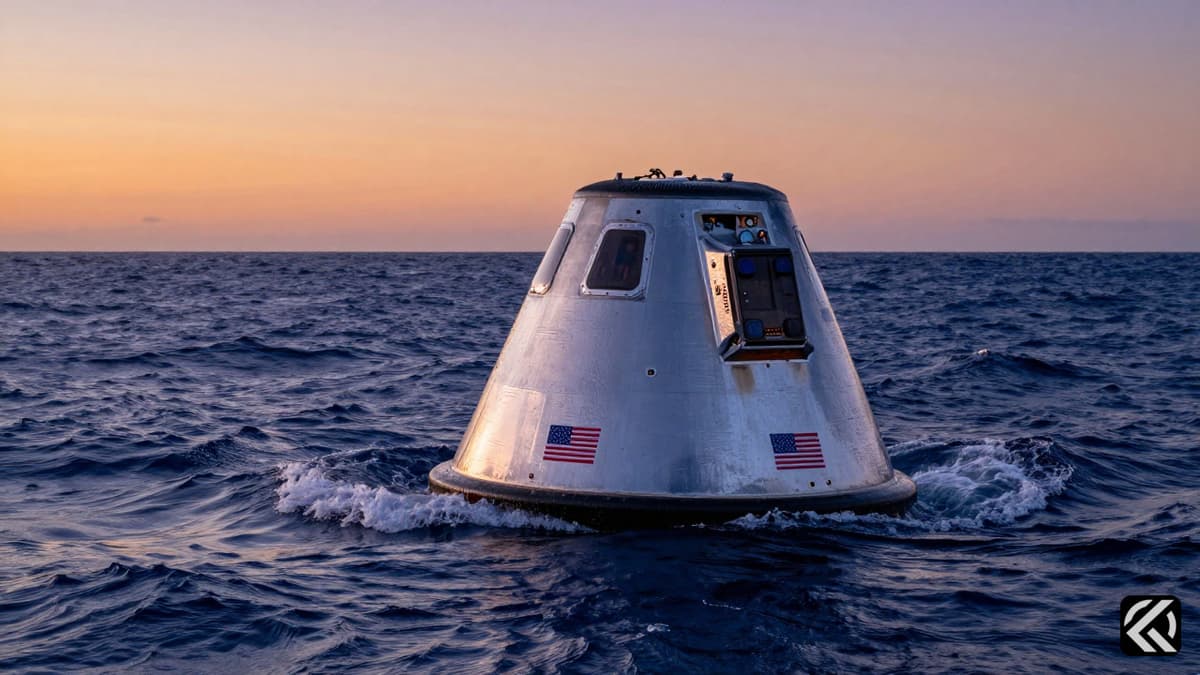
The NASA Artemis II crew returns safely after a historic Moon flyby, marking the first crewed mission of its kind in over half a century.
The historic crew named for the Artemis II mission returned to Earth safely as the NASA spacecraft splashed down on Friday, April 10, 2026, off the coast of California. This event capped a successful crewed test mission that sent the astronauts around the Moon, concluding the first such flyby in over 50 years.
Mission commander Reid Wiseman confirmed the condition of the team shortly after the water landing. In a statement regarding the four astronauts, Wiseman reported that the group, consisting of himself alongside Christina Koch, Victor Glover, and Jeremy Hansen, were "stable" and "green." The phrase indicates that the crew is in good health and ready for debriefing following their journey through space.
The mission represents a pivotal moment in space exploration history. For more than five decades, the United States has not executed a crewed mission to fly by the Moon since the Apollo era. This successful Moon flyby demonstrates the operational readiness of the spacecraft and the capabilities of the human crew to withstand the rigors of deep space travel. The recovery of the capsule marks the immediate conclusion of the flight, transitioning the mission from an orbital test to a safe arrival back on Earth.
The four astronauts who undertook this journey were all accounted for and in good spirits. The team included Commander Reid Wiseman, who led the mission, along with Christina Koch, Victor Glover, and Jeremy Hansen. Their successful return validates the extensive testing and preparation conducted by NASA prior to launch. The specific status of the crew as "stable" and "green" serves as the primary metric for the mission's success, reassuring the public and the scientific community alike.
While the specific details of the orbital mechanics remain a technical footnote to the human achievement, the significance lies in the return of these explorers. The spacecraft, carrying the weight of history and the hopes of future lunar ambitions, has successfully completed its trajectory and touched down in the Pacific Ocean. The proximity to the California coast facilitated a rapid recovery operation, ensuring the safety of both the crew and the hardware.
As the capsule floats on the surface, it stands as a testament to human ingenuity. The successful execution of this flight plan without incident suggests a robust framework for future missions. The return of the crew named for this specific flight underscores the collaborative effort required for such endeavors. The presence of a diverse crew, including veteran astronauts and new faces, highlights the evolving nature of the U.S. space program.
The mission's success has immediate implications for the agency's broader roadmap. With this test flight concluded, the focus now shifts to the next phases of the Artemis program. The data gathered from this flight will be critical in refining systems for upcoming expeditions. Although the details of the NASA Artemis III splashdown are not part of this current report, the completion of Artemis II is a necessary precursor to that future milestone.
The atmosphere surrounding the recovery is one of relief and celebration. The fact that the crew was described as "green" suggests they were not exhausted or injured, but rather in peak physical condition after the intense journey. This outcome validates the life support systems and safety protocols of the spacecraft. The mission commander's report serves as the official confirmation that the human element of the mission remained intact throughout the flight.
Historically, the gap of 50 years since the last crewed flyby makes this event particularly poignant. It bridges a significant period in spaceflight history, reconnecting the legacy of the Apollo missions with the new era of lunar exploration. The successful return of Wiseman, Koch, Glover, and Hansen ensures that the momentum built over decades has not been lost. Their safe arrival marks the end of the Artemis II chapter and the beginning of the analysis phase that will shape future missions.
As the team prepares for post-mission procedures, the legacy of this flight is already being written. The successful completion of the first crewed lunar flyby in half a century is a monumental achievement for the United States. The Moon flyby was not just a test of hardware, but a test of human endurance and the strategic vision of the space agency. The immediate feedback from the crew provides a strong foundation for the continued development of deep space capabilities.
This successful return confirms the viability of the Artemis spacecraft and crew for deep space operations, establishing a definitive timeline for subsequent lunar landings. With the crew safely recovered and the mission data secured, NASA is now positioned to leverage this critical success to accelerate preparations for future surface missions, ensuring that the momentum of this historic flyby translates directly into tangible progress toward sustained human presence on the Moon.
Jun 8, 2026 02:17 UTC
Magnitude 7.8 Quake Shakes Philippines, Urging Immediate Evacuations
Join 50,000+ readers getting the global briefing every morning.
No spam. Unsubscribe anytime.
Jun 8, 2026 02:17 UTC
Magnitude 7.8 Quake Shakes Philippines, Urging Immediate Evacuations
Jun 8, 2026 00:51 UTC
Trump Claims Iran Nuclear Deal Imminent Despite Diplomatic Fractures
Jun 8, 2026 00:47 UTC
Iran Fires Missiles at Israel After Beirut Strike
Jun 7, 2026 22:38 UTC
Congress Party Claims Unity for INDIA Bloc Delhi Meeting


