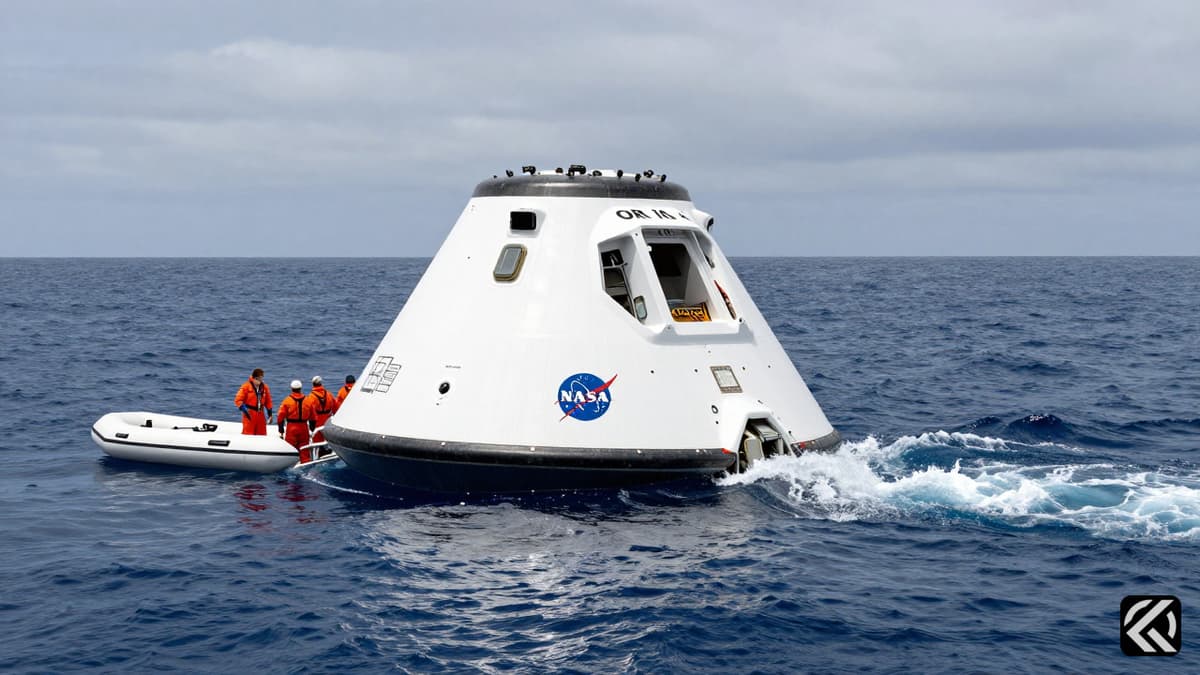
The historic Artemis II mission concluded as four NASA astronauts splashed down off California, marking the first crewed lunar flyby in over five decades.
The historic Artemis II mission concluded with a successful splashdown of the NASA spacecraft carrying four astronauts off the coast of California on Friday, April 10, 2026. This event capped the U.S. space agency's crewed test mission, marking the first lunar flyby of this kind in more than 50 years. The mission commander, Reid Wiseman, reported that the crewmembers-himself along with Christina Koch, Victor Glover, and Jeremy Hansen-were "stable" and "green" following their return.
The splashdown occurred as planned, signaling the immediate end of the testing phase for the Artemis program. The spacecraft, having completed its trajectory around the Moon, touched down in the Pacific Ocean near the California shoreline. This successful recovery was the culmination of a high-stakes test designed to validate the spacecraft's systems and the crew's ability to survive deep space travel. The return to Earth brought an end to a journey that had taken humanity further from our planet than any previous mission in recent history.
Mission commander Reid Wiseman provided the initial status update from the crew, confirming that all four individuals were in good condition. Wiseman, alongside Christina Koch, Victor Glover, and Jeremy Hansen, had completed the complex maneuvers required for the flyby. The use of the terms "stable" and "green" by Wiseman indicated a smooth recovery process and no immediate medical or technical issues affecting the astronauts. This positive report was crucial for the agency as they transitioned from the active flight phase to post-mission analysis and recovery operations.
The successful completion of this mission represents a significant milestone in the history of space exploration. It stands as the first time in over half a century that a human crew has traveled to the Moon and returned without landing. This flyby serves as a critical precursor to future lunar landings, testing the life support systems, navigation, and endurance capabilities required for long-duration spaceflight. The agency's ability to execute a perfect splashdown confirms that the Artemis spacecraft is ready for the more ambitious objectives planned for the program.
While the mission focused on the flight itself, the successful recovery operation off the California coast highlights the coordination between spaceflight and maritime rescue teams. The splashdown location was chosen for its logistical advantages, ensuring a swift and safe return of the crew to land. The data gathered from this flight will be instrumental in planning the upcoming Moon flyby mission and subsequent landing attempts. Every aspect of the flight, from launch to splashdown, provided the agency with the necessary confidence to proceed with the next phases of the Artemis program.
The arrival of the astronauts marks a new chapter in international space efforts. The collaboration and training that led to this return were essential for the success of the mission. The crew's ability to function effectively throughout the journey and upon return underscores the rigorous preparation required for deep space exploration. As recovery teams secured the capsule, the focus shifted to analyzing the telemetry and biological data collected during the flight. This information will guide the design of future missions and ensure the safety of the astronauts on the path to establishing a permanent presence on the Moon.
The successful return of the crew also serves as a validation of the technology developed for the Artemis program. The spacecraft's performance during the re-entry and splashdown phases was critical to the mission's success. The agency's commitment to testing and iterating on their systems is evident in the smooth execution of this complex operation. The NASA Artemis III splashdown timeline was adhered to, demonstrating the precision and planning involved in the program. This success sets a strong foundation for the future, with the agency now looking toward the next steps in lunar exploration.
The successful return of the Artemis II crew establishes a definitive proof of concept for human deep space travel. Based on the confirmed stability of the crew and the precise execution of the splashdown, the agency is positioned to accelerate its timeline for future lunar landings. The data gathered from this flyby mission will directly inform the design and operational protocols for the first lunar landing attempt. As the focus shifts to refining systems based on real-world performance, the path to a sustainable lunar presence becomes clearer. The successful outcome of this test mission suggests that subsequent missions will build upon this momentum, moving steadily toward the goal of returning humans to the lunar surface.
Jun 8, 2026 02:17 UTC
Magnitude 7.8 Quake Shakes Philippines, Urging Immediate Evacuations
Join 50,000+ readers getting the global briefing every morning.
No spam. Unsubscribe anytime.
Jun 8, 2026 02:17 UTC
Magnitude 7.8 Quake Shakes Philippines, Urging Immediate Evacuations
Jun 8, 2026 00:51 UTC
Trump Claims Iran Nuclear Deal Imminent Despite Diplomatic Fractures
Jun 8, 2026 00:47 UTC
Iran Fires Missiles at Israel After Beirut Strike
Jun 7, 2026 22:38 UTC
Congress Party Claims Unity for INDIA Bloc Delhi Meeting


