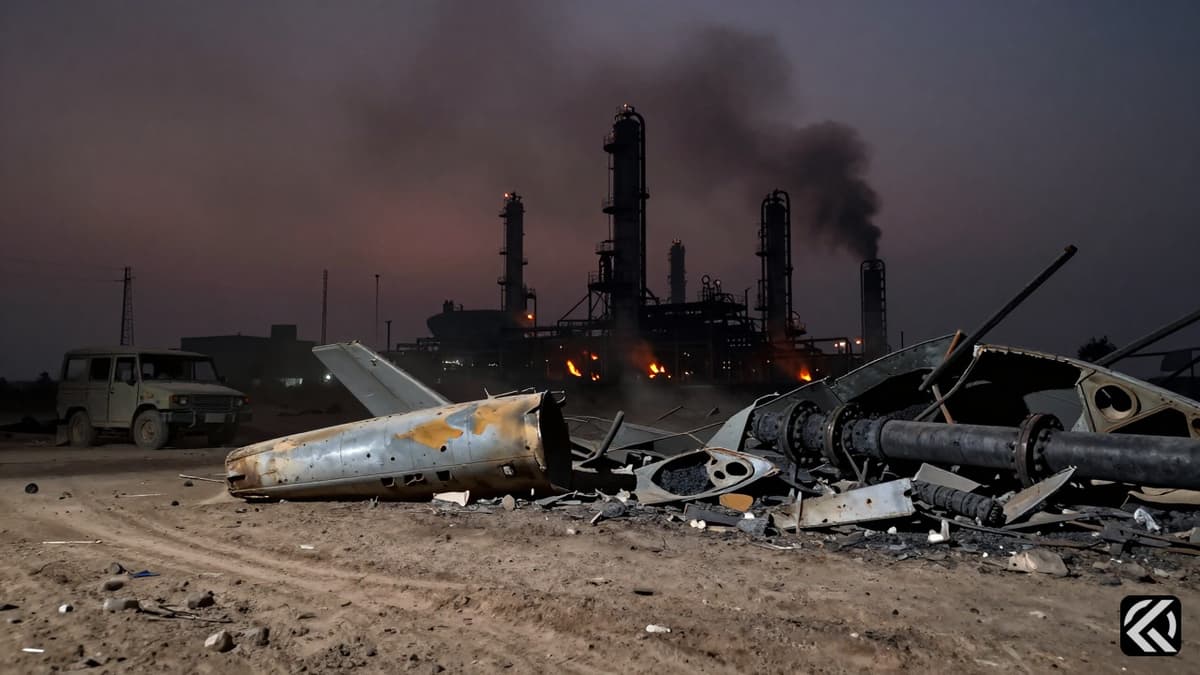
Amidst heightened tensions, US forces successfully retrieve a missing airman from a downed F-15 over Iran while Israel targets petrochemical sites, leaving Lebanon reeling from displacement.
The United States military has launched a critical search-and-rescue operation for a missing airman from a fighter jet shot down over Iran, marking a significant development in the escalating conflict. While US forces confirm that one crew member has been rescued and is in custody, the situation remains volatile as the second service member remains missing. Simultaneously, the geopolitical landscape has shifted dramatically, with Israel confirming attacks on Iranian petrochemical plants and Tehran issuing dire warnings against further escalation. The region is further complicated by widespread humanitarian crises in Lebanon, where displacement has reached catastrophic levels, and new fires have erupted at strategic facilities across the Gulf.
The operation to recover the missing US service member underscores the immense difficulty of modern warfare in the Middle East. Retired US Air Force Colonel Cedric Leighton, speaking to CNN, emphasized the technical and environmental hurdles faced by rescue teams in such missions. Leighton noted that the remote, rugged terrain of the area is fraught with dust and grime, conditions that can easily gum up aircraft engines and landing gear. He described the environment as "fairly rugged," warning that even minor malfunctions can spell disaster for a mission that relies on a highly choreographed routine where every component must function perfectly. Despite these dangers, the mission's success was partly attributed to advanced tracking technology, which would have made such a rescue nearly impossible decades ago.
The rescue effort took place against a backdrop of aggressive retaliatory actions from multiple state actors. Israeli Prime Minister Benjamin Netanyahu confirmed that his military conducted strikes on Iran's petrochemical plants. This confirmation followed reports from Tehran regarding damage to multiple petrochemical companies. Specifically, Israel's military reported hitting infrastructure at a petrochemical complex located in Mahshahr, in southwestern Iran. These actions are part of a broader exchange of fire that has seen Israeli Prime Minister Benjamin Netanyahu confirm that Israel attacked Israel Iran petrochemical attacks as part of their defensive measures against Iranian aggression.
In response to the widening conflict, Iranian military officials issued a stern warning to the United States and Israel. Tehran stated that the "gates of hell will be opened" if Iran's infrastructure continues to come under attack. This threat echoes earlier remarks from US President Donald Trump, who had threatened to unleash "all Hell" on Iran if the country did not make a deal to open the Strait of Hormuz by Monday. President Trump further claimed on Saturday that many Iranian military leaders died in a "massive strike" in Tehran. He posted a dark video showing explosions, loud blasts, and the sound of aircraft, though the footage lacked detailed visual confirmation beyond the noise and flashes.
The conflict has also sparked a wave of Iranian attacks targeting neighboring Gulf states. Early Sunday, an Iranian attack caused a fire at a facility in Bahrain, according to the Bahraini interior ministry, though the exact location was not specified. The United Arab Emirates activated its air defenses in response to a missile threat. In Kuwait, the situation deteriorated further when the state-owned Kuwait Petroleum Corporation's Shuwaikh oil sector complex caught fire after being targeted by drones. Additionally, two power and water plants in Kuwait were hit by drones, forcing two units to shut down. State media in Kuwait also reported damage to an office complex for government ministries. These incidents highlight how quickly the conflict in Iran is spilling over into regional infrastructure, threatening energy security and essential services across the Gulf.
The human cost of this regional conflagration is perhaps most visible in Lebanon, where a widespread humanitarian emergency is unfolding. As a result of ongoing Israeli strikes, displaced civilians are struggling to meet their most basic needs. Ahlam Ali Khalil Badak, speaking in a video released by the World Health Organization, described the dire conditions: "We are facing difficulties in everything. We can't even afford our medications." Zainab, a displaced mother of three, stated that no aid has reached the center where she is staying since Ramadan ended last month.
This crisis in Lebanon stems from a long-standing conflict between Israel and the Iranian-backed paramilitary group Hezbollah. When Hezbollah fired rockets into Israel following the start of the war in Iran, Israel launched an aggressive response. This included a massive aerial bombardment of Hezbollah positions, including those in densely populated cities, and a full-scale ground incursion in the south of the country. Aid workers report that Israeli strikes have resulted in significant civilian casualties and the Lebanon displacement of more than one million people. Many of these displaced individuals now lack access to clean water, hygiene supplies, and vital medications, creating a desperate humanitarian situation.
The integration of high-tech rescue capabilities with the brutal reality of ground warfare illustrates the complex nature of the current conflict. While the US has managed to secure the release of one F-15 crew member, the search for the missing airman continues, with Iranian tribesmen reportedly shooting at US helicopters involved in the operation. The situation remains precarious as Iranian officials offer rewards for the capture of the missing crew member. With President Trump claiming significant casualties for Iranian leadership and Tehran threatening total retaliation, the potential for the conflict to expand further into a broader regional war remains a distinct possibility. The simultaneous fires in the Gulf and the humanitarian disaster in Lebanon suggest that the current escalation could trigger a cascade of instability affecting the entire Middle East for the foreseeable future. If infrastructure continues to be targeted and aid blocked, the humanitarian toll will likely worsen, potentially drawing more international actors into the fray.
Jun 8, 2026 00:51 UTC
Trump Claims Iran Nuclear Deal Imminent Despite Diplomatic Fractures
Jun 8, 2026 00:47 UTC
Iran Fires Missiles at Israel After Beirut Strike
Jun 7, 2026 22:00 UTC
US, Iran Peace Hops Fade 100 Days Into War
Jun 7, 2026 20:57 UTC
Iran Strikes Israel: IRGC Promises Week of Continuous Offensive
Jun 8, 2026 02:28 UTC
Trump Walks Out of Meet the Press After Rejecting Evidence Demands


