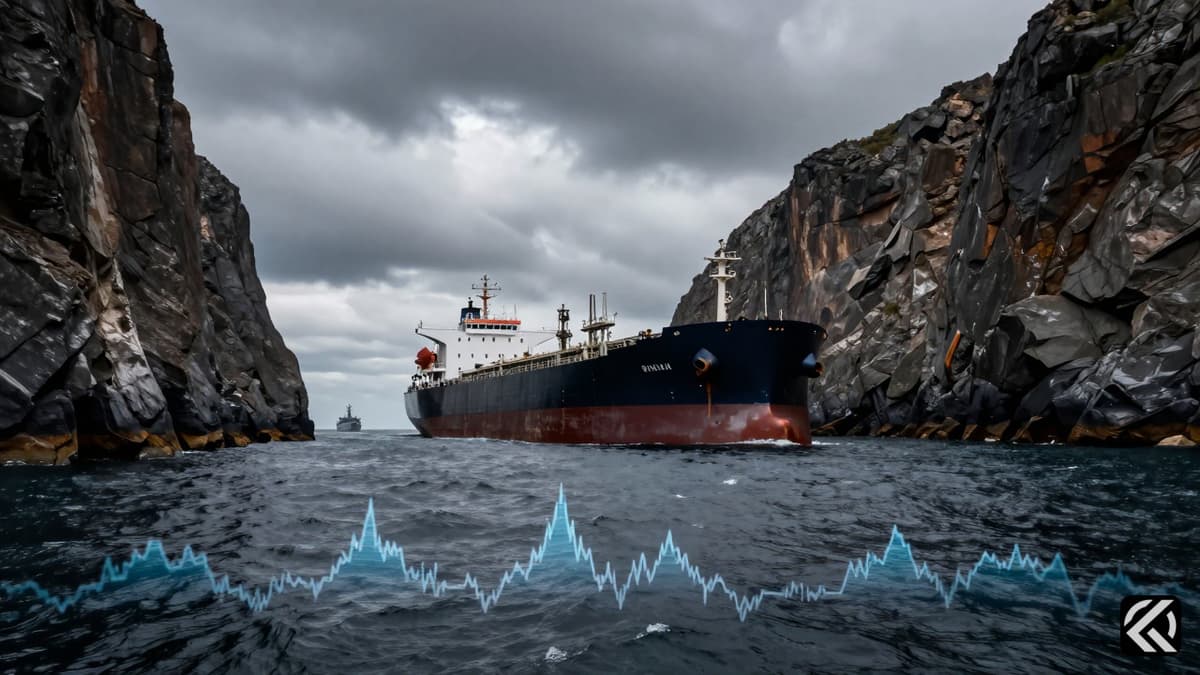
President Trump has issued contradictory threats regarding the Strait of Hormuz, yet his administration's actions reveal a deep economic reliance on the waterway amid a global price shock.
President Donald Trump has issued starkly different public instructions regarding the Strait of Hormuz, revealing a disconnect between his rhetoric and economic reality. On Wednesday, the President stated that the United States imports almost no oil through the waterway and has no need for it. Just four days later, he posted a fiery threat on Truth Social, demanding Iran open the strait or face catastrophic consequences. This rapid flip-flop coincides with a dramatic shift in global energy markets.
The primary driver of this volatility appears to be the immediate reaction of global markets to the President's changing words. Following the Wednesday address stating a lack of need for the strait, oil prices remained relatively stable. However, after the Sunday threat involving explicit language, US oil surged more than 11% on Thursday. The benchmark crude settled above $111 a barrel, marking its highest price in four years and one of the most significant single-day gains in history. West Texas crude had traded around $100 just before the speech, compared to less than $70 before the conflict began.
Despite the President's assertion that the US does not require oil from the strait, the data indicates a complex dependency. While the United States produces around 22 million barrels of oil daily, making it energy independent in terms of total volume, the market dynamics are more nuanced. America imports more than 6 million barrels of crude a day, or roughly a third of its daily consumption. This import necessity stems from a disparity in oil types; the US produces light, sweet crude ideal for gasoline but lacks sufficient heavy, sour crude needed for heating fuel, asphalt, and diesel. Consequently, the US continues to import from regions like Venezuela and the Middle East to balance its refined product mix.
The health of the US economy remains tied to the stability of the global market, even if domestic supply is robust. Dan Pickering, founder and chief investment officer at Pickering Energy Partners, notes that during supply crunches, importers compete for available barrels, driving prices higher for whoever needs them most. Although the US is likely well-supplied with physical oil during the conflict, the economy is not insulated from the price shocks of the global market. High crude and gas prices are already taking a toll, with US gas prices rising to an average of $4.11 a gallon.
The economic consequences are becoming evident across various sectors. Many middle- and lower-income Americans are struggling with rising costs at the pump, while small businesses face difficult staffing decisions as they are unable to raise prices further. The broader concern lies in the potential for high prices to destroy demand for gasoline and oil. If energy becomes too expensive for Americans to afford, the resulting drop in consumption could create significant economic problems. While the war is only five weeks old, analysts warn that prolonged high prices could inflict recession-level damage.
Wall Street analysts estimate that every $10 increase in the price of a barrel of oil shaves between 0.1 and 0.4 percentage points off the gross domestic product. The current $40 increase in oil prices could therefore reduce GDP by around a percentage point. While this is a notable hit, the situation could deteriorate rapidly if prices spike further. The impact extends beyond fuel; diesel prices are surging, making everything delivered by truck more expensive. Additionally, other imports passing through the strait, including aluminum, helium, and fertilizer, are driving up costs for building materials, microchips, and food.
The uncertainty surrounding the Strait of Hormuz continues to escalate as diplomatic solutions falter. Trump's administration has pledged naval escorts for oil tankers and guaranteed insurance for ships that lost coverage from maritime insurers. Yet, the President has simultaneously urged countries heavily reliant on Middle Eastern oil to handle the reopening themselves, posting, "Go get your own oil!" Traders have grown concerned that the President has failed to provide a clear exit strategy, fearing that his threats of escalation could further damage crude supply.
Iran has signaled it would charge tolls for safe passage, a fee many Gulf countries are unlikely to pay. Even if the strait is only partially reopened, Citi global energy strategist Anthony Yuen estimates the world would remain short by between 4.4 million and 8 million barrels per day. Joe Brusuelas, chief economist at RSM US, cautions that while the US economy can absorb oil prices over $100 per barrel for a period, a surge to $150 or $200 would present a fundamentally different and more severe challenge. With annual consumer inflation expected to surge to around 3.5% in March, the window to mitigate these economic shocks is narrowing.
Jun 8, 2026 02:17 UTC
Magnitude 7.8 Quake Shakes Philippines, Urging Immediate Evacuations
Jun 8, 2026 00:51 UTC
Trump Claims Iran Nuclear Deal Imminent Despite Diplomatic Fractures
Jun 8, 2026 00:47 UTC
Iran Fires Missiles at Israel After Beirut Strike
Jun 7, 2026 22:00 UTC
US, Iran Peace Hops Fade 100 Days Into War
Jun 8, 2026 04:15 UTC
Trump Urges Netanyahu to Halt Iran Strike for Peace


