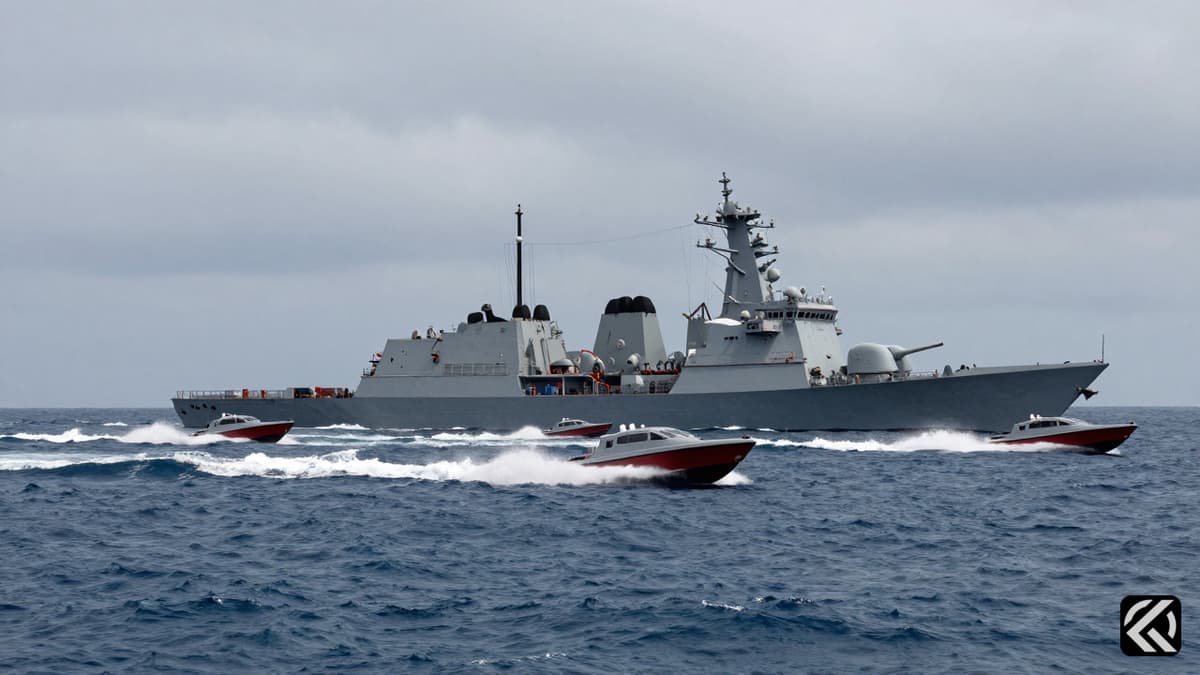
President Trump issues a stark warning that any Iranian fast attack ships approaching the new U.S. naval blockade will be immediately eliminated using established military protocols.
On Monday, April 13, 2026, President Donald Trump issued a severe directive regarding the escalating conflict in the Middle East. He stated that U.S. forces are authorized to destroy any Iranian fast attack ships that approach the newly established U.S. blockade of Iranian ports. This blockade officially came into effect on the same day, triggering immediate warnings from the American President regarding the consequences of any further naval aggression.
The President's response was delivered via his Truth Social network, where he emphasized the lethality of the American response. "Warning: If any of these ships come anywhere close to our BLOCKADE, they will be immediately ELIMINATED," Trump stated in a capitalized message. He further added that the remainder of the Iranian navy had already been "completely obliterated," signaling a significant shift in the status of the regional military balance.
When addressing the specific methodology of this new military strategy, President Trump clarified that U.S. forces would be "using the same system of kill that we use against the drug dealers on boats at Sea." This reference points directly to existing protocols involving air strikes on alleged narcotics vessels operating off the coast of Venezuela. This approach marks a specific application of counter-narcotics tactics now being scaled for use during the Iran Strait of Hormuz war. The President's comments underscore a willingness to deploy lethal force against any vessel perceived as a threat to the American naval presence.
While the United States maintains a hardline stance on the seas, other global leaders are attempting to manage the diplomatic fallout. Pakistan's Prime Minister Shehbaz Sharif addressed the situation during a cabinet meeting on Monday, offering a contrasting view on the current stability of the region. Sharif announced that a ceasefire between the United States and Iran is "holding," despite the aggressive rhetoric emanating from Washington.
"We have to resolve the outstanding issues," Sharif noted during brief televised remarks, indicating that "full efforts are underway to resolve the outstanding issues" following weekend talks that failed to produce an immediate agreement. This suggests that while military postures are shifting, diplomatic channels remain active, at least according to the Pakistani leadership.
The legal implications of the U.S. naval action against fast attack ships and the broader blockade have also drawn attention from international maritime authorities. The head of the U.N. maritime agency, the International Maritime Organization (IMO), issued a statement on Monday asserting that no nation possesses the legal right to block shipping lanes in the Strait of Hormuz. The Strait, a critical trade passage, has been paralyzed by the ongoing conflict between the United States and Iran.
Arsenio Dominguez, the Secretary General of the IMO, told a news conference that "In accordance to international law, no countries have the right to prohibit the right of innocent passage or the freedom of navigation through international straits that are used for international transit." This statement directly challenges the legitimacy of the blockade established by the U.S., highlighting a potential clash between American military actions and established international maritime regulations.
The tension is palpable as the U.S. prepares to enforce the blockade with the same intensity previously reserved for drug interdiction operations. The combination of the President's absolute warning and the international legal pushback creates a volatile environment. The U.S. stance, backed by the claim of total obliteration of the Iranian navy, stands in stark contrast to the appeals for navigation rights from the U.N. agency. As the situation evolves, the question remains whether the diplomatic efforts cited by Pakistan's Prime Minister can stabilize the region or if the "system of kill" will be fully deployed to enforce the American decree.
The conflict highlights a direct collision between American enforcement of a naval blockade and international maritime legal standards. While President Trump asserts the right to eliminate any fast attack ships breaching the blockade, the International Maritime Organization maintains that such actions violate the freedom of navigation. This legal and military standoff could define the trajectory of the Iran Strait of Hormuz war, with the potential for significant escalation depending on whether any Iranian vessels attempt to challenge the U.S. naval presence. The coming days will be critical in determining if the diplomatic efforts for a ceasefire can prevent further military confrontations.
Jun 8, 2026 00:51 UTC
Trump Claims Iran Nuclear Deal Imminent Despite Diplomatic Fractures
Jun 8, 2026 00:47 UTC
Iran Fires Missiles at Israel After Beirut Strike
Jun 7, 2026 22:00 UTC
US, Iran Peace Hops Fade 100 Days Into War
Jun 7, 2026 20:57 UTC
Iran Strikes Israel: IRGC Promises Week of Continuous Offensive
Jun 8, 2026 02:28 UTC
Trump Walks Out of Meet the Press After Rejecting Evidence Demands


